
If you learned cards with hearts, diamonds, clubs and spades, you probably picture that set of four symbols as the natural shape of a deck. It is not. It is one pattern — the French one, now global. Across Spain and large parts of the Spanish-speaking world, cards carry four different pips: gold coins, cups, swords and club-like batons. Decks drawn in this style are called Spanish-suited, and they are not a museum piece. They are printed, sold and dealt every day.
The stranger part: the solitaire games you already know — Klondike, Spider, FreeCell — run on this deck, baraja española in Spanish, without changing a rule. More on that below. First, the deck itself.
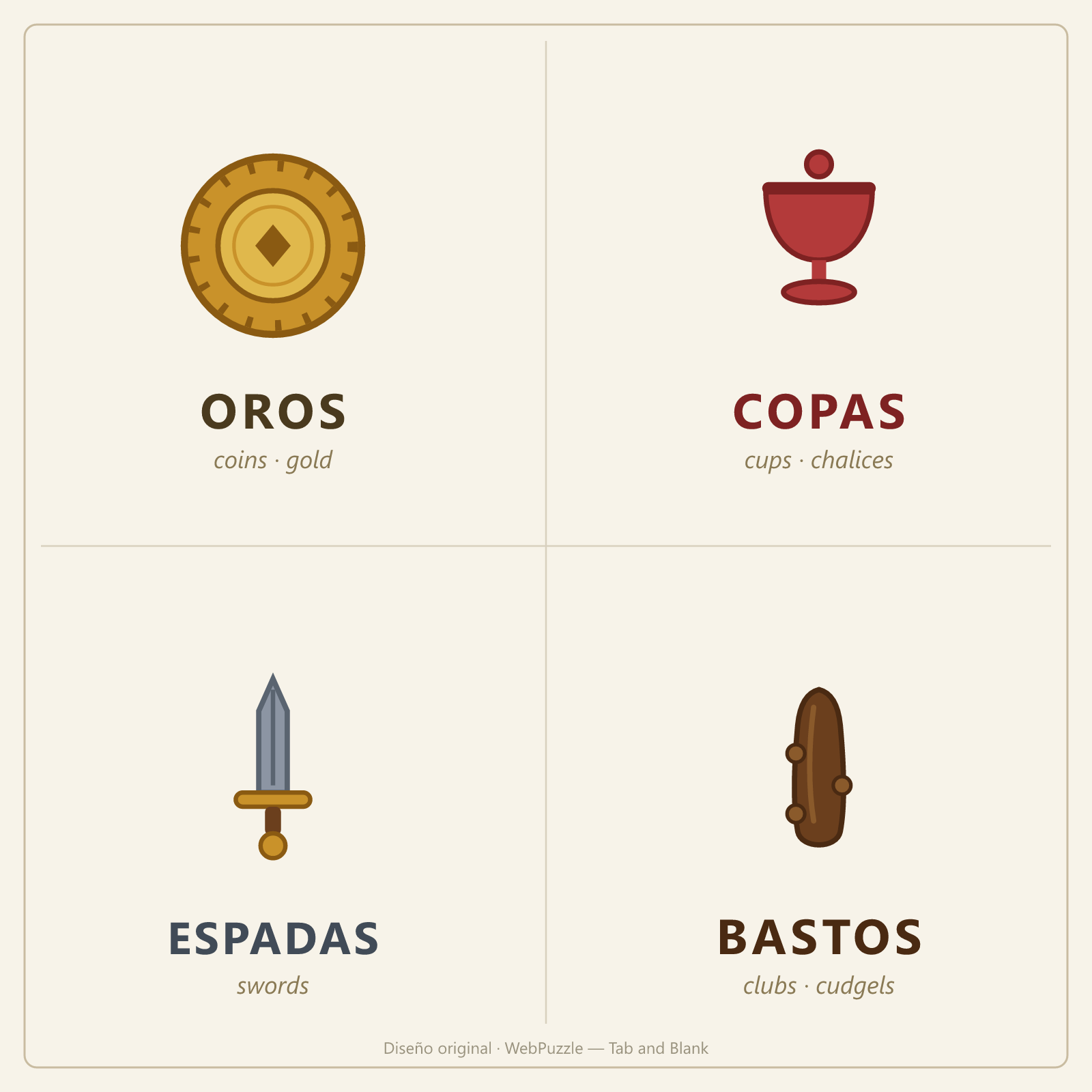
How the cards got to Spain
Playing cards did not start in Europe. The standard account is that they reached Italy and the Iberian Peninsula from the Islamic world in the late fourteenth century, and that the earliest European cards probably already used the Latin suits — coins, cups, swords and batons. The batons may even have been polo sticks: card art travels, then forgets its own meaning. (Pagat's overview of Latin-suited cards is the plain-language survey.)
Spain has a hard anchor for how long the look has lasted. Fournier dates the oldest deck surviving in Spain to Seville, 1390 — and it already speaks the visual language any Spanish child recognizes: oros, copas, espadas, bastos. Six centuries and counting.
Even the words carry the inheritance. The Royal Academy traces naipe — a single card — through Catalan naip, and possibly through Arabic maʿīb, "censurable": moral suspicion built into the vocabulary from day one (RAE). Baraja, the whole pack, is simpler: it comes from barajar, to shuffle (RAE).
And the tradition never stopped being made. In 1870 the printer Heraclio Fournier, of French descent, set up in Vitoria; in 1877 — on the company's official history page — he commissioned the deck design from Emilio Soubrier, a master at the city's School of Arts and Crafts, and the painter Ignacio Díaz de Olano. In 1889 the artist Augusto Rius recut that deck into the twelve-colour lithographic baraja española that became the modern emblem, and it took a design prize at the Universal Exhibition of Paris that same year. (The company's own account also records the naiperas — the factory women who, unusually for the era, held paid sick leave and a company store.) It merged with the United States Playing Card Company in 1986 and has belonged to Cartamundi since 2020; the collection its founder's grandson Félix Alfaro Fournier began is now the Museo Fournier de Naipes de Álava.
Four suits, and what people think they mean
Here is the map, once, for readers raised on the French pattern:
- Oros (coins) — golden discs. This is the diamond analogue.
- Copas (cups) — chalices with handles. The heart analogue, in function only.
- Espadas (swords) — long blades. The spade analogue, if you squint.
- Bastos (batons) — knobby cudgels. The club analogue.
They are not translations of hearts and diamonds. Pagat's page on Spain adds a practical detail: many packs mark the suits in the card's narrow ends — three border breaks for batons, two for swords, one for cups, none for coins. A self-identifying deck, printed for players who argue at the table.
The court cards are where the medieval shape shows most clearly. Instead of jack, queen and king, the Spanish pack has sota, caballo and rey — a maid or servant, a horseman and a king — numbered 10, 11 and 12 in the corners. There is no queen: the highest figures are a rider and a throne, roughly how chivalry ranked people.
One popular reading assigns the four suits to the estates of medieval society: coins for money and trade, swords for the military nobility, cups for the Church, batons for the rural populace. Be clear whose idea that is. It was put forward in 1781 by the French writer and esotericist Antoine Court de Gébelin; Fournier's own account of the deck's origin reports the attribution and honestly adds that the symbolism's real origin is still unclear. A documented reading, not a signed design brief: a lens, not proof.
48 or 40: there is no single "Spanish deck"
Travel guides love to say the baraja española has forty cards. That is half right, and the half that is wrong travels.
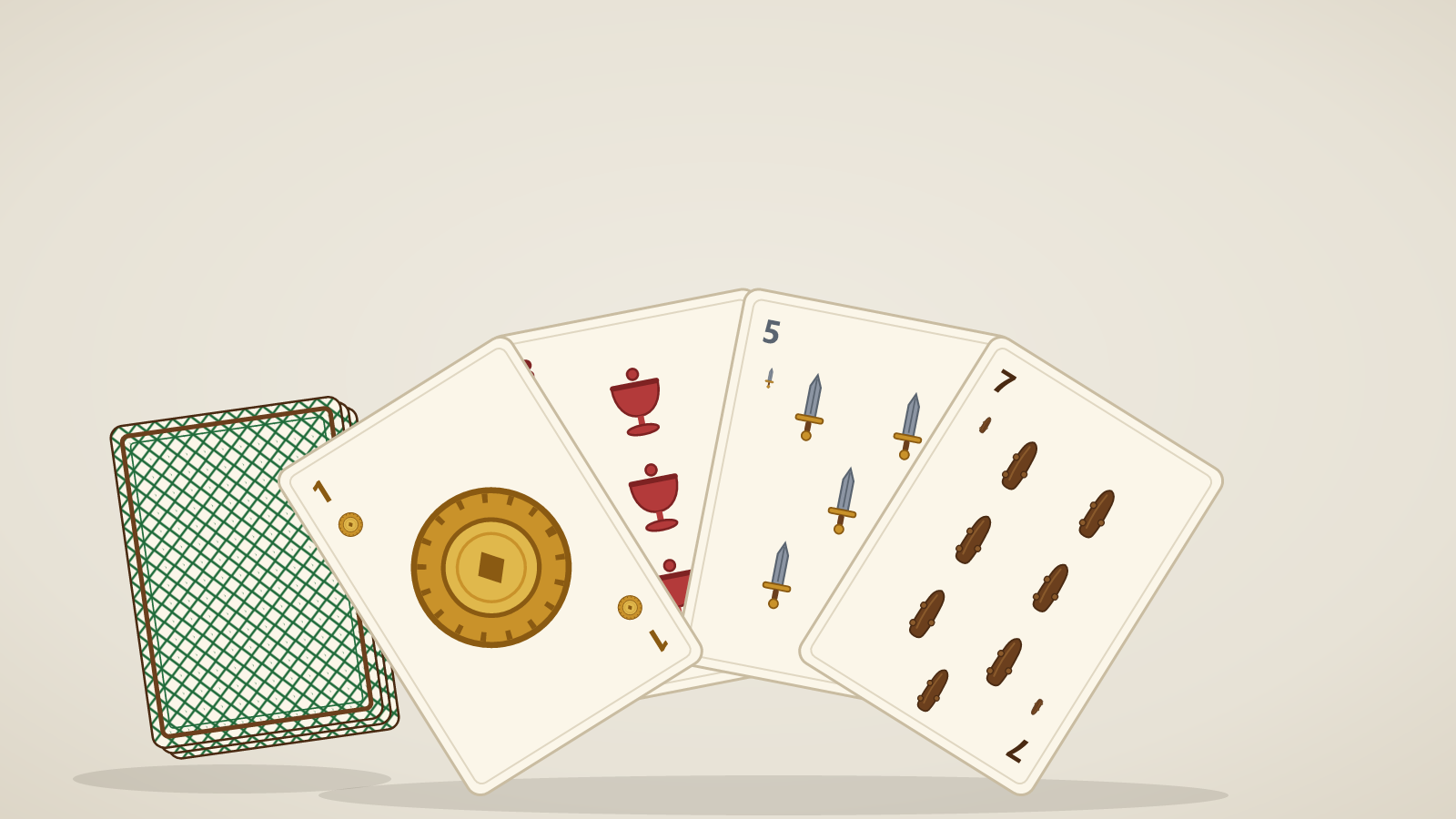
The standard pack sold in Spain has forty-eight cards: numerals one to nine in each suit, plus sota, caballo and rey. Many Spanish games then throw eight of those cards back in the box — the eights and nines come off — and are played with forty. Mus, the Basque partnership game of bluffing that structures whole evenings in parts of Spain, is played with the forty-card pack. But the count changes with the country: forty-card Spanish-suited packs are the norm for regional Italian games like Briscola and Scopa (the Italo-Spanish pattern, with designs tied to Naples, Sicily and Sardinia), across several North African countries, and in much of Latin America, including Argentina, Venezuela, Bolivia and Peru. Western France keeps a forty-eight-card Spanish-suited pack alive for the bluffing game Aluette. The Philippines, for Cuajo, use a Spanish-suited pack of one hundred and twelve.
| Pack | What it holds | Where it lives |
|---|---|---|
| 48 cards | 1–9 plus sota, caballo, rey | Spain's shop standard; Aluette in western France; games that need the nines |
| 40 cards | the eight and nine removed | Mus and many Spanish games; Italo-Spanish regional play; North Africa; much of Latin America |
| 52 cards | full ranks marked K–Q–J, plus jokers | Spanish-suited Bridge and Poker |
| 112 cards | expanded pack | Cuajo in the Philippines |
There are design variants on top: the "Catalan-face" baraja, common in Catalonia and the Valencian Community, keeps the same suits and figures but redraws every card. (Sizes and geographies above follow Pagat; the Catalan variant and the fifty-two-card "Spanish Poker" pack are documented in Fournier's own overview of baraja varieties.)
Your solitaires do not care which suits they wear
Now the bridge this catalogue was built for. Look at what the rules of the great patiences actually reference.
Klondike builds one foundation per suit from ace to king, and stacks the tableau down in alternating colours. It never mentions hearts by name. FreeCell deals all fifty-two cards face up and sorts them by suit into foundations; its famous near-total winnability is a property of the machinery, not of the pip art. Spider cares even less: you may build on any suit and only same-suit runs move as a unit. Memory needs only duplicated ranks and a table.
Suit identity matters; suit artwork does not. Deal the Spanish-suited deck, assign two suits the "red" job and two the "black" one, and the games run untouched. The pairing is arbitrary — colours on a Spanish pack are decorative — so choose it before the first deal and stick to it. And the fifty-two-card Spanish-suited pack exists precisely so international-format games need no compromise at all.
Klondike — the patience Windows turned into simply "Solitaire" in 1990 — is popularly attributed to the 1890s gold rush that gave it its name; the legend outlives the paper trail, so hold it loosely. The arithmetic of the rules, though, is not legend: it is suit-blind.
An old deck, still in circulation
That is the quiet miracle of the baraja española. The pattern that crossed the Mediterranean in the fourteenth century did not fossilise; it got lithographers, museums, factory workers with paid sick leave, and a place in this catalogue's solitaires. The French pattern conquered by standardising; the Spanish one survived by keeping its faces — coins, cups, swords, batons — and letting new games borrow them.
Next time you open a patience, try it the four-suit way: deal Klondike and let the oros do the job of diamonds. The deck has had six centuries of practice at adapting; you only need one afternoon. Full rules, variants and FAQs for Klondike, Spider, FreeCell and Memory are in the catalogue — start anywhere.