
What the game is
Galaxies is the rare logic puzzle with no numbers in it at all. Nikoli first printed it in its magazines in 2001 under the Japanese name Tentai Show — roughly "celestial show" — because the finished board resembles a sky of spiral galaxies, each drawn around its bright core. It has since become a fixture of puzzle championships worldwide, and it asks one faculty: seeing symmetry.
The setup is minimal. A grid arrives dotted with small circles — every dot sits squarely in the middle of a cell, its galaxy's core — and the cells themselves are blank. Your job is to hand every single cell to one of the dots, so the board breaks into as many colored regions as there are stars. A region is lawful when it has exactly one dot at its heart, looks identical after a half-turn around that dot, and holds together edge to edge.
The win check grades those laws, not the pattern the board was cut from: any complete partition of lawful regions seals the game. And since cells are painted by region, the finished board is a patchwork of color where every blot is rotationally balanced around its own dot.
How to play
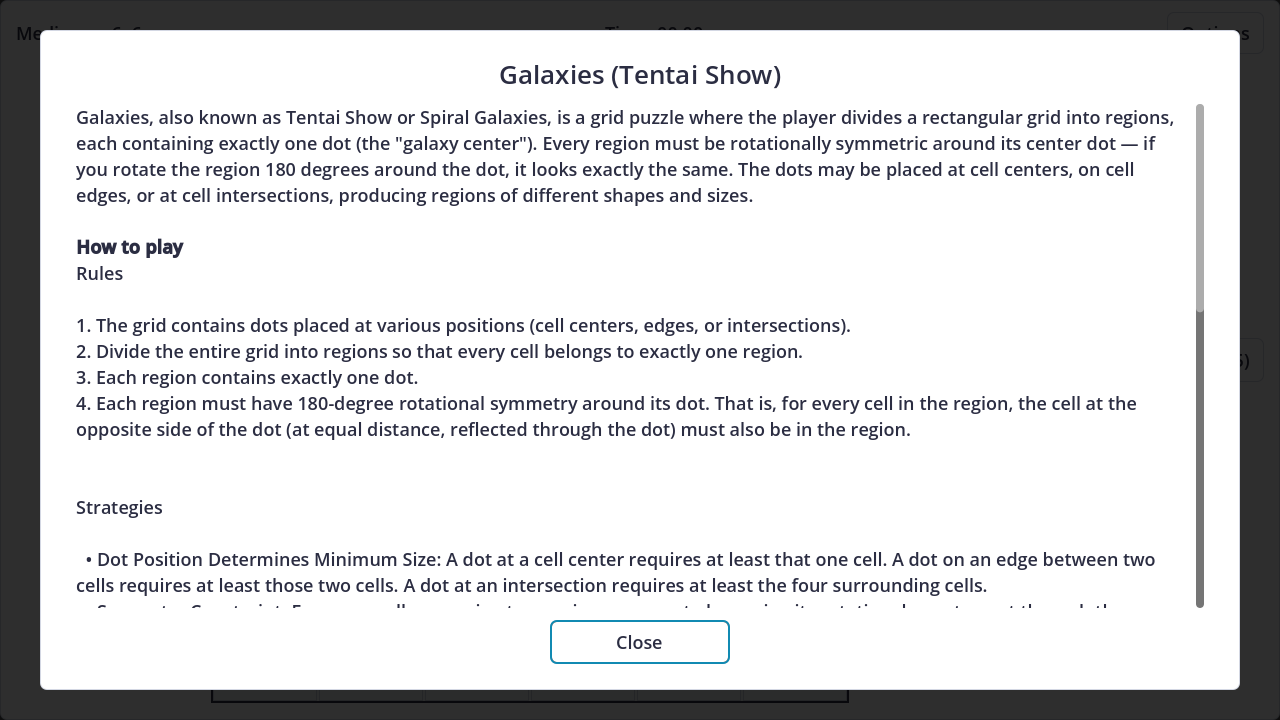
The rules the game enforces:
- Every cell of the grid must belong to exactly one region.
- Every region contains exactly one dot — and that dot sits in the center of one of its cells.
- Every region has 180-degree rotational symmetry around its dot: for each cell in the region, the cell on the opposite side of the dot, at the same distance, is in the region too.
- Every region is connected: its cells form one piece you can walk across edge to edge.
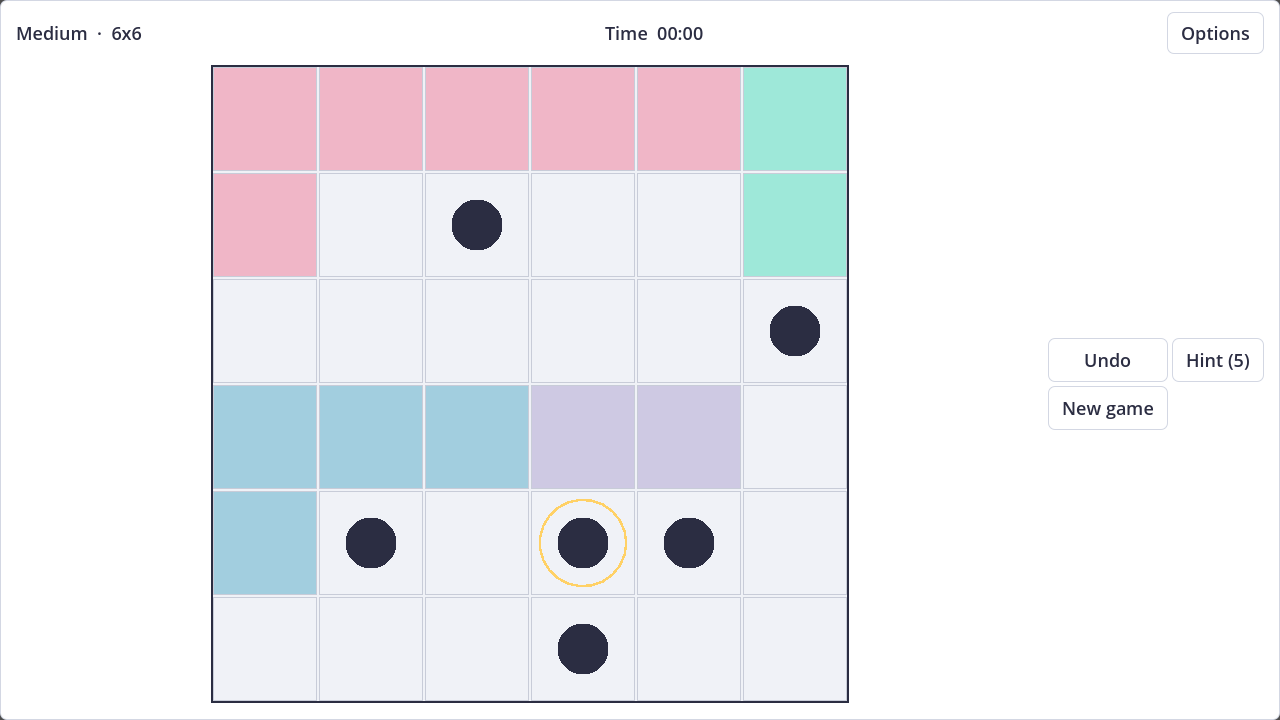
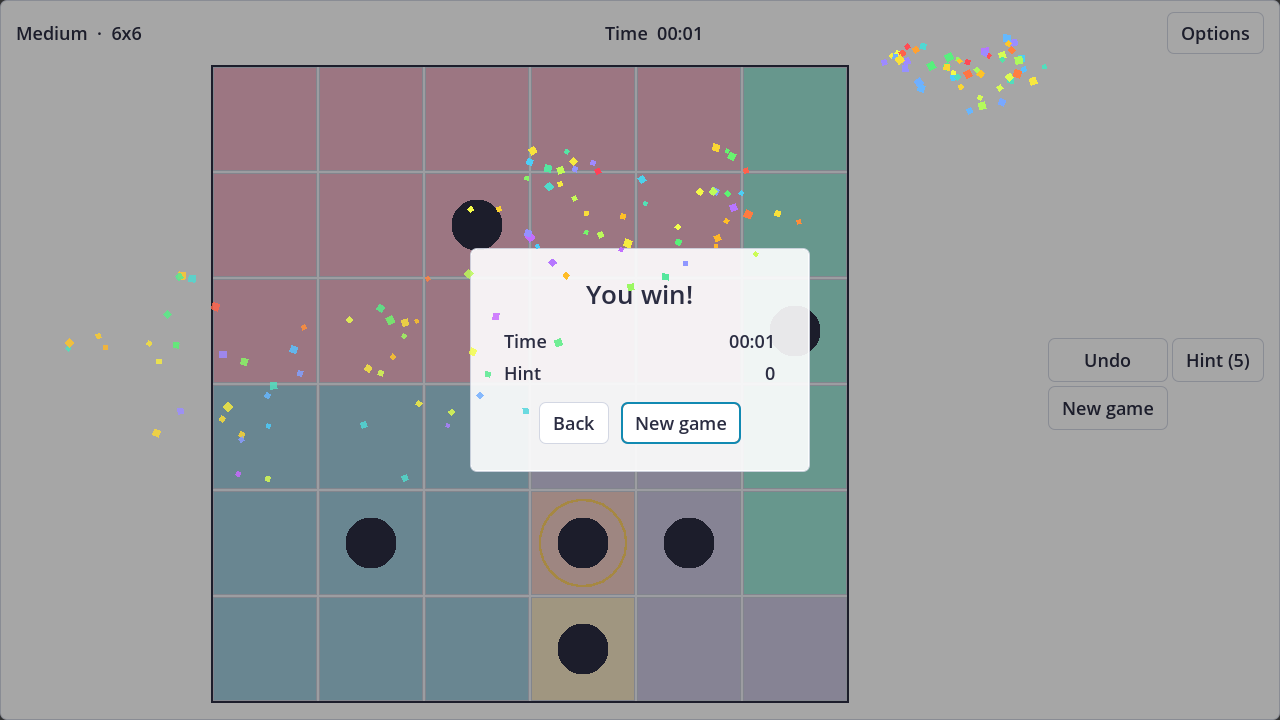
Step by step. Medium fills a 6×6 grid, and the HUD says so — the level and its dimensions together ("Medium · 6x6"), with a clock you can hide in Settings. Tapping a dot selects its region, marking that dot with an amber ring and making its color the active paint. Then tap cells to claim them for that dot; tap an already-claimed cell of yours and it lets go again. Undo reverses claims and releases alike.
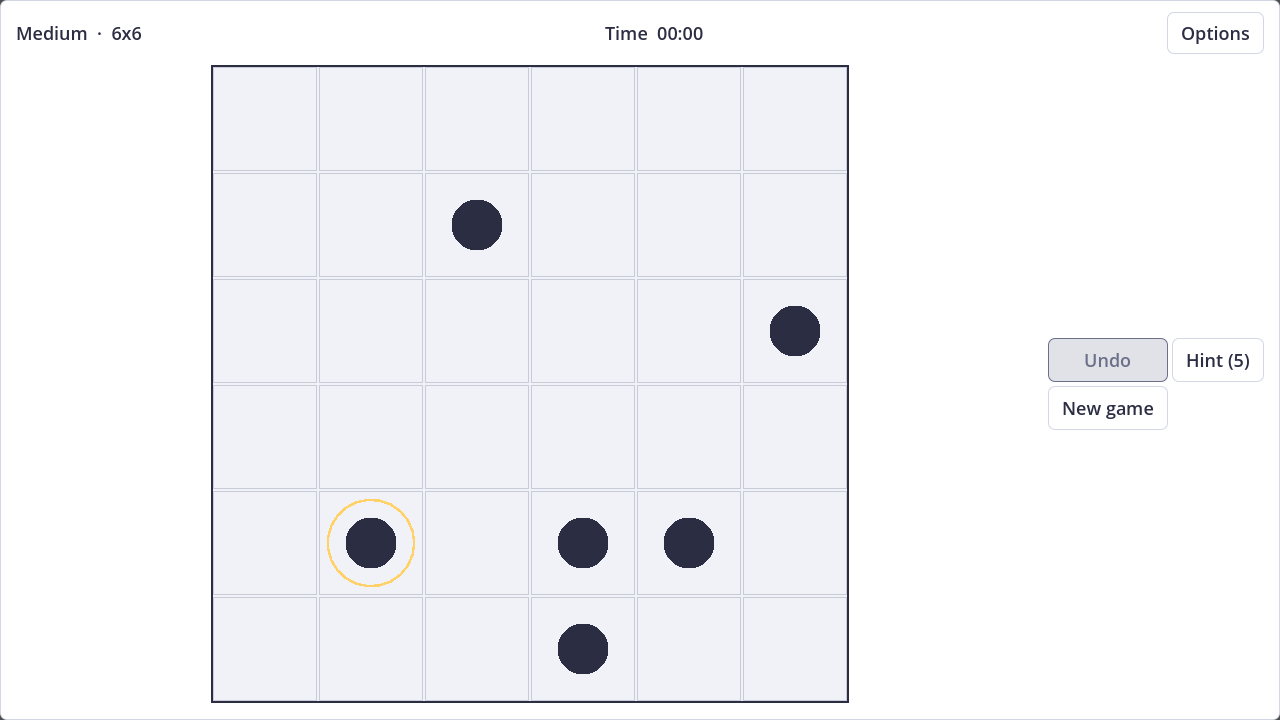
Here is the part every new player asks about: mid-game, the board shows nothing wrong even if something is. The conflict tint is computed only once not a single cell is left free — until then, regions that will never be symmetric or connected stay unmarked while you paint. So Galaxies plays with your own symmetry check, not the board's: claim a cell and immediately look for its twin on the far side of the dot. Fill the last cell and every broken region finally flushes with color.
Hints, pause and the win panel
Five hints wait at every level. Galaxies' hint is the methodical kind: it scans the grid cell by cell, top to bottom, and claims for its dot the first cell that disagrees with the board's own finished blueprint — one correction per press. It fixes what is misplaced; it does not invent your strategy. When no cell disagrees with that blueprint — or the five are already spent — the button answers with a "No hints left" toast instead.
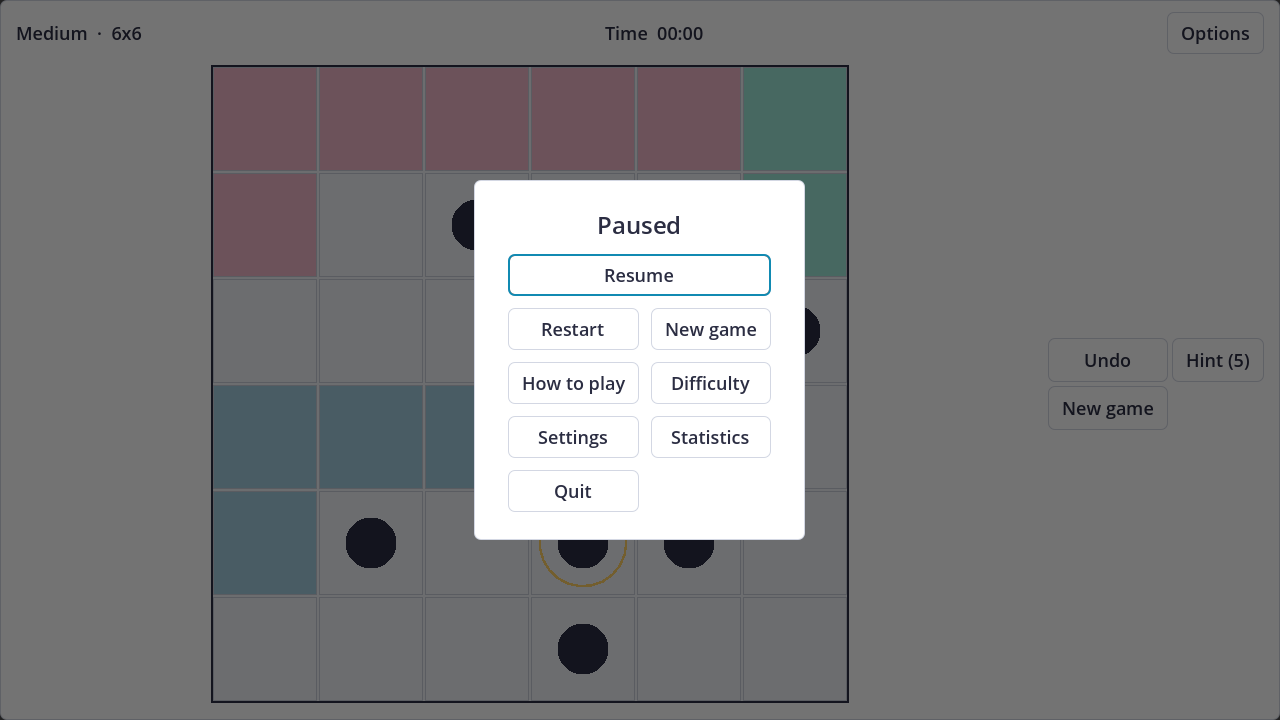
Pause covers the usual bench: Resume, Restart, New Game, How to Play, Difficulty, Settings and Statistics — seven options in the browser build; the installed app adds Quit. The help sheet keeps the region laws and a page of strategies within reach.
Claim the last free cell in lawful order and the board seals on the spot: the "You win!" panel arrives with the time and the hints spent, confetti over a sky of balanced color.
Strategy and tips
- Every claim is really two. The symmetry law works like a payment rule: the moment a cell joins a region, its twin through that dot must join too. Paint in pairs and half the board closes itself; paint singles and the deficit waits for you at the final cell.
- Count from the core. The dot's own cell is in the region from the start, and everything else arrives in matching pairs — so every finished region holds an odd number of cells. A border cell that would need an off-board twin is a free deduction: that dot cannot have it.
- Corners and edges speak first. A dot near the edge has its pairs pressed against the grid boundary — the region it can lawfully build is squeezed by geometry. Dots in open water between two neighbors are the ones with real choices.
- Draw borders between close dots. Two neighboring dots cannot both claim the cell between them. Decide where that frontier runs: a cell denied to one galaxy often has no lawful home anywhere else.
- Bank the forced cells. As regions grow, some free cells lose every candidate dot but one that could take them without breaking symmetry. Claim those immediately — they are the puzzle's own notes to you.
- Finish to see the truth. Don't trust a half-painted board's calm: run your own pair-checks, and when the last claim flushes a region red, undo back through that region's pairs rather than starting over.
Controls
- Mouse and touch: tap a dot to select its region (amber ring), tap cells to assign them to the selected dot, tap again to release. The play bar carries Undo, Hint, New game and the pause menu.
- Gamepad: the D-pad walks a cursor across the grid and A presses the highlighted cell — selecting the dot or claiming the cell exactly as a finger would. Start opens and closes the pause menu, and B steps back: it closes menus and panels, and with the cursor already on the board it asks whether you want to quit.
- Keyboard: Galaxies has none. Dots and cells answer taps and the D-pad; no arrows or letters are wired to the board.
- Restart replays the same sky with your assignments wiped; New game deals a different one, and changing difficulty discards the run in progress.
Difficulties and sizes
Easy starts at 5×5, Medium at 6×6, Hard at 7×7 and Expert at 8×8 — the HUD prints the dimensions at every level. Each level also caps how large one region may grow: six cells at Easy, seven at Medium, nine at Hard, eleven at Expert. That ceiling quietly decides the board's character, because it bounds how many dots a grid can carry: tighter caps force more, smaller galaxies; looser caps let regions stretch into long shapes. Five hints sit at every level, the four laws never change, and the dots never move off their cell centers.
When the board confuses you
- I painted a region badly and the board said nothing. By design: conflict colors are computed only when zero cells remain free, so a half-assigned board stays permanently silent. Your own pair-checking is the mid-game instrument — or finish the assignment and let the flush expose every broken region at once.
- The board filled and now cells are flushed — what do I undo? The tint marks regions that fail symmetry or connectivity. Work inside a flushed region: its cells came in pairs, so undo pairs back to the last one whose twin also fit, then reassign the leftovers toward a dot that can take them.
- A cell with a dot in it won't change color. Dots are cores, not territory: tapping one selects its region instead of claiming the cell, and that cell belongs to its own dot for the whole game.
- "No hints left" though I didn't win? Two ways to hear it: you spent all five, or your board already agrees with the blueprint on every cell. In the second case your assignment equals the maker's — the laws grade from there.
- I win with a different patchwork than a friend's. Any full split into lawful regions wins, so the same sky can admit more than one partition. The rules decide, not the recipe.
Where to play
Galaxies is free in the Tab and Blank catalog, in the browser, nothing to install: play Galaxies (Tentai Show).