
What the game is
Hex is a connection game. Two players, one rhombus of hexagonal cells, one objective each: join your two assigned edges with an unbroken chain of your stones. That is the entire promise; under it sits a world of virtual links and forced answers.
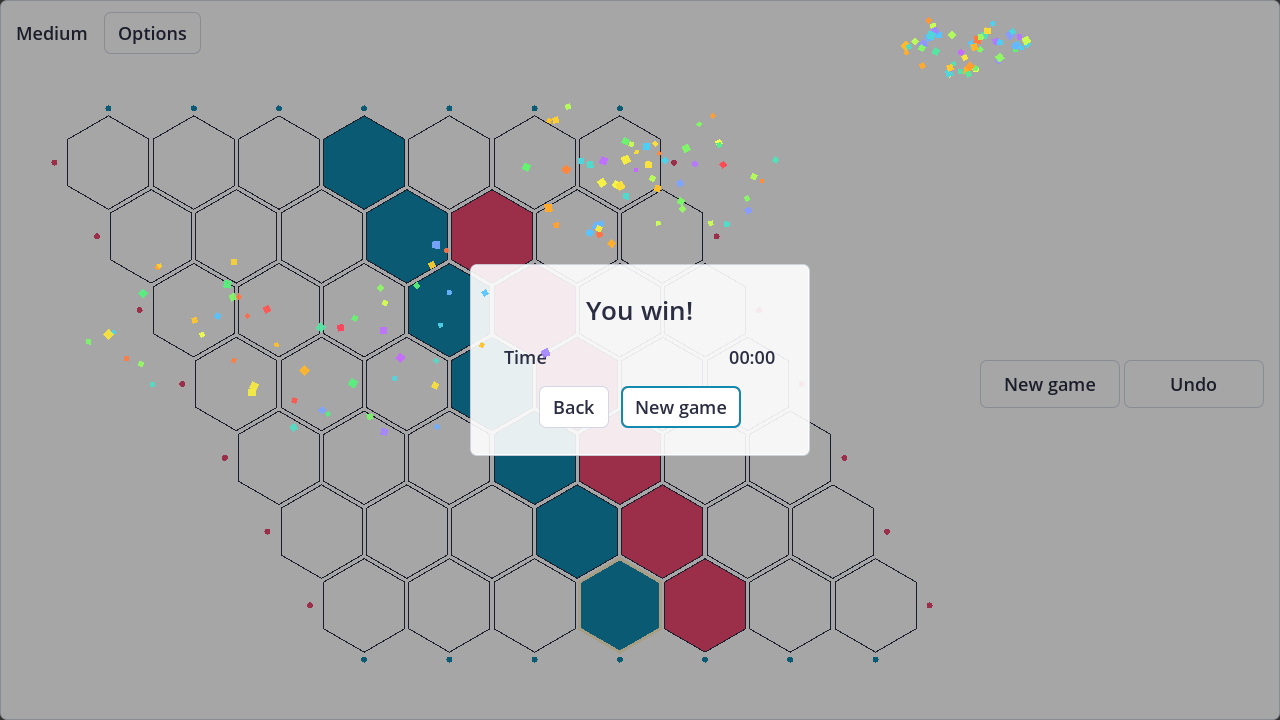
This version gives you one pair of edges and hands the other to the game's own AI. Which sides are yours is drawn onto the board: small coloured dots line each pair of edges, and the pair matching your stones is the top-and-bottom one. Three properties shape every match: stones never move once placed, nothing is ever captured, and a draw is mathematically impossible — one chain always completes first. The in-game rules sheet states it plainly, and the board's topology guarantees it.
How to play
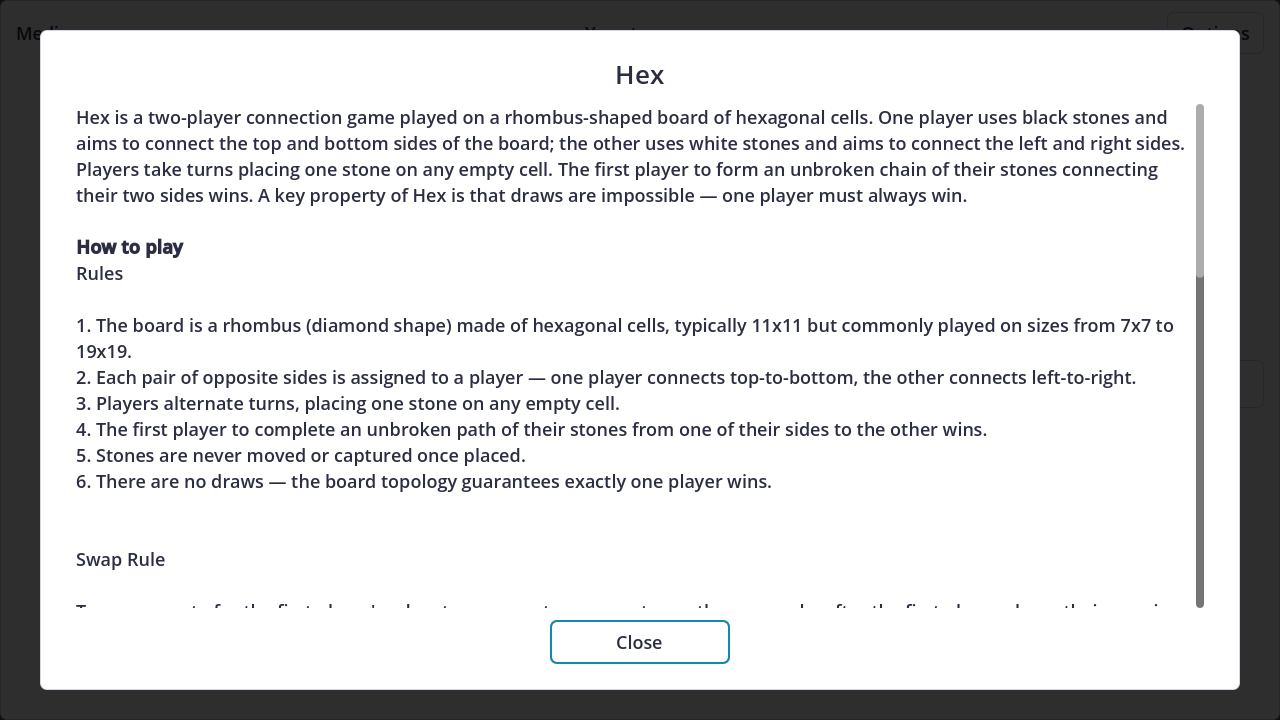
The rules, in the same numbered order the help sheet uses:
- The board is a rhombus of hexagonal cells. Medium here is 7×7; classic Hex is played anywhere from 7×7 to 19×19.
- Each player owns a pair of opposite sides — yours run top to bottom.
- Players take turns placing one stone on any empty cell.
- The first to form an unbroken path between their two sides wins.
- Stones are never moved or captured once placed.
- There are no draws.
Step by step. A new Medium game opens on an empty 7×7 diamond, edge markers telling you who must connect what.
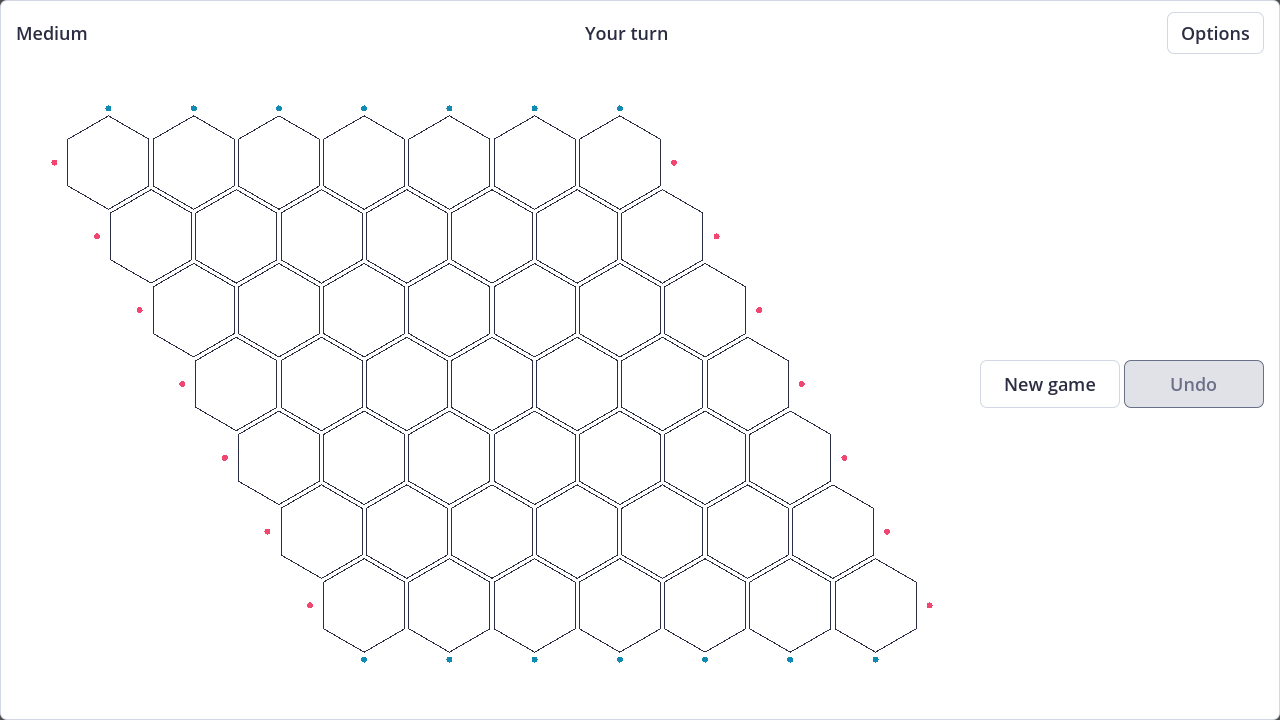
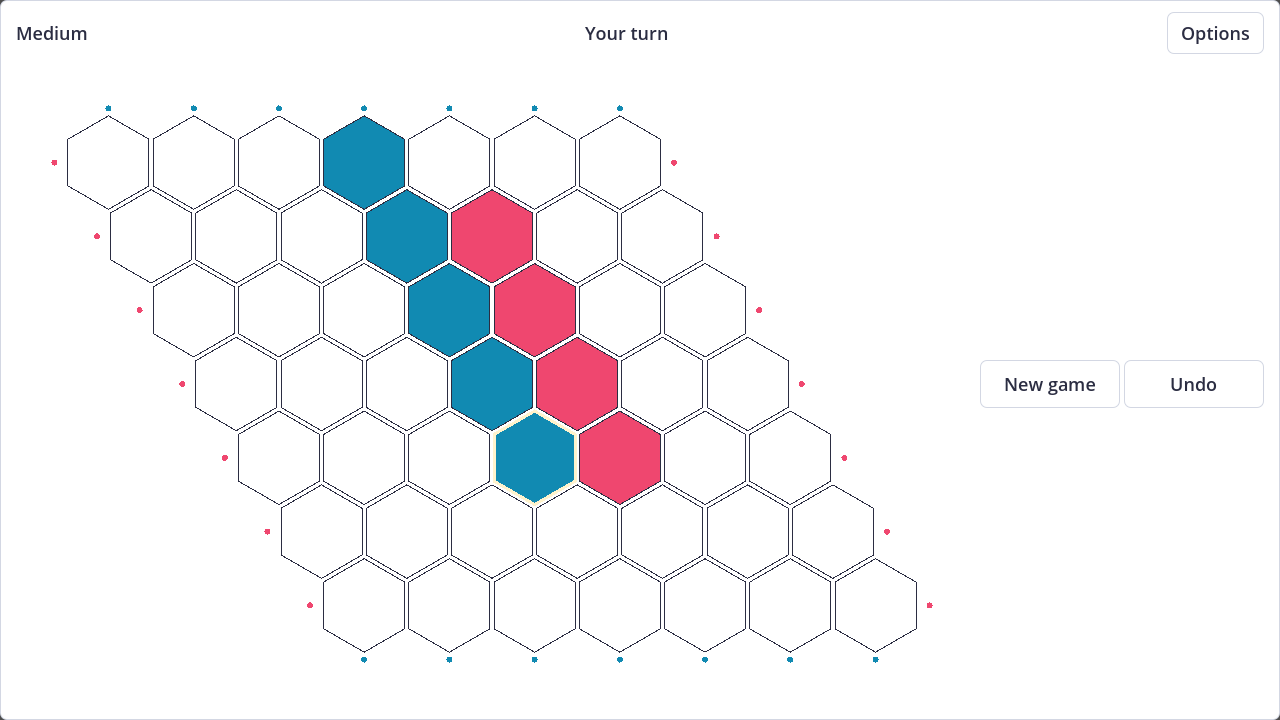
Click an empty cell and your stone lands there; the HUD announces whose move it is — "Your turn", then "Opponent's turn" while the machine thinks — and the most recent stone wears a highlight ring. The AI answers every move somewhere, usually in the thick of the board where your best paths run, so the game becomes a race to build faster than you get blocked.
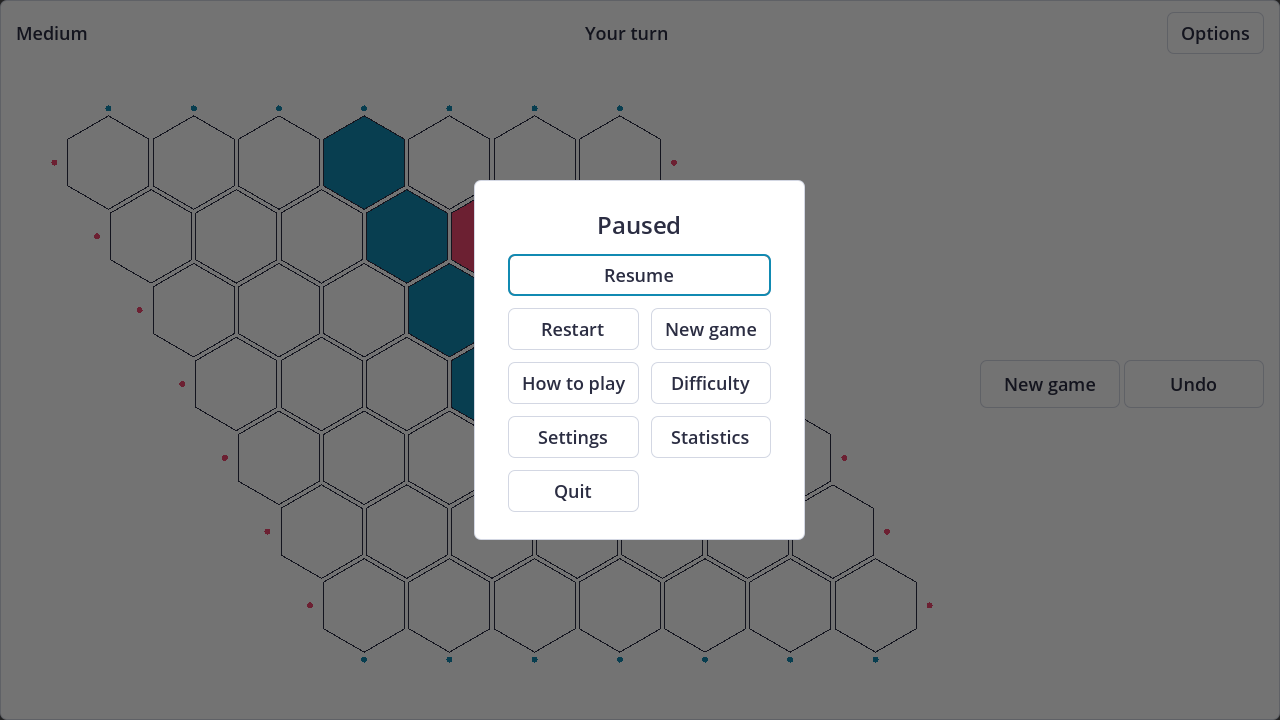
Resting, or checking a rule? The pause menu holds Resume, Restart, New Game, How to Play, Difficulty, Settings and Statistics — seven options in the browser build; the installed app adds Quit. "How to Play" keeps the numbered rules, the strategies and the swap-rule tradition readable inside the game itself.
The win check fires the moment a chain closes: the "You win!" panel arrives with your run time, confetti included. The AI can close its own chain first — the same panel reports that outcome.
Strategy and tips
- Take the centre. Middle cells contribute to paths in every direction; an early central stone is the strongest simple move on the board.
- Learn the bridge. Two stones separated by one gap, linkable through either of two hexagons, form a virtual connection your opponent cannot cut. Recognising bridges is what separates planning from pushing.
- Feel the ladder. Near the edges, some sequences of replies force every step — a correctly read ladder reaches your goal no matter how the other side defends.
- Defend while building. The best blocks double as progress: stones that jam the enemy chain while extending yours.
- Every stone counts forever. With no captures, every turn adds permanent information to the position.
- About the swap rule. Tournament Hex lets the second player steal the opening stone to balance the first-move edge. The help sheet explains the convention; this app never makes you manage it — you just play.
Controls
- Mouse and touch: click or tap any empty cell to place a stone; buttons for Undo, New Game and the pause menu. Occupied cells ignore you.
- Gamepad: the D-pad walks a cursor over the cells, A taps the highlighted one exactly like a finger would, Start opens and closes the pause menu, and B steps back — closing menus first and, with the cursor already on the board, asking whether you want to quit.
- Keyboard: arrow keys move the same cursor and Enter performs the tap.
- Hex offers no hint button: when stuck, Undo rewinds — one press takes back your stone and the AI's reply together — and the help sheet is one menu away.
Difficulties and variants
Four levels raise the board and the opponent together. Easy is a 6×6 diamond with an AI searching one move deep and blundering about 45% of the time; Medium, 7×7 at two-deep search and roughly one blunder in five; Hard, 8×8 with three-deep vision and a 5% slip rate; Expert, 9×9 at six-deep search, no deliberate mistakes and up to 1.2 seconds of thought per move. Blunders keep the lower levels beatable; depth makes Expert feel like wall-running.
Classic books play Hex up to 19×19; this build caps at 9×9. Changing difficulty discards the run in progress and starts a fresh diamond, "Restart" replays the current game from empty, and "New Game" rolls a new one. One last piece of theory to keep in your pocket: Nash proved the first player has a winning strategy, and nobody has ever found it — you are racing an opponent with proven resources and hidden ones.
Where to play
Hex is free in the Tab and Blank catalog, in the browser, nothing to install: play Hex.
If pure connection hooked you, the same board shelf keeps Gomoku (Five in a Row) — line five instead of link two — and Reversi (Othello), where the board flips under your feet.