
What the game is
Most grid puzzles hand you an empty board and ask you to fill it. Hitori starts in the opposite direction: every cell already carries a number, and your job is to take some of them out of play — not by erasing them, but by shading the cells that hold them. It is a Nikoli puzzle, first printed in the company's magazines in the early 1990s, and its name is the Japanese word for "alone": every number left visible must stand alone in its row and column.
Three laws decide the whole game. Among the cells you leave white, no number may appear twice in the same row or column. No two shaded cells may touch along an edge — corners are fine. And every white cell must reach every other white cell by stepping only across shared edges, so the unshaded cells form one single landmass. Shade a cell and you delete it from the first law and the third while tightening the second; unshade it and everything flows back.
The app cuts each board so that every cell meant to be shaded has a genuine duplicate planted behind it — no dark square is arbitrary. But the win check grades your board against the three laws, never against the pattern it was carved from: any shading that satisfies all of them at once seals the game, even one the maker never pictured.
How to play
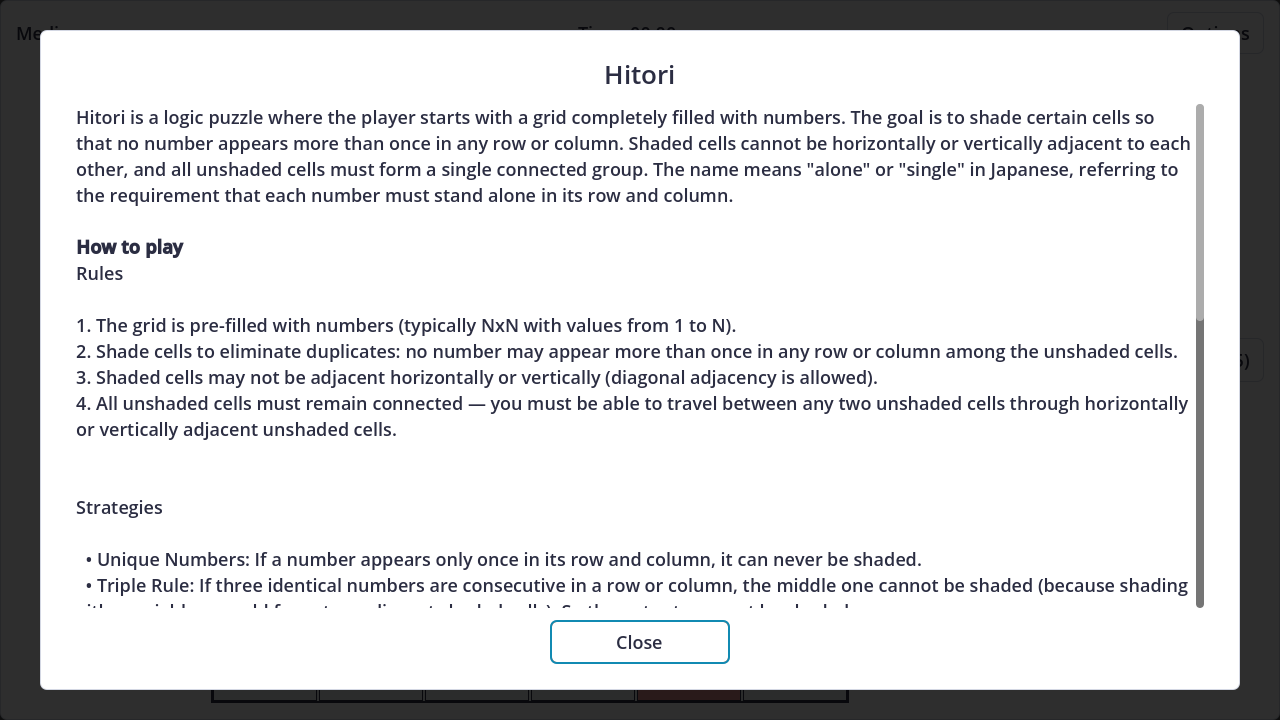
The rules, in the order the in-game help sheet numbers them:
- The grid arrives pre-filled — a number in every cell.
- Shade cells to eliminate duplicates: among the unshaded cells, no number may repeat in any row or column.
- Shaded cells may never touch horizontally or vertically. Diagonal contact is allowed.
- All unshaded cells must form one connected area, reachable edge to edge.
Step by step. Medium is a 6×6 grid of thirty-six numbers. The HUD names the level and runs a clock, which you can hide in Settings; there is no mistake counter, because the board itself is the judge. Tap any cell and it goes dark; tap it again and it comes back. That single toggle is the entire game, and Undo peels presses back one at a time.
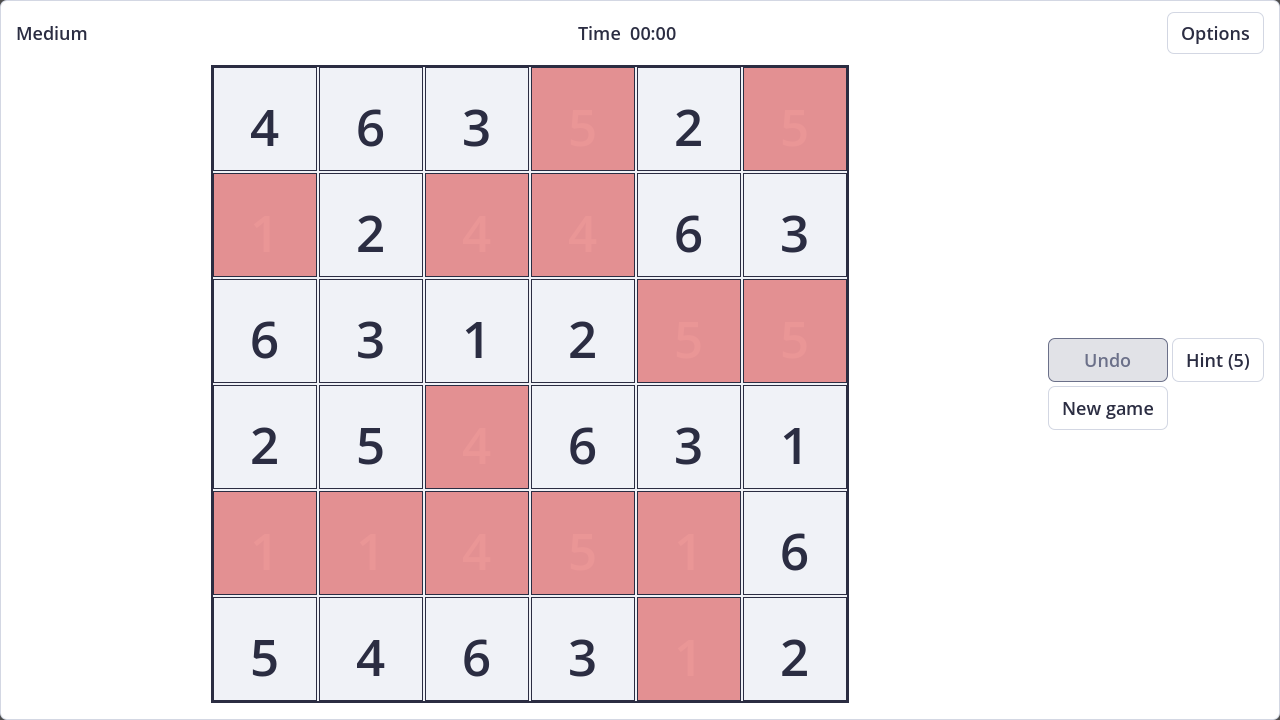
The board talks back in red from the first second. Two equal numbers still white in one row or column both light up, and two shaded cells that touch light up too. Nothing else is ever flagged — a board that simply isn't finished is not a wrong board. On a fresh deal that first screen is a wall of red: every duplicate pair the maker planted sits there openly, because you have shaded nothing yet. Far from an error, it is your starting map — each lit pair is exactly one decision: which of the two goes dark.
Hints, pause and the win panel
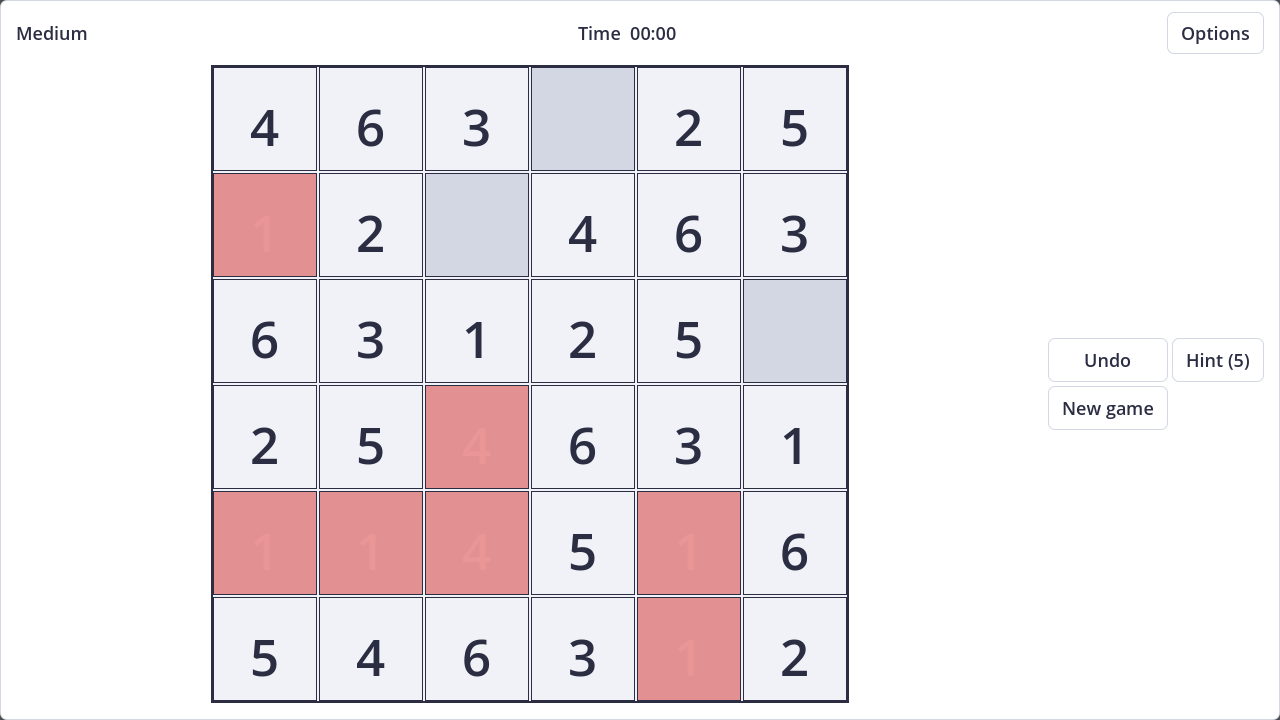
Five hints wait at every level, and the button counts them down from Hint (5). A Hitori hint only ever adds shading: it picks one of the cells the board's original pattern still owes and darkens it, chosen at random among the candidates. It will never brighten a cell back for you, so a hint can tell you a cell belongs in the dark, but never which cells must stay white. And because its pool is tied to the maker's pattern rather than your path, it can run dry while the board is still open — then a "No hints left" toast appears and the game simply leaves you to reason. The win check has never cared about the hint budget anyway.
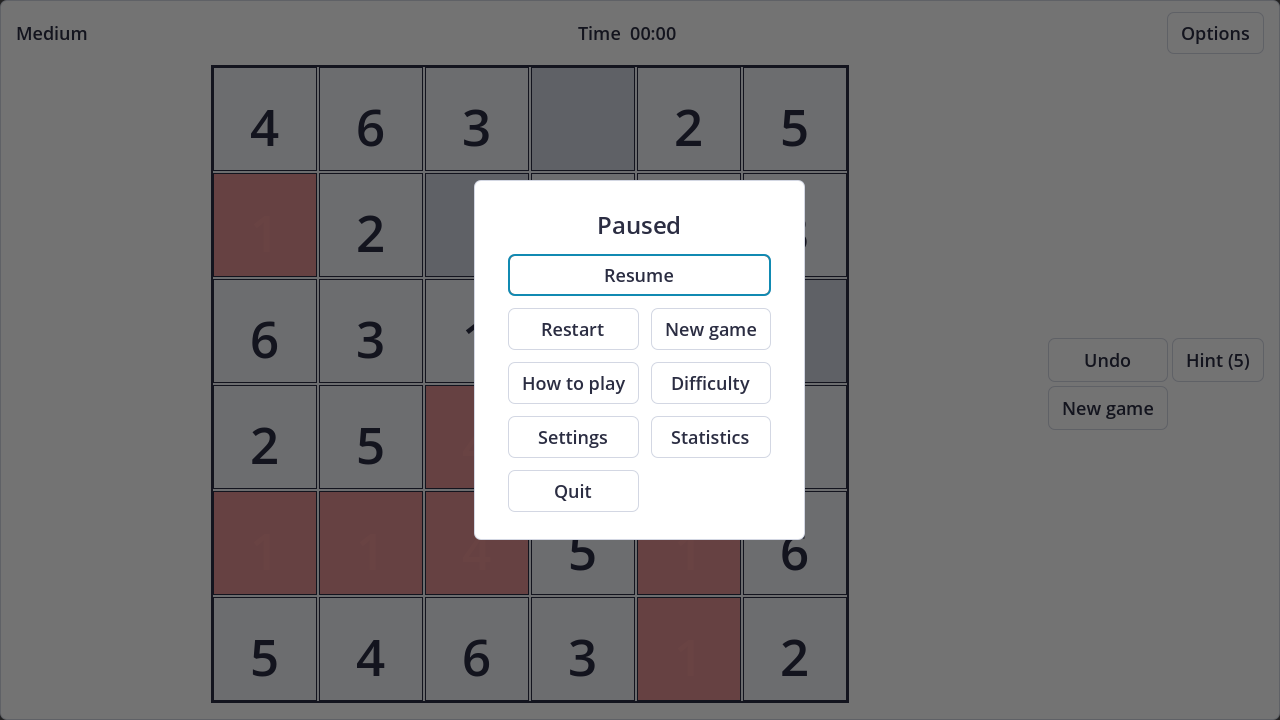
Pause covers the usual bench: Resume, Restart, New Game, How to Play, Difficulty, Settings and Statistics — seven options in the browser build; the installed app adds Quit. The help sheet keeps the four rules and a page of strategies within reach.
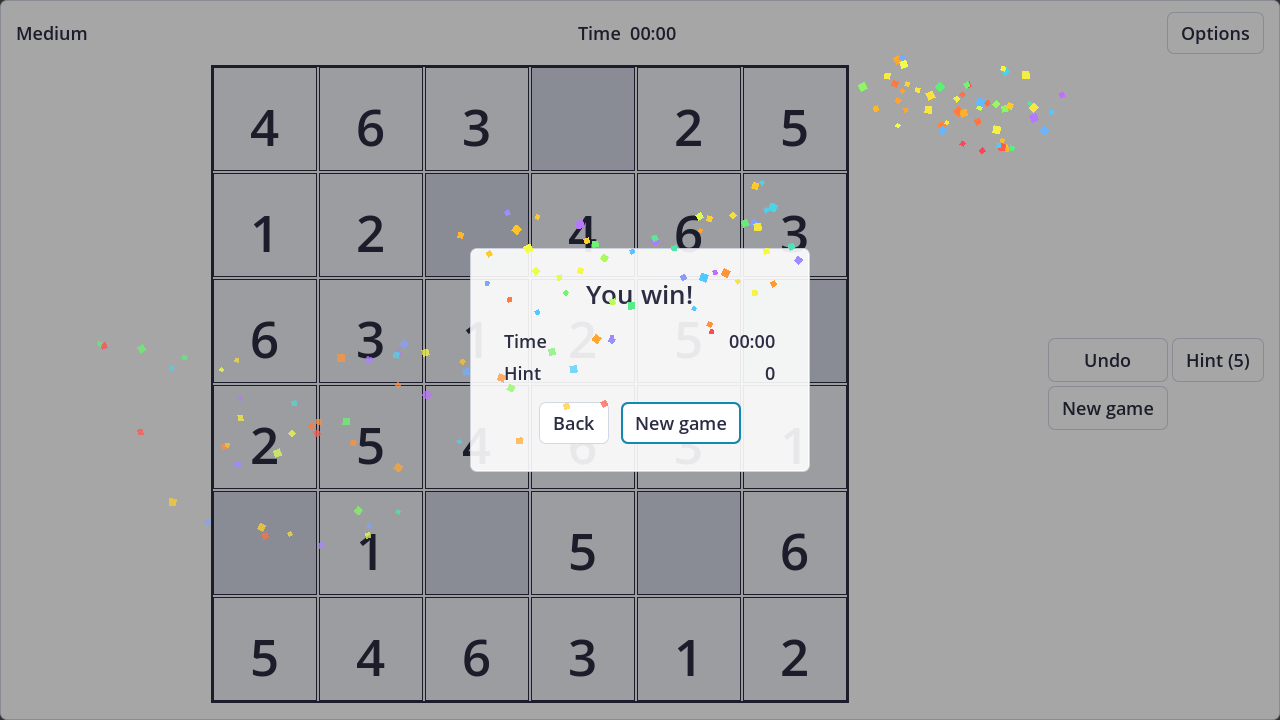
Close the last duplicate and the win lands on the spot: the "You win!" panel drops over the board with the time and the hints spent, plus confetti for a grid pared down to one clean white region.
Strategy and tips
- Numbers without twins stay white. If a value appears only once in its row and only once in its column, shading it buys nothing: no duplicate is removed, and a lit-up white corridor loses a link for free. Keep it in the light and use it as an anchor.
- A shaded cell blesses its neighbours. The moment a cell goes dark, its four edge-neighbours are confirmed white — and a confirmed white cell whose twin value sits next to it forces the next shade. Chains of "one dark, four white" are where boards open up.
- Work the triples. When three identical numbers sit consecutively in a line, shading the middle one would strand its two neighbours as forced whites that still repeat each other. The help sheet's verdict: the two outer cells go dark and the centre stands.
- Test the sandwich. Two equal numbers separated by a single cell: if shading the middle cell would cut the white area in two or press two shades together, then one of the twins must take the hit — and which one decides itself.
- Protect the landmass. Before shading, ask what you are leaving behind. A shade that walls the white cells into two islands never wins, no matter how clean the numbers look. Edges and corners are the fragile spots: fewer neighbours, more ways to cut.
Controls
- Mouse and touch: tap a cell to shade or unshade it; the play bar carries Undo, Hint, New game and the pause menu.
- Gamepad: the D-pad walks a cursor across the grid and A presses the highlighted cell — the same toggle a finger gives you. Start opens and closes the pause menu, and B steps back: it closes menus and panels, and with the cursor already on the board it asks whether you want to quit.
- Keyboard: Hitori has none. The board answers taps and the D-pad, full stop — no arrow or number keys are wired to it.
- Restart replays the same puzzle with your shading wiped; New game deals a different one, and changing difficulty discards the run in progress.
Difficulties and sizes
Easy starts on a 5×5 grid, Medium fills a 6×6, Hard steps up to 7×7 and Expert to 8×8. The four levels change geometry only: the same three laws, five hints at every size, and numbers that never stop meaning what they mean. How many cells the finished shading covers is up to the board — the rules never count shaded cells for you, so no quota exists to chase.
When the board confuses you
- A brand-new grid already covered in red. Correct behaviour, not corruption: before your first shade, every planted duplicate stands white side by side, and the game marks all of them at once. That red is the puzzle telling you where the decisions are.
- "No hints left" before winning. The hint pool is the set of cells the original pattern still needs darkened; if you shaded them by hand — or simply spent all five — the well is dry while the board is still open. Reason the rest out: the win is graded on rules, not on hints.
- Everything looks clean and the board still won't close. Red flags duplicates and touching shades, but it does not paint a cut: if your white cells sit in two islands, nothing glows and nothing wins. Hunt for the pinch point — usually a shade that severed a one-cell corridor — and undo it.
- You win with a shading nobody expected. Any configuration obeying all three laws seals the board, so the game may end on a pattern different from the deal sheet. That is the rules grading, not a bug.
Where to play
Hitori is free in the Tab and Blank catalog, in the browser, nothing to install: play Hitori.