
What the game is
Takuzu is the puzzle that builds a picture out of nothing but two symbols. Widely attributed to Belgian puzzle designers and first printed in European magazines in the early 2000s, it travels under several names — Binary, Binario, Binairo — and the board always says the same thing: every cell takes a 0 or a 1, and three laws sort the finished grid from a mess. A completed field looks like a strip of machine code, but the whole game is counting and pattern-matching.
The board is always square and even-sized, so each line splits exactly in half. Just under half the cells arrive already printed at Medium — locked digits you can consult but never move — and the rest wait for you. The win check grades the three laws, not the pattern the puzzle was cut from: any full board obeying them all wins, even one the maker never imagined.
How to play
The rules, in the order the in-game help sheet numbers them:
- Fill every cell with a 0 or a 1.
- Each row must hold exactly as many 0s as 1s.
- Each column must hold exactly as many 0s as 1s.
- No more than two identical symbols in a row — 000 and 111 are forbidden in any line.
- All rows must be different from one another.
- All columns must be different from one another.
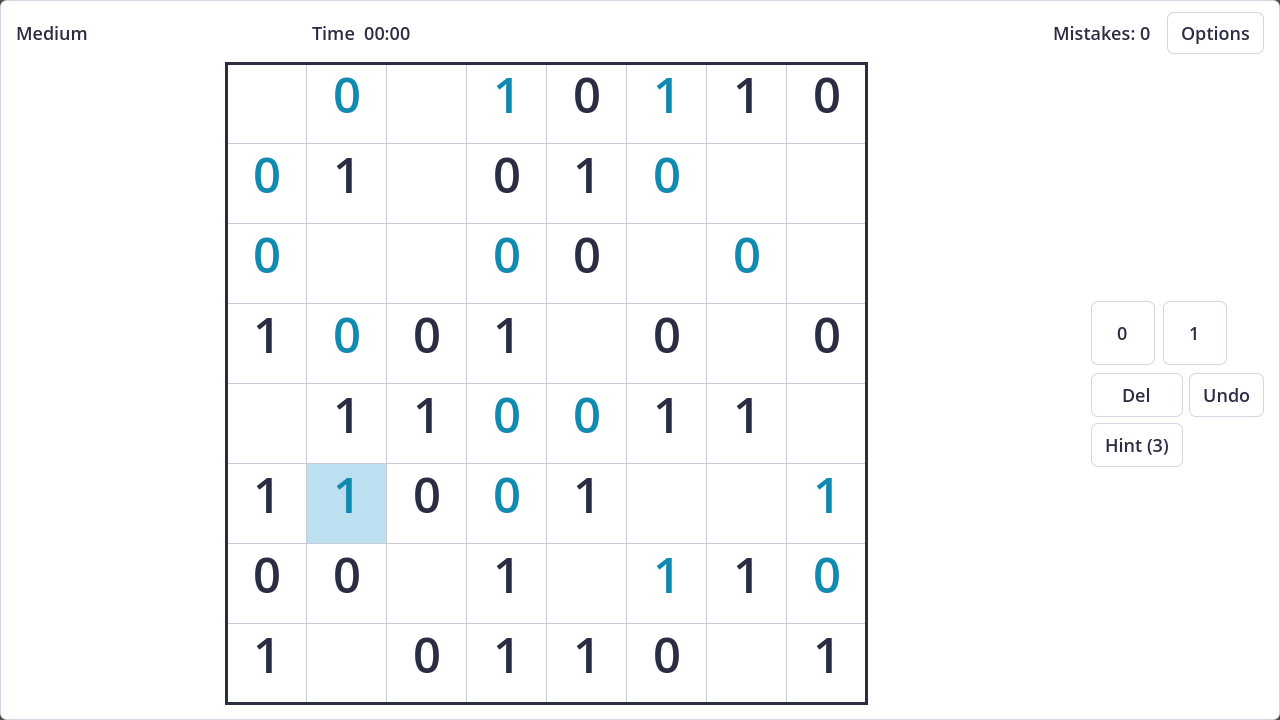
Step by step. Medium deals an 8×8 grid — the board the app opens on by default — so every line wants four 0s and four 1s. Tap any empty cell to select it, then press 0 or 1 on the on-screen keypad. The digits you enter glow blue against the plain printed ones, so you can tell the puzzle's voice from yours. Pressing the symbol a cell already carries wipes it, and the Del button clears the selection outright. The printed cells refuse everything: taps select them, writes and erases slide off in silence.
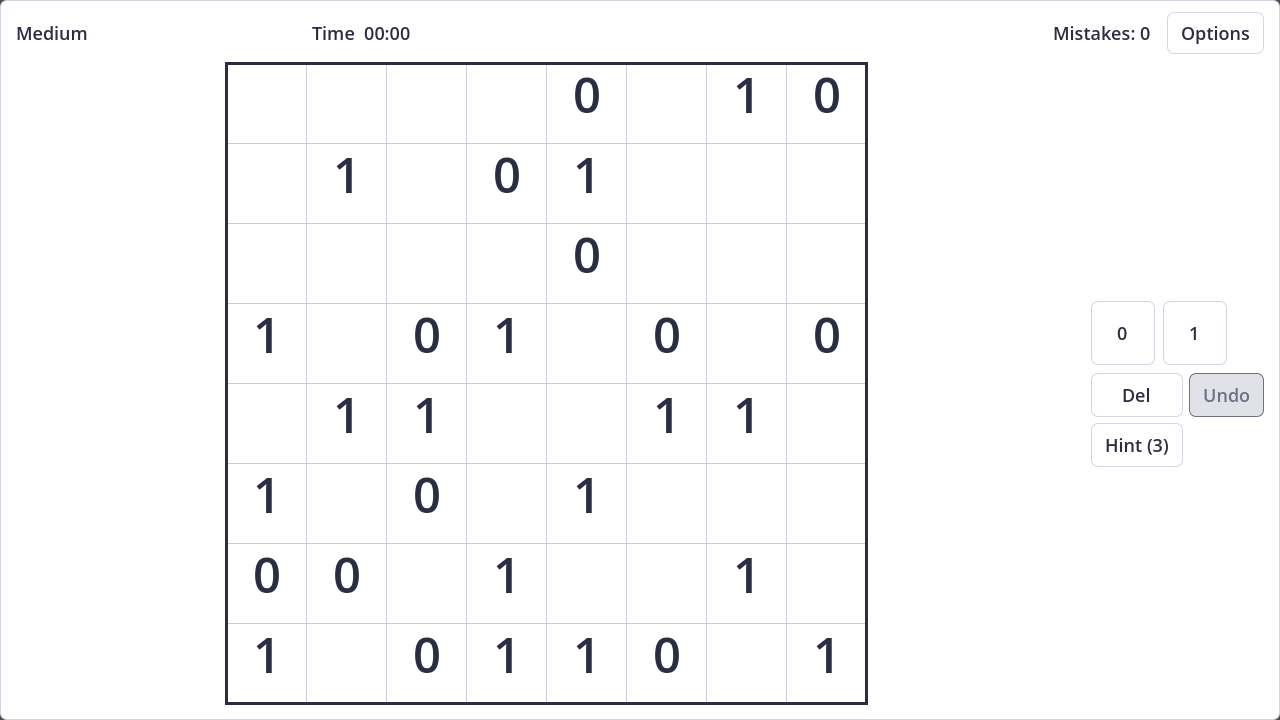
The board flags two of the three laws in red, the instant they break: three identical symbols in a line light all three cells, and a line whose 0s (or 1s) already outnumber half lights up every one of those symbols in the line. The third law — no two rows or columns alike — is never painted. A row that is a clone of another passes unnoticed until the board is full and the win simply doesn't come. Remember the asymmetry: red means "wrong"; the absence of red does not mean "right".
Hints, mistakes and the win panel
Three hints per game. Each one picks an empty cell at random and writes the symbol the puzzle's own answer carries there, leaving the touched cell selected so you can see what its line owes. The button answers with a "No hints left" toast when it genuinely has nothing to give: either the board has no empty cells left, or all three hints are already spent.
The Mistakes counter runs in the HUD, and it is exactly that: a counter. It ticks whenever you write a symbol that disagrees with the board's hidden answer, but there is no limit to catch — no accumulation of failures ends a Takuzu run. Keep writing; the grid only closes when the three laws say so.
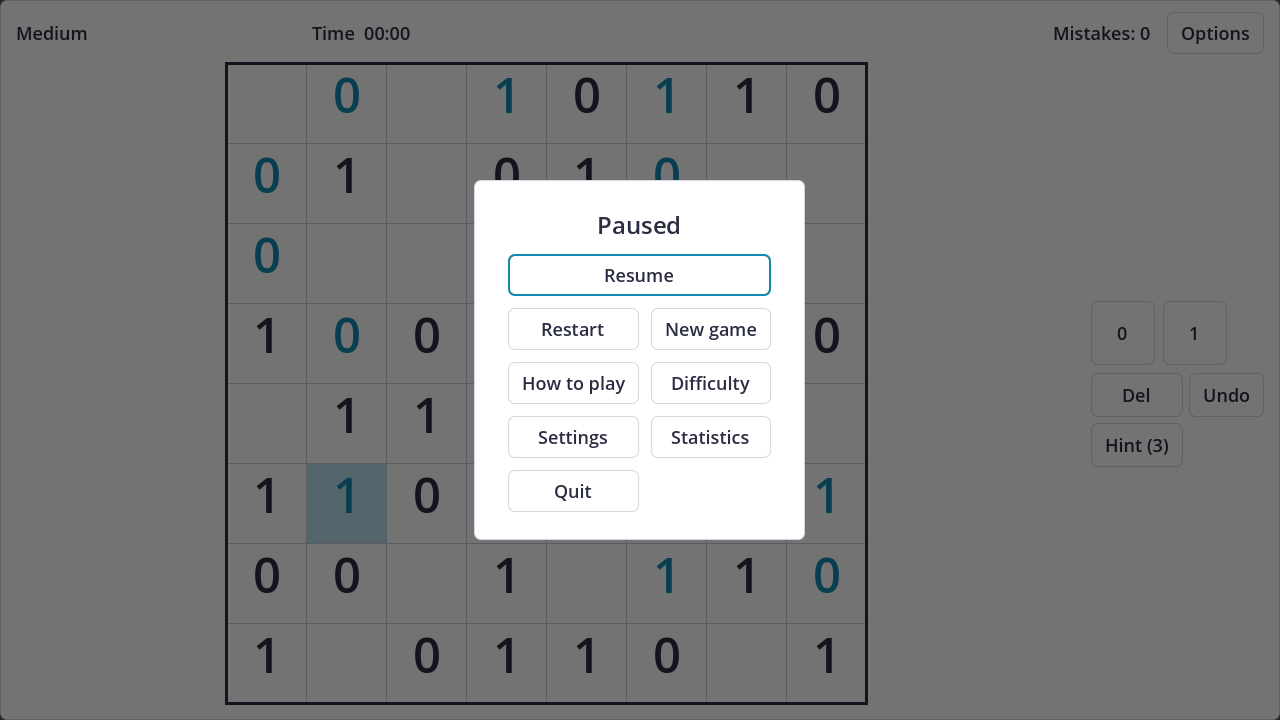
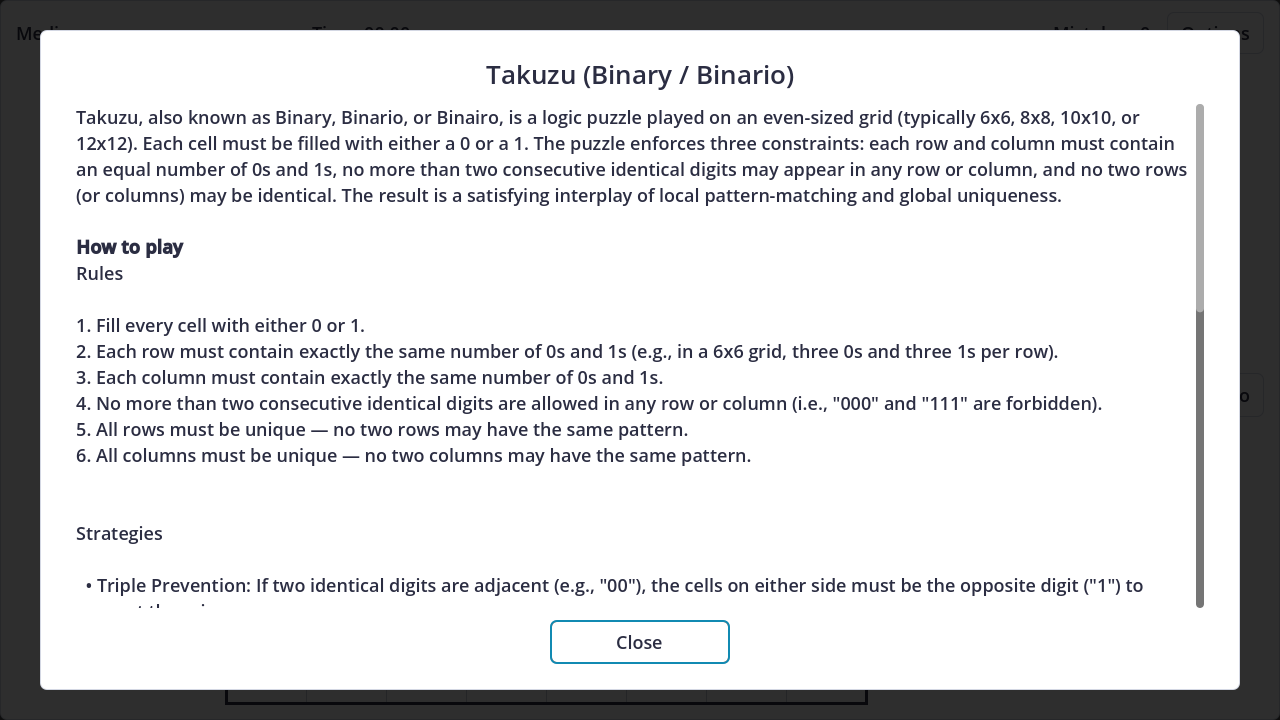
Pause covers the usual bench: Resume, Restart, New Game, How to Play, Difficulty, Settings and Statistics — seven options in the browser build; the installed app adds Quit. Note that the play bar itself carries no New game button: fresh deals live only in this menu. The help sheet keeps the six rules and a page of strategies at hand.
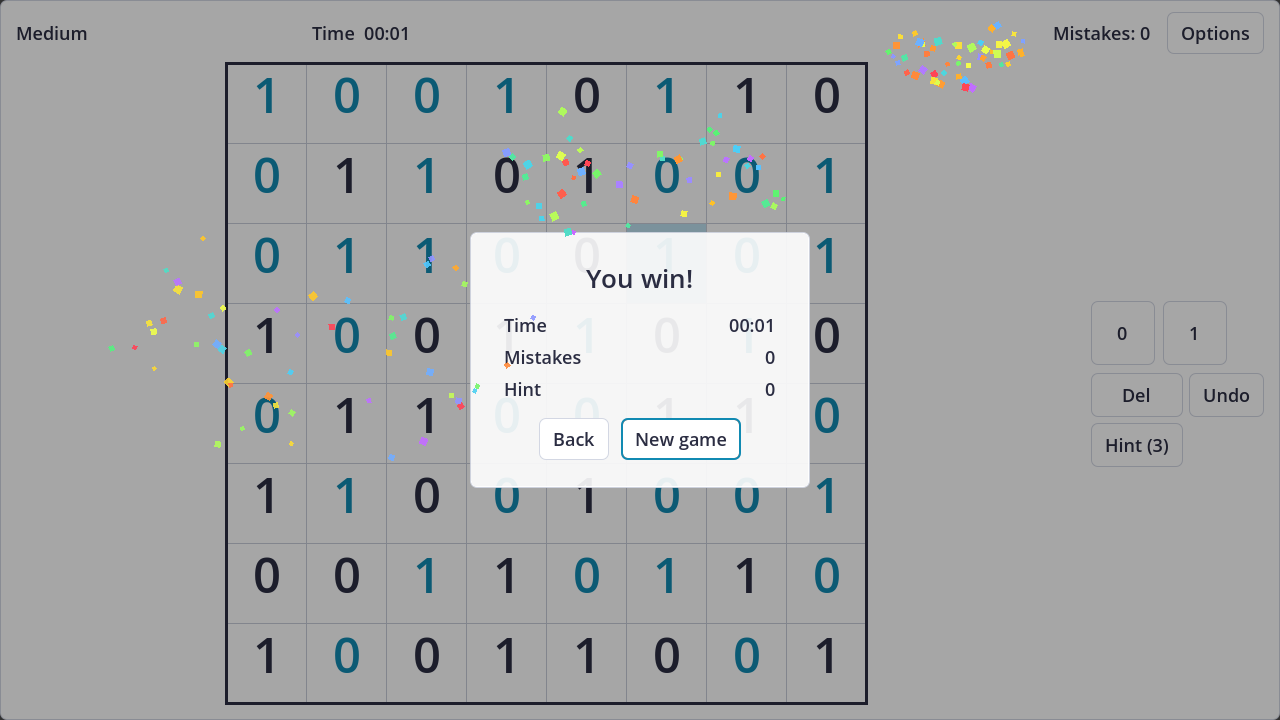
Complete the last cell in lawful order and the "You win!" panel drops with the time, mistakes and hints spent, confetti over a field that finally balances.
Strategy and tips
- Answer the pair. Two adjacent identical symbols are a sentence with one word left: the cells at either end must hold the opposite symbol, or a triple forms. Scan for 00 and 11 before doing anything else.
- Answer the gap. The same trick with one hole between two matching symbols: that gap can only take the opposite symbol, or the line ends up with three in a row.
- Count the half. Each line has room for exactly half of each symbol. Once a row of eight carries four 1s, every empty cell in it is a 0 — and symmetrically for the 0s. Near-full lines are free answers.
- Read each move twice. Rows and columns share cells; a symbol forced by a row's count can complete a column's triple or finish its half. The best moves are the ones that survive inspection from both directions.
- Compare lines against each other. Uniqueness has no red marker, so it is your job: when a line is almost full, hold it up against every line already finished. If all your filled positions match a completed twin, the last cells cannot copy it — flip at least one.
Controls
Takuzu offers three full ways in, and an on-screen keypad that never leaves the bar.
- Mouse and touch: tap a cell to select; press 0 or 1 to write (pressing the symbol already there erases it) or Del to clear. Undo, Hint and the pause menu share the same bar.
- Keyboard: arrow keys move the selection cell by cell; the 0 and 1 keys — top row or numpad, either works — write into the selected cell; Backspace or Delete clears it; Ctrl+Z undoes and Ctrl+Y (or Ctrl+Shift+Z) redoes, one entry at a time.
- Gamepad: the D-pad walks the grid cursor and A selects the cell under it. The 0, 1 and Del keys in the bar are ordinary buttons: focus reaches them with standard navigation and A presses them. Start opens and closes the pause menu, and B steps back — closing panels, and asking whether you want to quit once you're on the board.
- The keypad reflows with how you hold the device: two columns of square buttons in landscape, four of taller ones in portrait, always in the play bar with Undo and Hint.
- Restart replays the same puzzle with your entries wiped; New Game deals a different one — both from the pause menu, since the bar keeps no deal button.
Difficulties and sizes
Difficulty here moves two dials at once, never the rules. The grid grows from 6×6 at Easy through 8×8 at Medium and 10×10 at Hard to 12×12 at Expert, while the share of printed cells shrinks — about 55% at Easy, 45% at Medium, 38% at Hard, 32% at Expert. That is the whole of the slope: three hints at every level, no mistake ceiling at any of them, and the two symbols never change.
When the board confuses you
- The grid is full, every line balanced, nothing red — and it won't win. Two rows or two columns are almost certainly clones. That law has no colour on the board by design: compare lines one against another until you find the twin pair, then flip one cell.
- A printed digit won't change. It's a given, locked from the deal: taps select it, writes and erases bounce off.
- Pressing 1 erased a 1. The toggle, not a slip: writing the symbol a cell already shows clears it. Use Del for an unambiguous wipe.
- The Mistakes counter climbs though nothing looks wrong. It scores your entries against the pattern the puzzle was cut from, not against the rulebook — a legal-but-different move can still tick it. Nothing ever ends the run over it; play on.
- "No hints left" with an empty board. If you have already spent the three hints, the button is simply out of budget — no toast will ever fill another cell for you. The answer now is checking your lines for clones, not asking for help.
Where to play
Takuzu is free in the Tab and Blank catalog, in the browser, nothing to install: play Takuzu (Binary / Binario).