
What the game is
Akari — "light" in Japanese, Light Up to the puzzle world — is Nikoli's 2001 puzzle about illumination as logic. A square grid mixes open cells with black walls, and some walls wear a number. You place bulbs on open cells; each floods its row and column with light until a wall cuts the beam dead. The target is total brightness — every free cell lit — under one strict courtesy: no two bulbs may shine into each other's eyes. Numbered walls are the local tax: a wall marked 3 wants exactly three bulbs pressed against its sides.
What makes Akari different is that its reasoning runs along lines of sight: you watch corridors of light and ask who can see whom. The app's boards keep sightlines long — walls cover roughly a sixth of the grid and never touch each other edge to edge — and each puzzle is lit into existence first: a single generator pass drops a bulb on every cell still in the dark, guaranteeing a conflict-free reference solution. The win check grades the rules, not the reference: any final layout that lights everything cleanly wins.
How to play
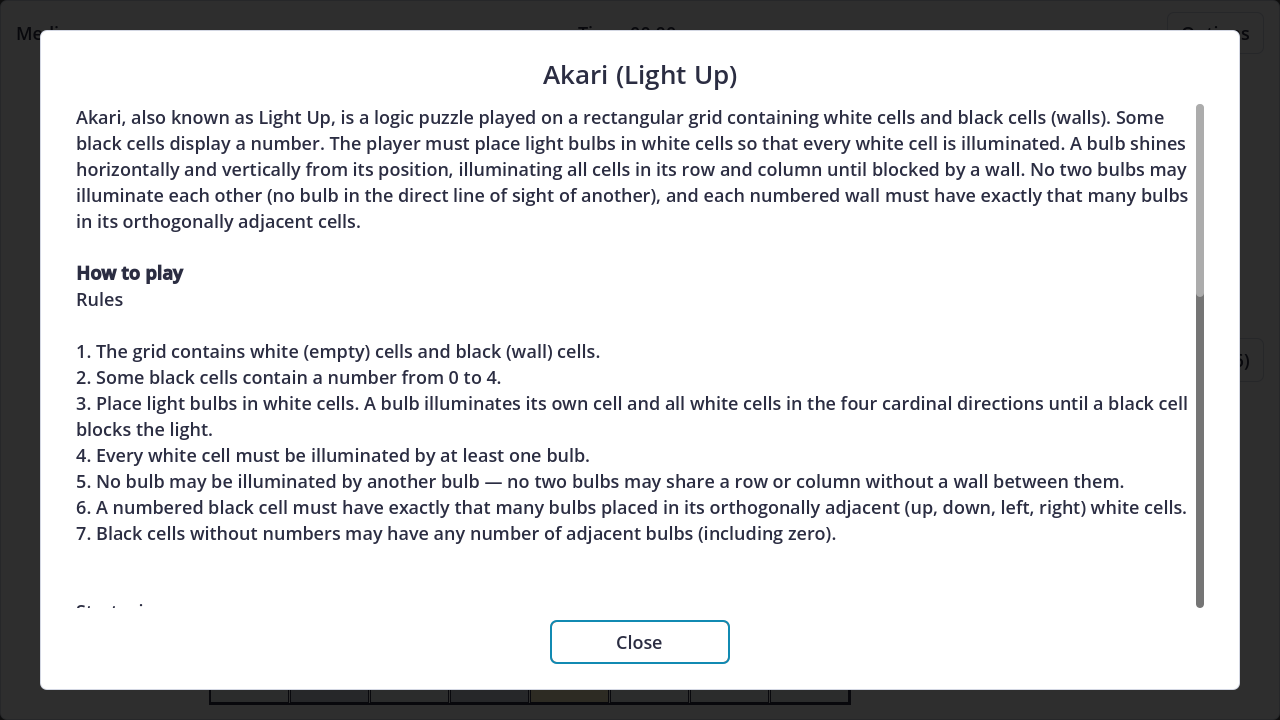
The rules, in the order the in-game help sheet numbers them:
- The grid contains free cells and black wall cells.
- Some walls carry a number from 0 to 4.
- A bulb sits on a free cell and lights its own cell plus every free cell in the four directions until a wall blocks the light.
- Every free cell must be illuminated by at least one bulb.
- No bulb may be lit by another — two bulbs sharing a row or column with no wall between are forbidden.
- A numbered wall must have exactly that many bulbs in its orthogonally adjacent cells.
- An unnumbered wall tolerates any number of adjacent bulbs, including zero.
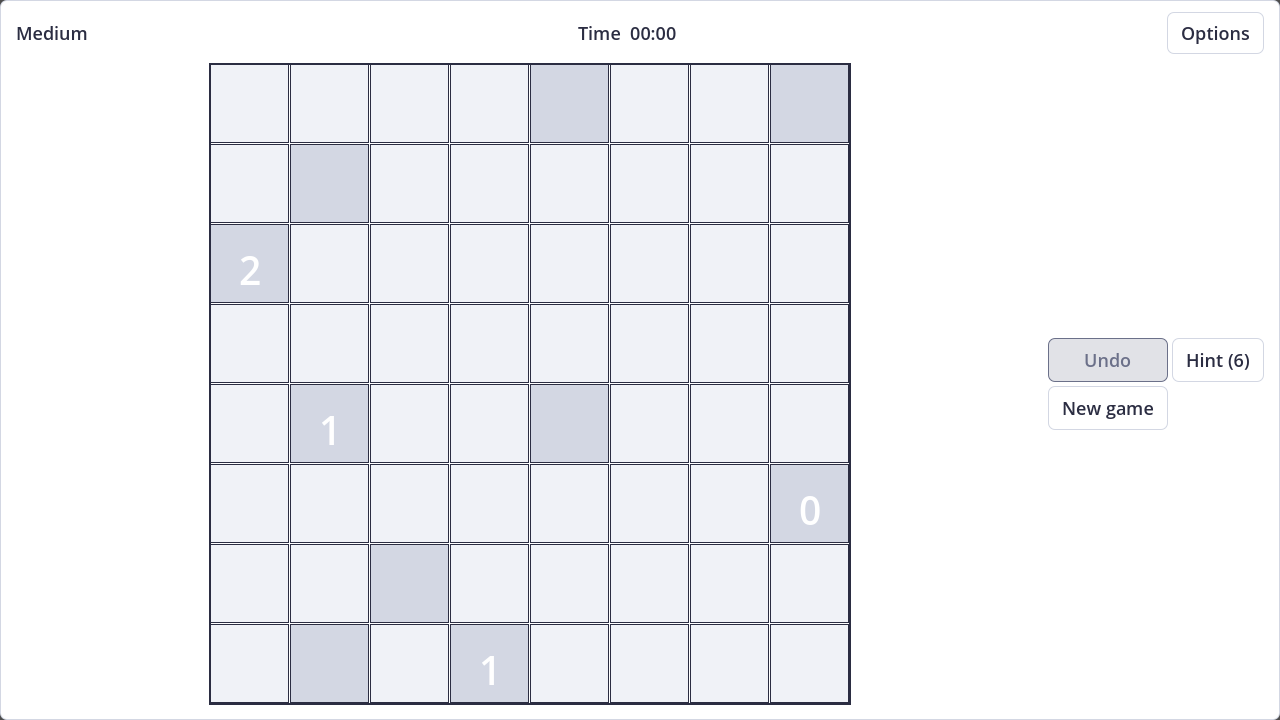
Step by step. Medium is an 8×8 grid — the HUD names the level; scattered gray walls, some of them numbered, everything else dark.
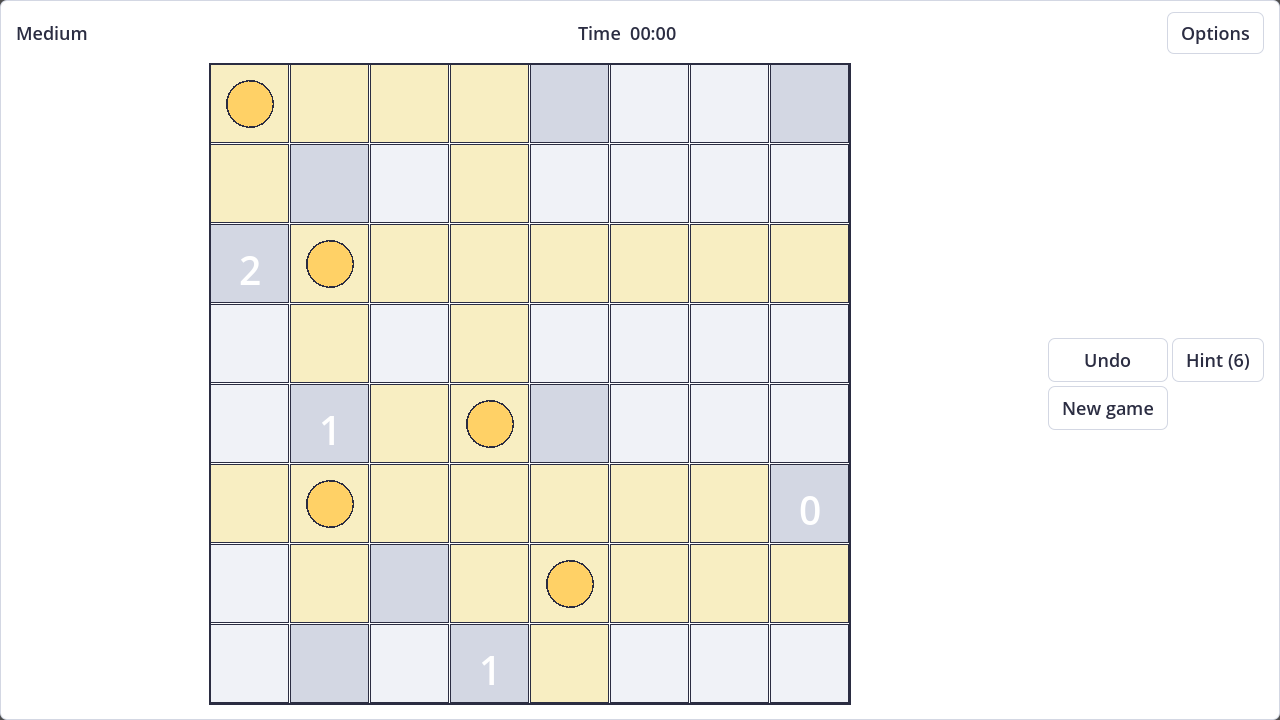
One tap, one bulb: touching a free cell lights it; touching the same cell again takes the bulb back out — the whole game is a toggle, and walls simply ignore your finger. A warm tint floods each bulb's row and column up to the first wall, so coverage and dark spots read at a glance. Conflicts flash red: bulbs that can see each other, walls overshooting their count. A wall with too few stays quiet — unfinished, not wrong. Six hints per game, each dropping a reference-solution bulb through the same toggle the player uses; every placement stays undoable.
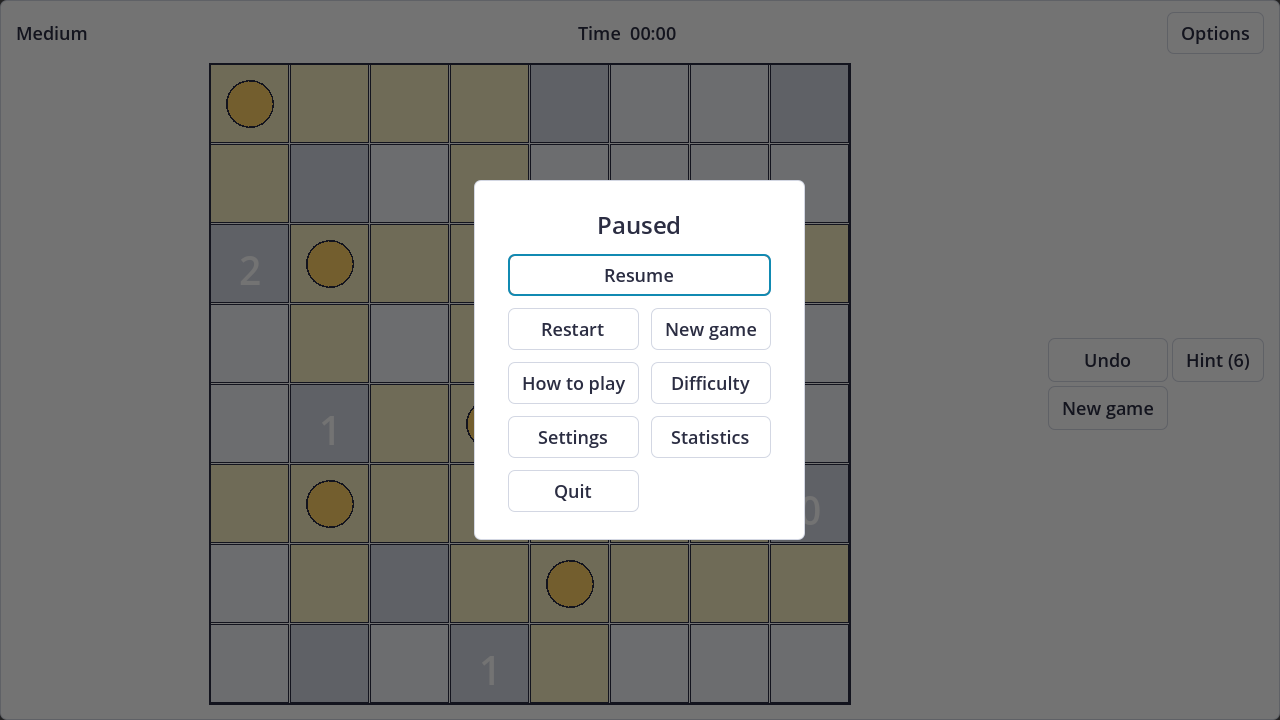
The pause menu is the same bench as everywhere else in the catalog — Resume, Restart, New Game, How to Play, Difficulty, Settings and Statistics, seven options in the browser build; the installed app adds Quit — and the help sheet holds the seven rules.
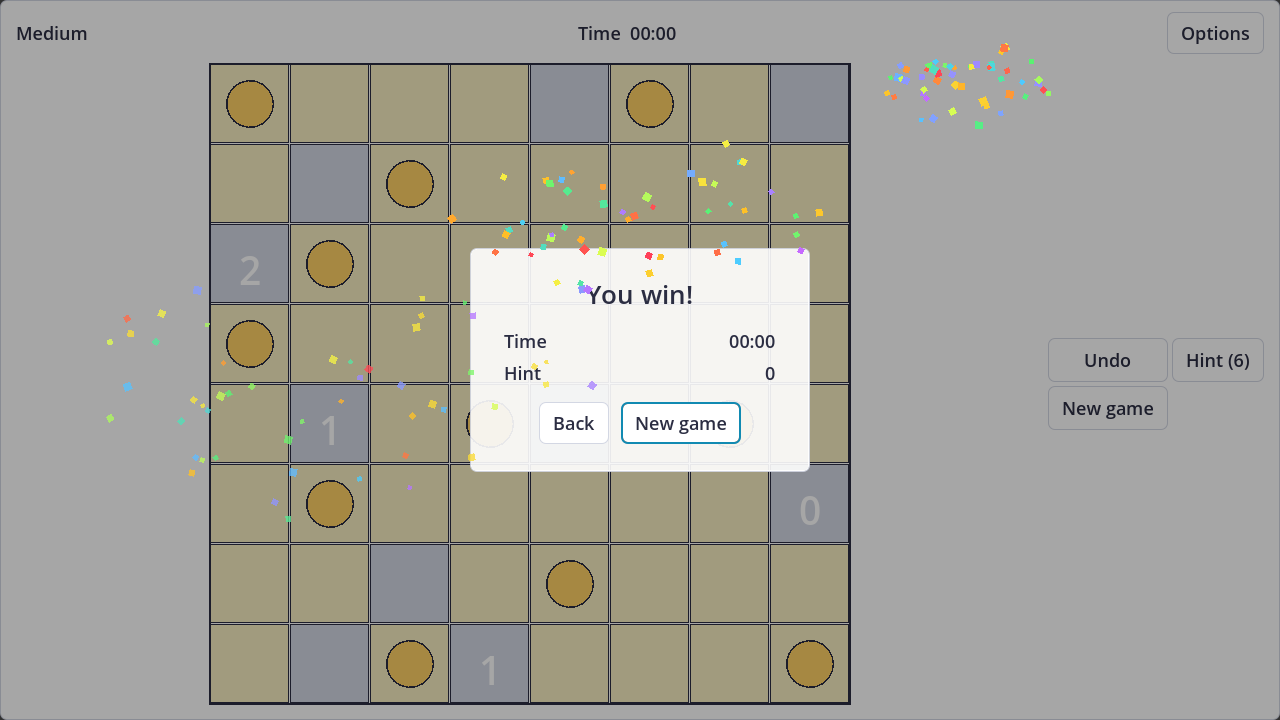
The win arrives when darkness stops existing: every free cell lit, no mutual glare, each numbered wall touched by exactly its count. The panel reports time and hints spent — ten bulbs were enough for this 8×8.
Strategy and tips
- Start with 0s and the fat numbers. A 0 wall poisons all its open neighbours; a 4 needs bulbs on all four sides, and a 3 in a corner has its answer forced. Free placements first.
- Finish half-done walls. A numbered wall seeing N−1 of its N bulbs with one legal neighbour left is decided — place or eliminate, immediately.
- Pair up look-alikes. Two open cells that see each other can hold at most one bulb between them; for a cell lit from only one corridor, mutual exclusion often leaves exactly one place for the bulb.
- Never orphan a shadow. Before committing a bulb, check what it still leaves unilluminatable — a cell no legal bulb can reach has lost you the board.
Controls
- Mouse and touch: tap a free cell to toggle its bulb; buttons for Undo, Hint, New Game and the pause menu.
- Gamepad: the D-pad walks the cursor cell to cell — walls are not navigable stops, it simply skips them — A toggles the highlighted free cell, Start opens and closes the pause menu, and B steps back: it closes menus and panels, and with the cursor already on the board it asks whether you want to quit.
- Keyboard: arrow keys move the same cursor and Enter performs the tap.
- Undo walks placements and removals back one at a time — hints included. Restart replays the same wall layout dark; New Game rolls a fresh one, and changing difficulty discards the run in progress.
Difficulties and variants
Akari scales the grid, never the rules: Easy is 7×7, Medium 8×8, Hard 9×9 and Expert 10×10, with the same six hints at every level. Bigger boards mean longer corridors to audit; the deduction stays the same, the bookkeeping stretches. About half the walls carry numbers, and a clue never exceeds the four sides a wall can face.
Where to play
Akari is free in the Tab and Blank catalog, in the browser, nothing to install: play Akari.
If counting neighbours against numbered squares was your medicine, the same logic shelf keeps Creek — its intersections tally shaded neighbours the way Akari's walls tally bulbs.