
What the game is
Hashiwokakero is Nikoli's bridge-building puzzle — the Japanese name means "build bridges"; players call it Hashi or Bridges. A grid holds a scatter of numbered circles, the islands. Your tool is the straight line: bridges run horizontally or vertically, and each island must be touched by exactly as many of them as the number stamped on it. That is the local rule. The global one is what makes the game bite: every island has to belong to a single connected network, so a board can satisfy every number and still lose.
The app builds boards the safe way round — islands are placed one at a time, each wired into the network already on the water, and the clues are read off that construction. Every puzzle you are dealt therefore hides a real, complete solution; you are untangling it, not testing whether the generator was kind. The grid stays 9×9 at every level; difficulty changes how many islands float on it.
How to play
The rules, in the order the in-game help sheet numbers them:
- The board holds islands — circles marked with a number from 1 to 8; that number is the bridges the island needs.
- A bridge is a straight horizontal or vertical line joining two islands that share a row or column with no other island between them.
- Bridges cannot cross each other, and none may pass through a third island.
- Any pair of islands can carry at most two bridges.
- Each island's bridges must total exactly its number — a double bridge counts as two.
- All islands must form one connected group: you can sail from any island to any other over bridges.
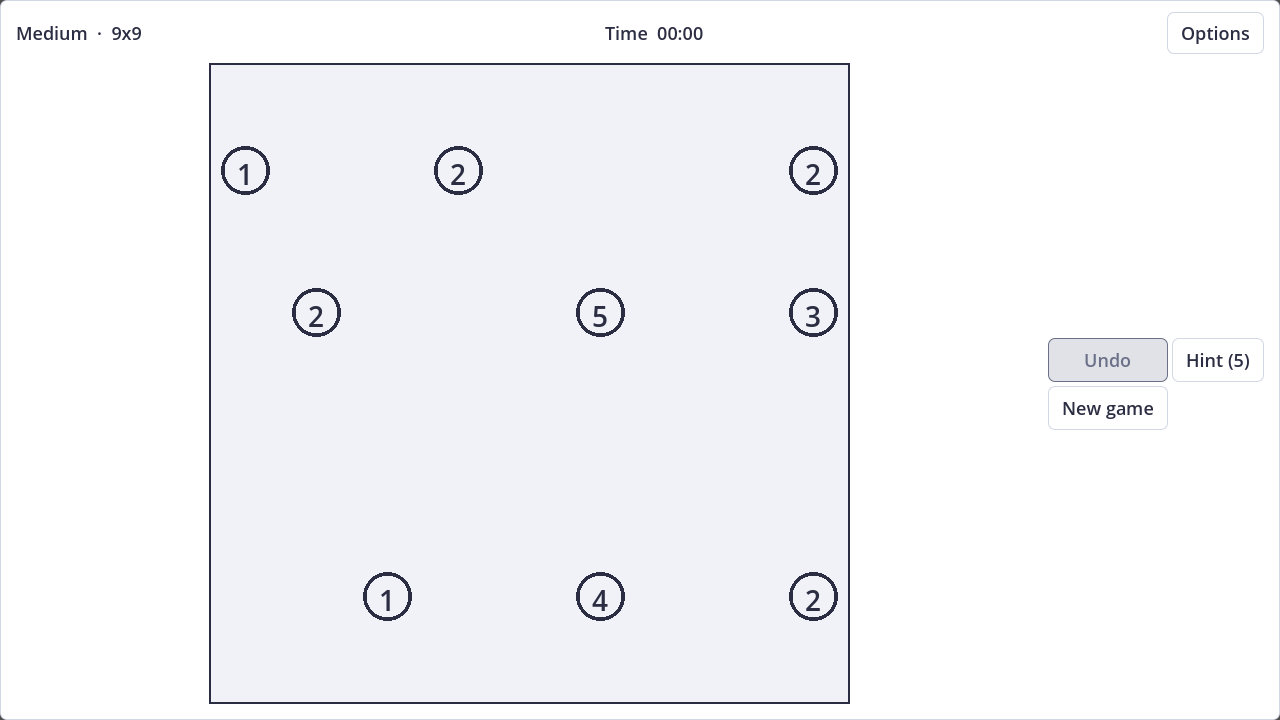
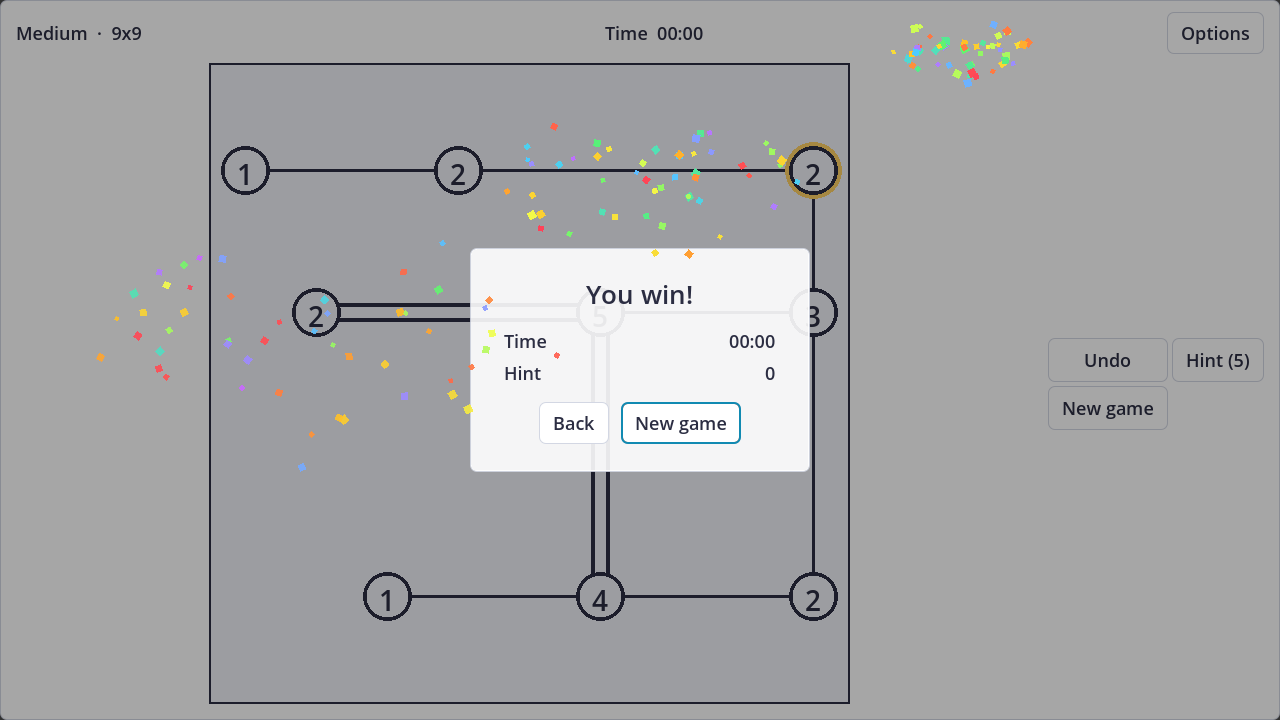
Step by step. Medium deals nine numbered islands onto the 9×9 grid, no bridges drawn; the HUD prints level and board size together.
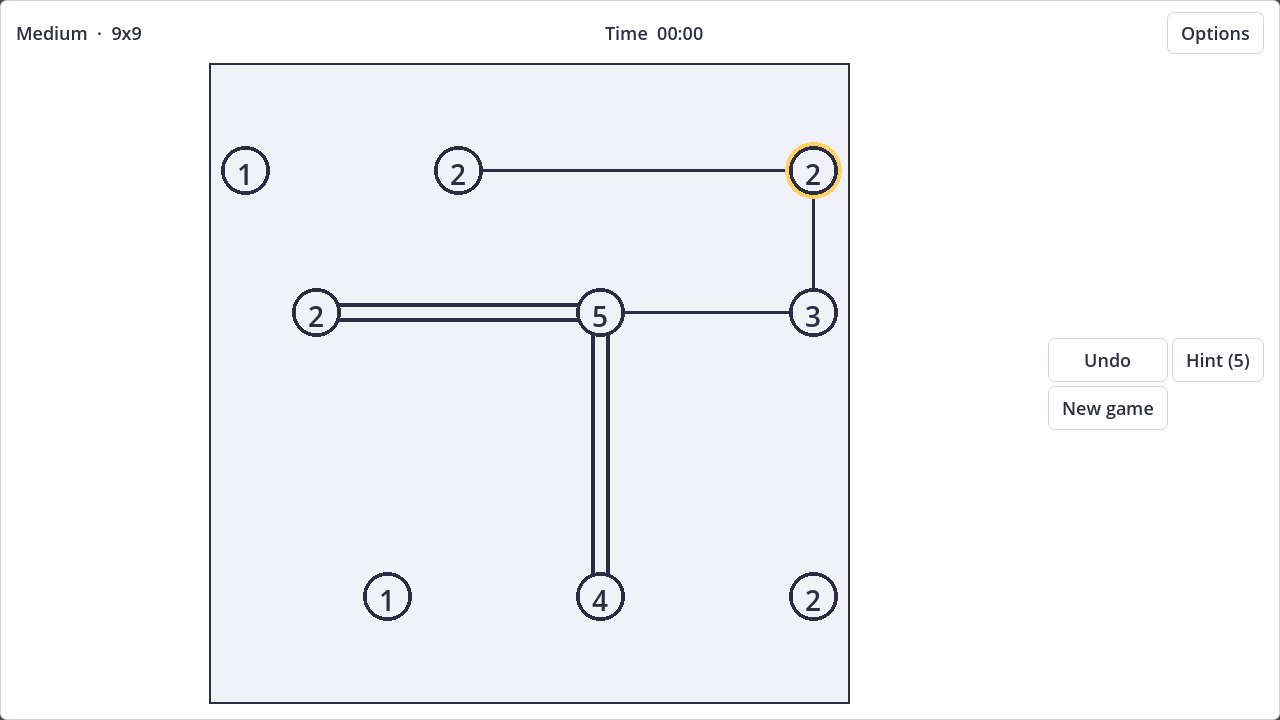
Bridging is a two-tap gesture. Tap an island and it takes an amber selection ring; tap a second island in line and clear of it, and a single bridge snaps out. Tap the same pair again and the second line appears beside the first — and one more tap clears the pair entirely, because the gesture cycles zero, one, two, back to zero. Illegal proposals refuse: a line that would cross an existing bridge or reach across another island is rejected with a short error sound, and an island pushed over its number turns its digit red until you take one back. Five hints per game, each decisive: a hint grabs a pair from the hidden solution and places that pair's full bridge count in one move.
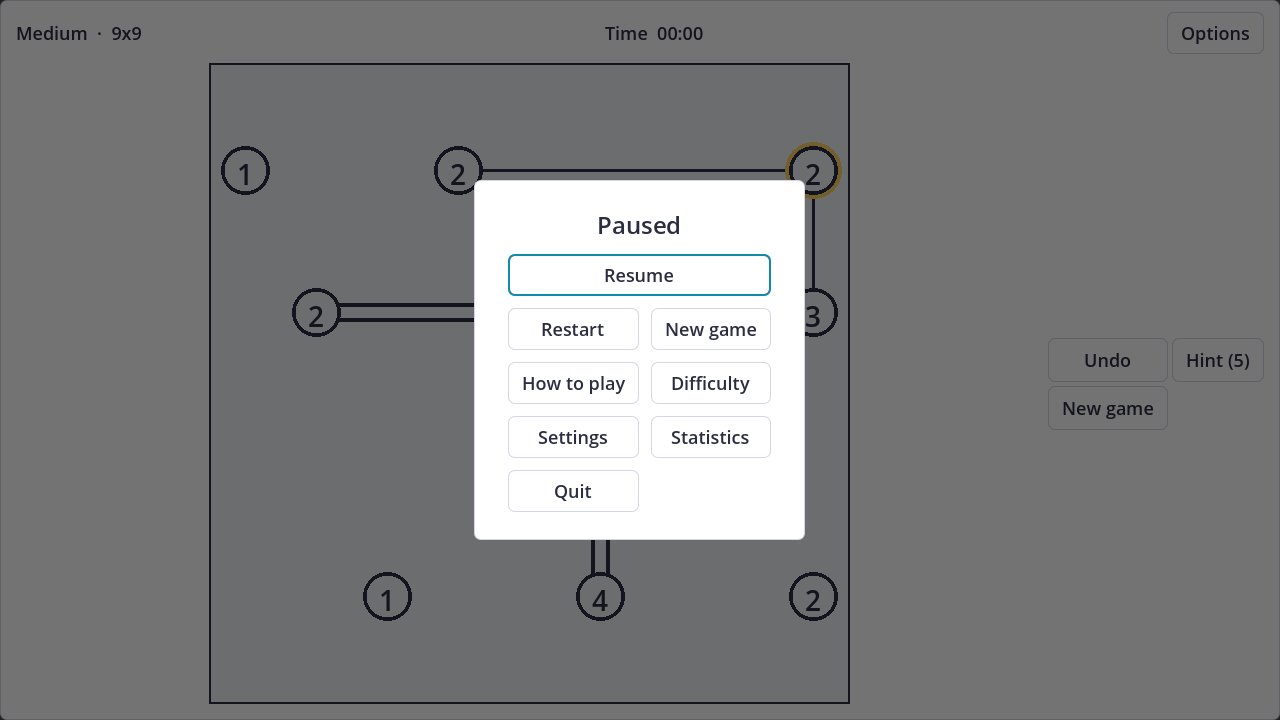
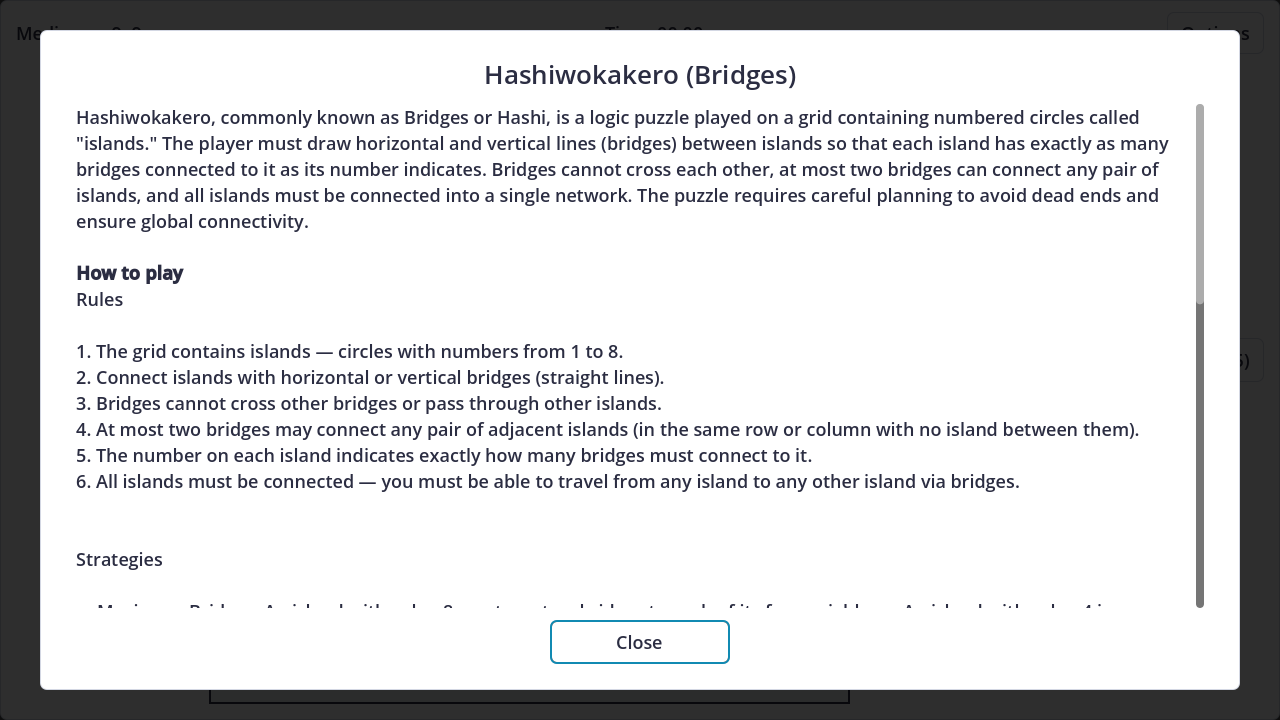
The pause menu is the standard workbench: Resume, Restart, New Game, How to Play, Difficulty, Settings and Statistics — seven options in the browser build; the installed app adds Quit. The help sheet repeats the six rules on screen.
The win lands with the last bridge: once every island totals its number, nothing crosses, no pair exceeds two, and the archipelago is one network, the victory panel opens with your time and the hints you spent.
Strategy and tips
- Force the doubles. If an island's number equals twice its reachable neighbours, every connection there is doubled — a 4 facing two neighbours, or the classic 8 in open water, settles on sight.
- Sevens reach everyone. An island needing one more bridge than doubling allows must touch every visible neighbour at least once.
- Mind parity. An odd remaining count with only two candidates cannot split into evens — at least one single goes to each side.
- Never strand a group. Connectivity is a rule, not a bonus: ask whether any island now floats alone.
- Finish near-complete islands. One bridge missing with one legal neighbour left is free placement.
Controls
- Mouse and touch: tap an island, tap its partner; repeat on the pair to double or clear. Buttons for Undo, Hint, New Game and the pause menu.
- Gamepad: the D-pad hops a cursor between islands only — open water is skipped — A taps the highlighted island (select, bridge, double, clear), Start opens and closes the pause menu, and B steps back: it closes menus and panels, and with the cursor already on the board it asks whether you want to quit.
- Keyboard: arrow keys move the same cursor and Enter performs the tap.
- Every bridge change goes through the undo history, hint placements included.
Difficulties and variants
The grid never resizes; the traffic does. Easy floats 6 islands, Medium 9, Hard 12 and Expert 15 on the same 9×9 board, and all levels share the same five hints. More islands means more numbers to balance; the rulebook stays six lines long. Choosing a new difficulty discards the run in progress and deals fresh; Restart replays the same layout with your bridges wiped, and New Game rolls a different one.
Where to play
Hashiwokakero is free in the Tab and Blank catalog, in the browser, nothing to install: play Hashiwokakero.
If linking islands by feel of the network hooked you, the logic shelf next door keeps Masyu — Nikoli's other draw-lines classic on this site.