
What the game is
Kakuro is a crossword that adds up. It was born in the United States, published by Dell Magazines in 1966 as Cross Sums; Japan redrew it in the 1980s under Nikoli's Maki Kaji, and the name itself contracts "kasan kurosu" — addition cross. The 2005 sudoku boom carried it into Western newspapers, The Guardian among the first to run it. Black cells sit inside a white field just like a printed crossword, but the clues are not definitions — they are sums: every run of white cells carries a target, its digits must hit it exactly, and no digit may repeat within the run.
The app ships its crosswords rather than dealing them: each difficulty owns two fixed layouts, and a dice roll picks one. Every clue is read off a baked solution, so the sums on the black cells always have at least one working answer. The win check grades the rules, not that reference — any fill that completes every run without repeats and hits every sum wins the board. Runs are always at least two cells long, so no lone box hides a private sum.
How to play
The rules, in the order the in-game help sheet numbers them:
- Fill the white cells with digits from 1 through 9.
- Black cells hold the clues: a number in the upper-right triangle is the sum for the run to its right; a number in the lower-left triangle is the sum for the run below.
- Every consecutive horizontal or vertical run of white cells must add up to its clue.
- No digit may repeat within a single run.
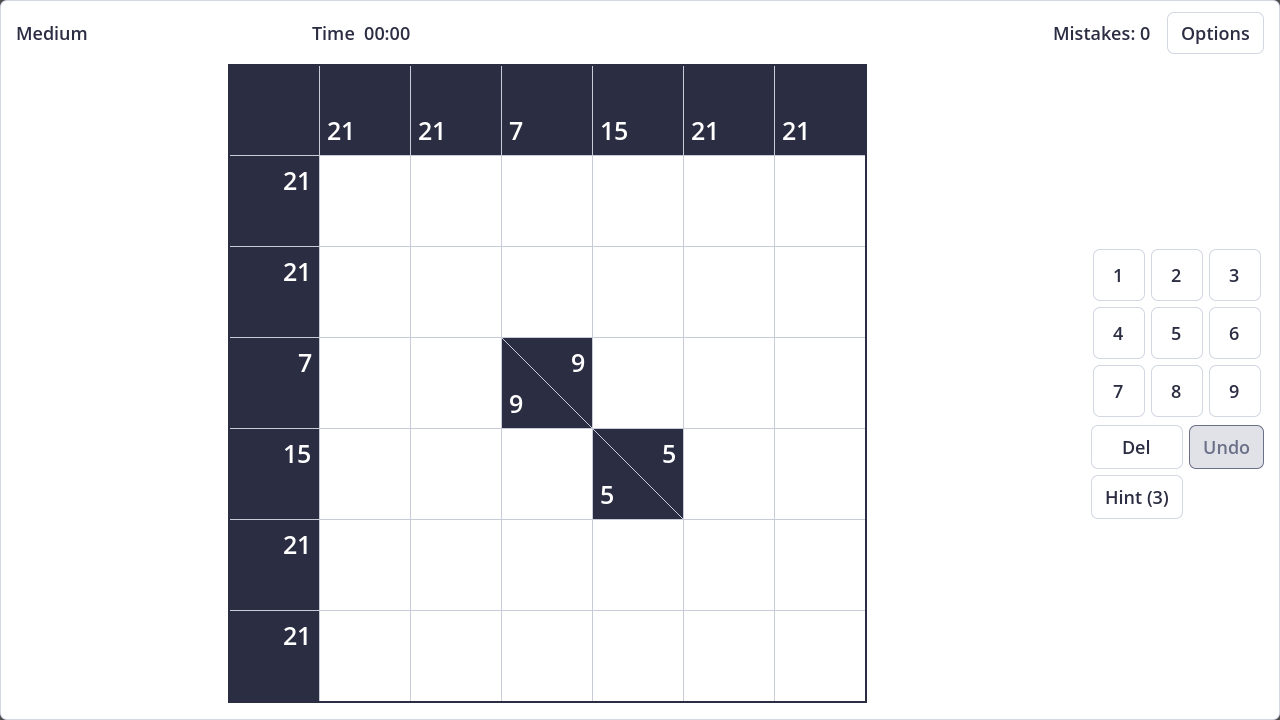
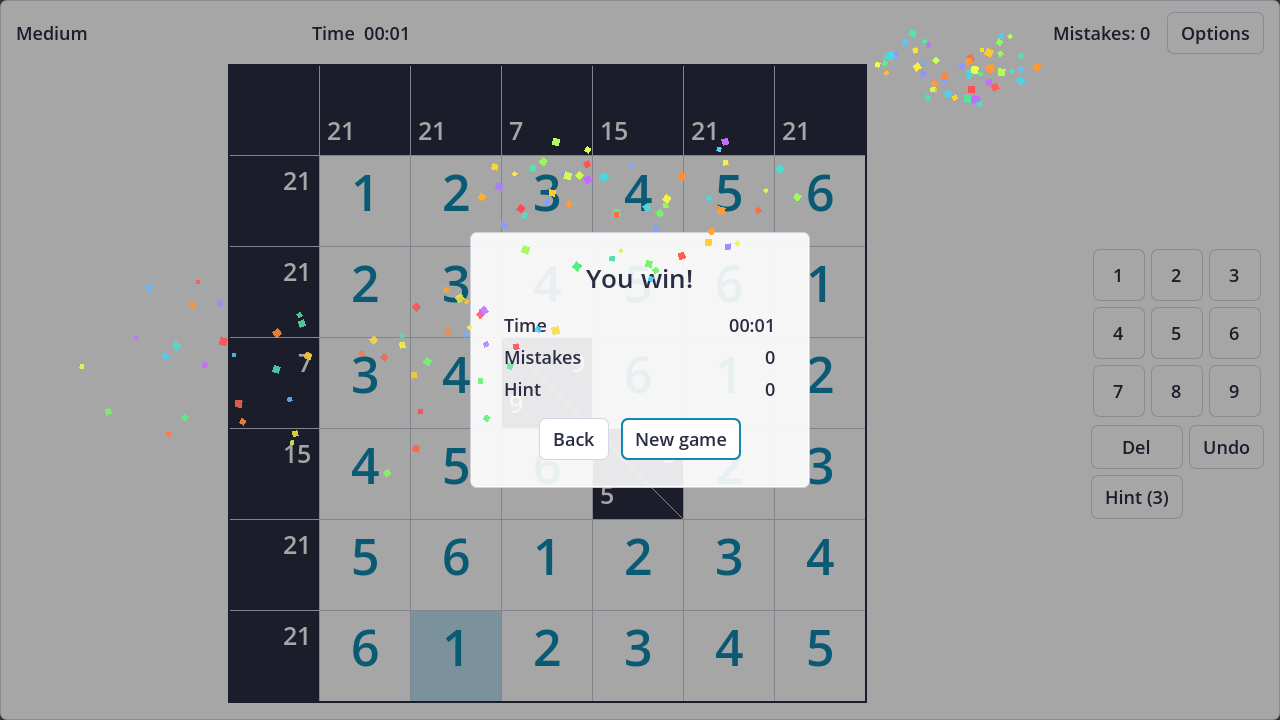
Step by step. Medium draws one of two layouts — a 7×7 or an 8×8; the HUD names the level and keeps a running Mistakes counter, never the size. Tap a white cell and it lights amber; press a digit on the numpad or type it on the keyboard. Entering the same digit twice empties the cell, and the "Del" (erase) button does it in one press. Digits turn red where the rules break: a repeat inside one run, or a run completed to the wrong total. A digit that differs from the board's own reference ticks the Mistakes counter — it judges, never condemns: no mistake limit, no game over from arithmetic.
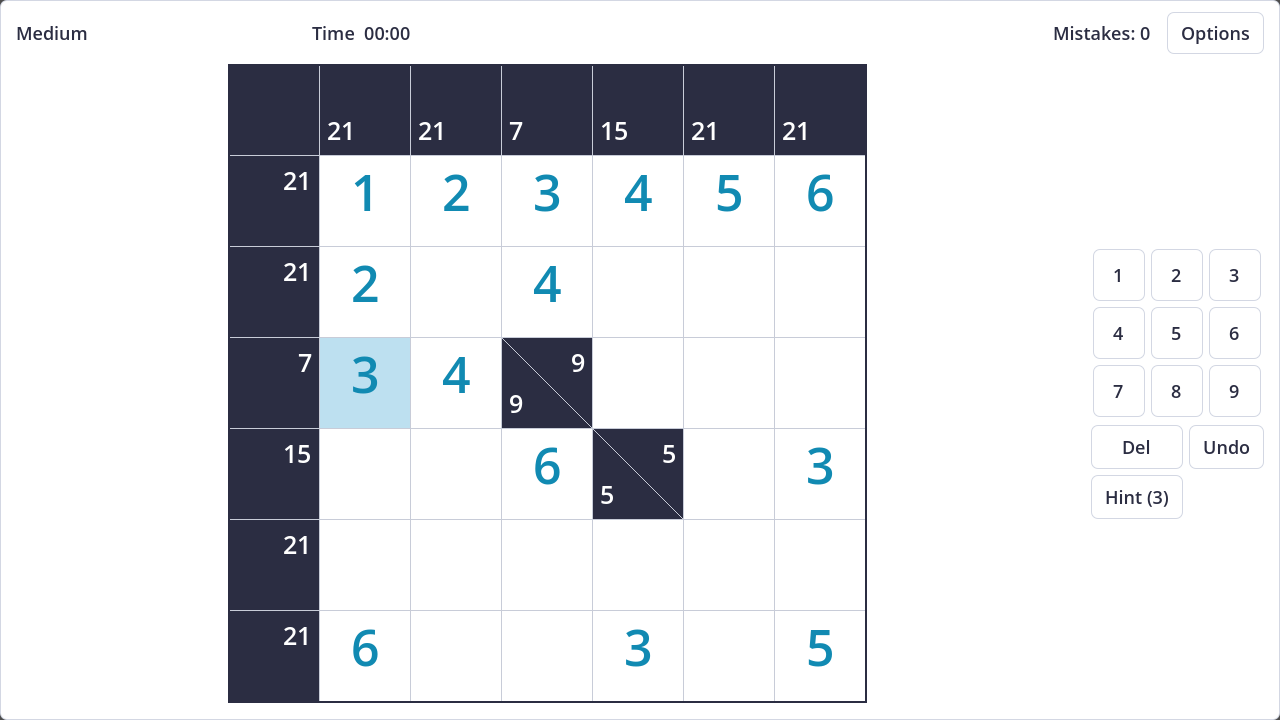
Three hints per game, each filling an empty cell — or righting a wrong digit — with the value the sums were built from, leaving the touched cell selected so you can watch its effect on both sums. Undo — and redo from the keyboard — cover every placement.
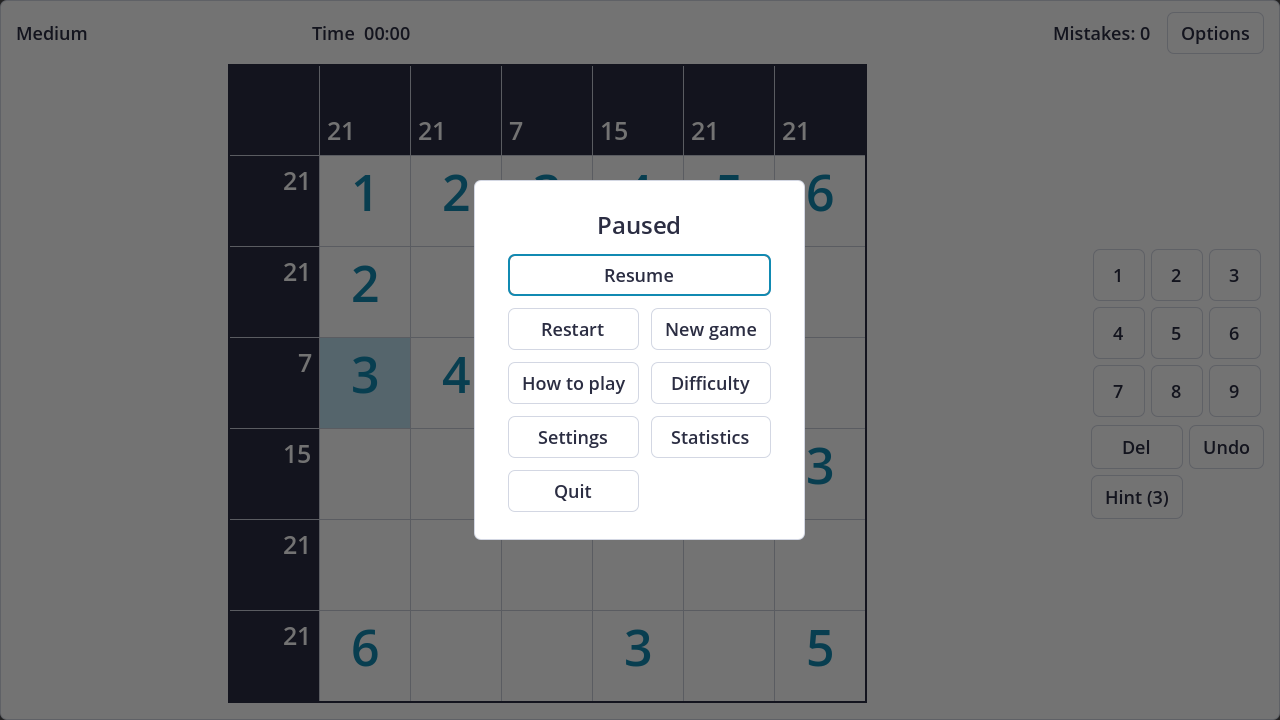
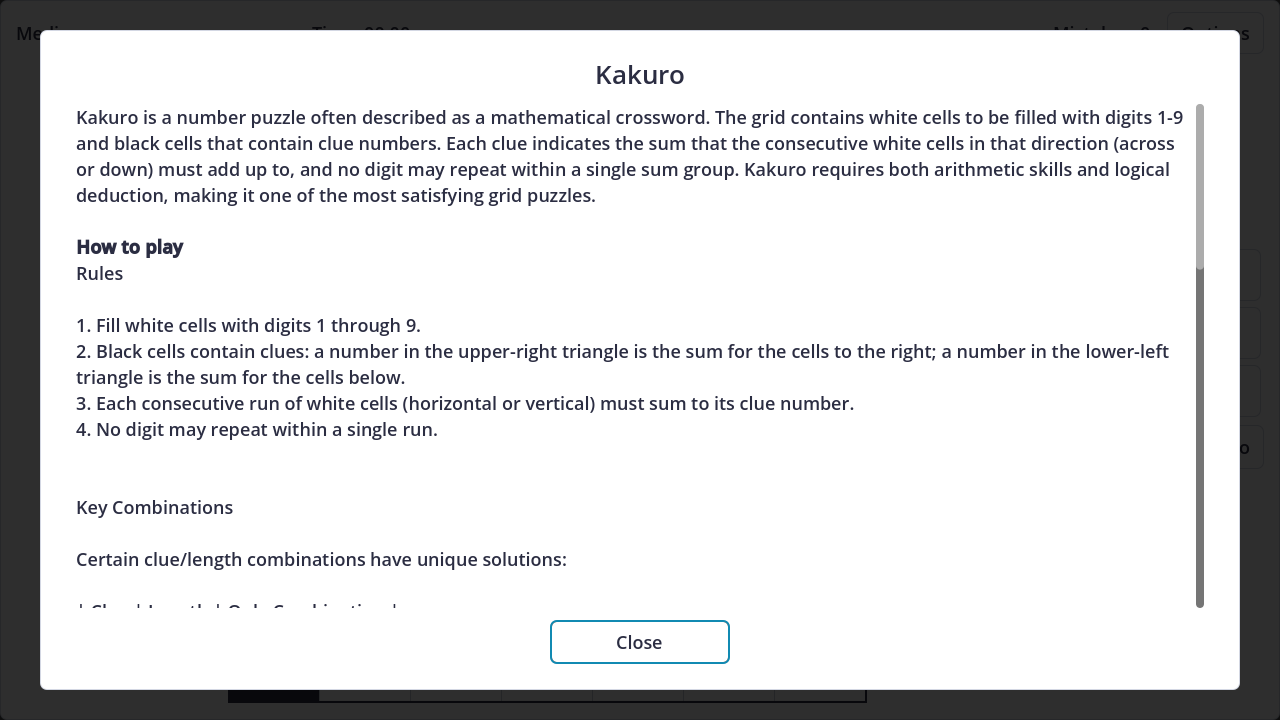
Pause covers the usual bench: Resume, Restart, New Game, How to Play, Difficulty, Settings and Statistics — seven options in the browser build; the installed app adds Quit. The help sheet keeps the four rules and the table of key combinations at hand.
Close the last crossing and the win check seals the board on the spot: time, mistakes, hints — and confetti over a crossword that finally adds up.
Strategy and tips
- Bank the forced combinations. Some clue-and-length pairs have exactly one answer: 3 over two cells is 1+2, 17 over two is 8+9, 24 over three is 7+8+9. The in-game sheet carries the full table — start where the clue has no choice.
- Read a run's extremes. A four-cell run sums no lower than 1+2+3+4=10 and no higher than 6+7+8+9=30; a clue near either end squeezes the possible digit sets to almost nothing.
- Work the crossings. Every cell lives in two runs — across and down. A digit plausible for one sum can be impossible for the other; intersections are where boards unlock.
- Spend each digit once. A digit placed in a run is dead weight for that run; use it to eliminate candidates in every crossing run.
Controls
- Mouse and touch: tap a white cell to select, tap the numpad for a digit 1-9; buttons for Del, Undo, Hint and the pause menu.
- Gamepad: the D-pad walks a cursor across the grid and A selects the highlighted cell — exactly like a finger; the numpad is a grid of ordinary focusable buttons, reached with standard focus navigation and pressed with A. Start opens and closes the pause menu, and B steps back: it closes menus and panels, and with the cursor already on the board it asks whether you want to quit.
- Keyboard: arrow keys hop the selection between white cells, skipping the black ones; typing 1-9 enters a digit; Backspace, Delete or 0 clears it; Ctrl+Z undoes and Ctrl+Y redoes, one digit at a time.
- Restart replays the same crossword emptied; New Game re-rolls between the two layouts the level owns, and changing difficulty discards the run in progress.
Difficulties and variants
There is no board generator here, so difficulty means layout pair: Easy deals a 5×5 or 6×6, Medium a 7×7 or 8×8, Hard either of two 9×9s, Expert either of two 10×10s. Runs grow from four or five cells at Easy to nine at Expert, and the sums swell with them. Three hints at every level; the rules never vary, and the digits stay 1 through 9.
Where to play
Kakuro is free in the Tab and Blank catalog, in the browser, nothing to install: play Kakuro.
If you want more digit logic, the catalog also keeps Sudoku on its plain 9×9 grid.