
What the game is
The Knight's Tour is a chess knight let loose to cover a board without treading on the same square twice. One piece, one kind of move — the L-shaped jump of chess, two squares along and one across — and one relentless goal: visit every square exactly once. It is one of the oldest problems in recreational mathematics; in graph-theory terms, a Hamiltonian path over the knight's network of jumps.
The app version keeps it clean. The knight starts parked in a corner, already stamped as square number 1, and the squares it could legally jump to glow with rings. Tap one and the piece glides over, the destination takes the next number, and the rings redraw for the new position. Fill every square with a number and the tour is complete. Note what is not demanded: the final square need not reach back to the first — the app accepts an open tour; the looping closed tour stays a bonus you can set yourself.
How to play
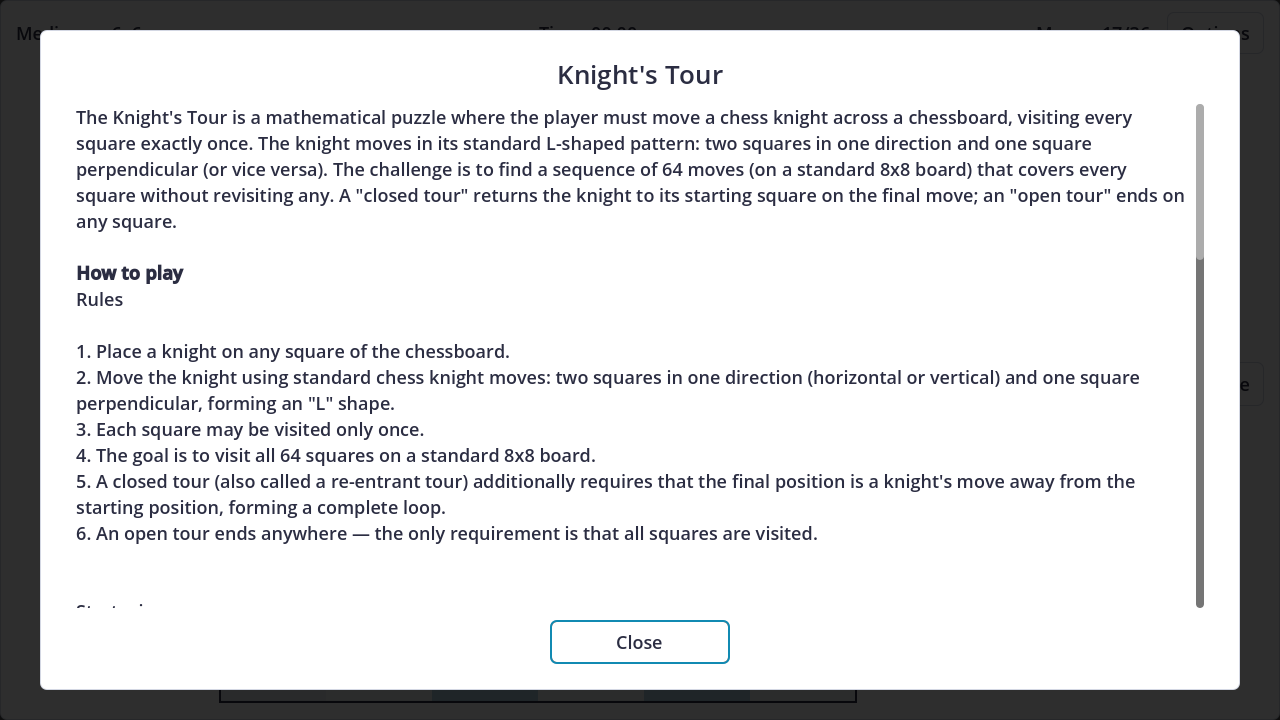
The rules, in the numbered order the help sheet lays them out:
- A knight starts on the board — in a corner here, counted as visited.
- Each move is a standard knight jump: two squares in one direction and one perpendicular.
- No square may be visited twice.
- The goal is to visit every square on the board.
- An open tour ends anywhere; a closed tour additionally lands a knight's jump from the start.
- Run out of unvisited landings and the run ends — the game says so rather than leave you stranded in silence.
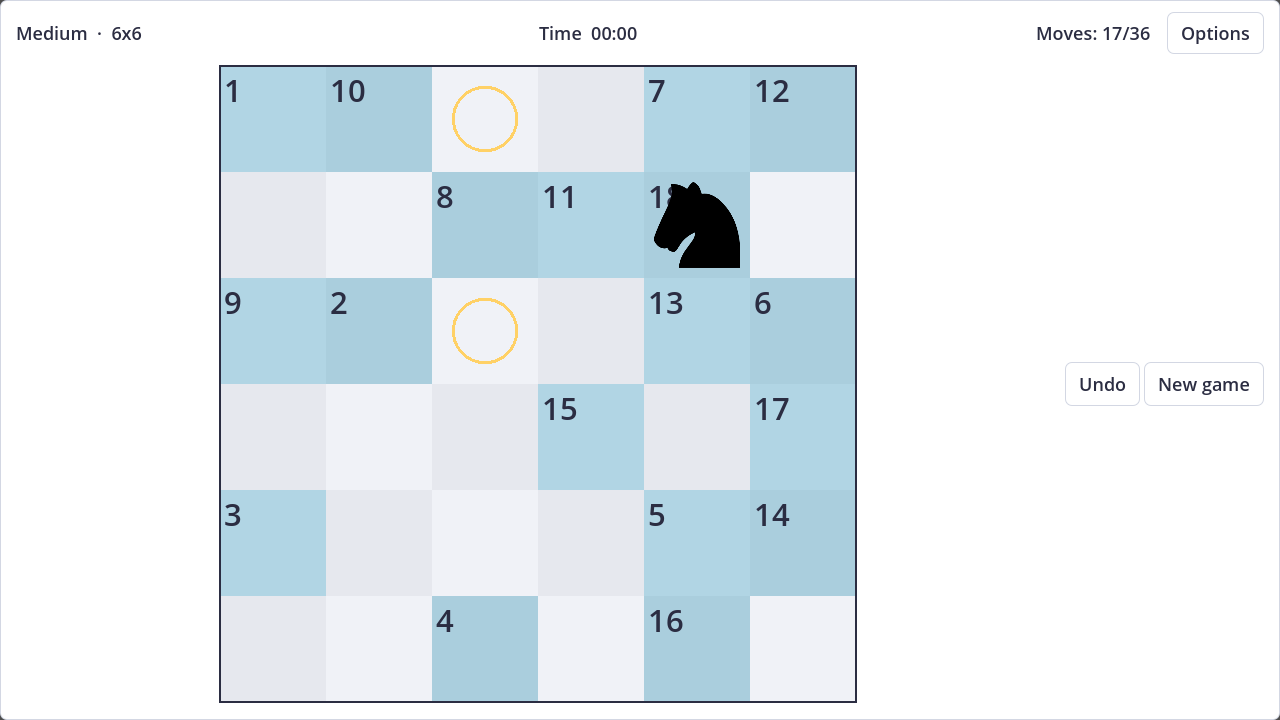
Step by step. Medium is a 6×6 board: 36 squares to number, so 35 successful jumps from the corner start. The HUD shows level and size together and a visit counter, and visited squares keep a tint plus their order, so the tour's shape stays readable at a glance.
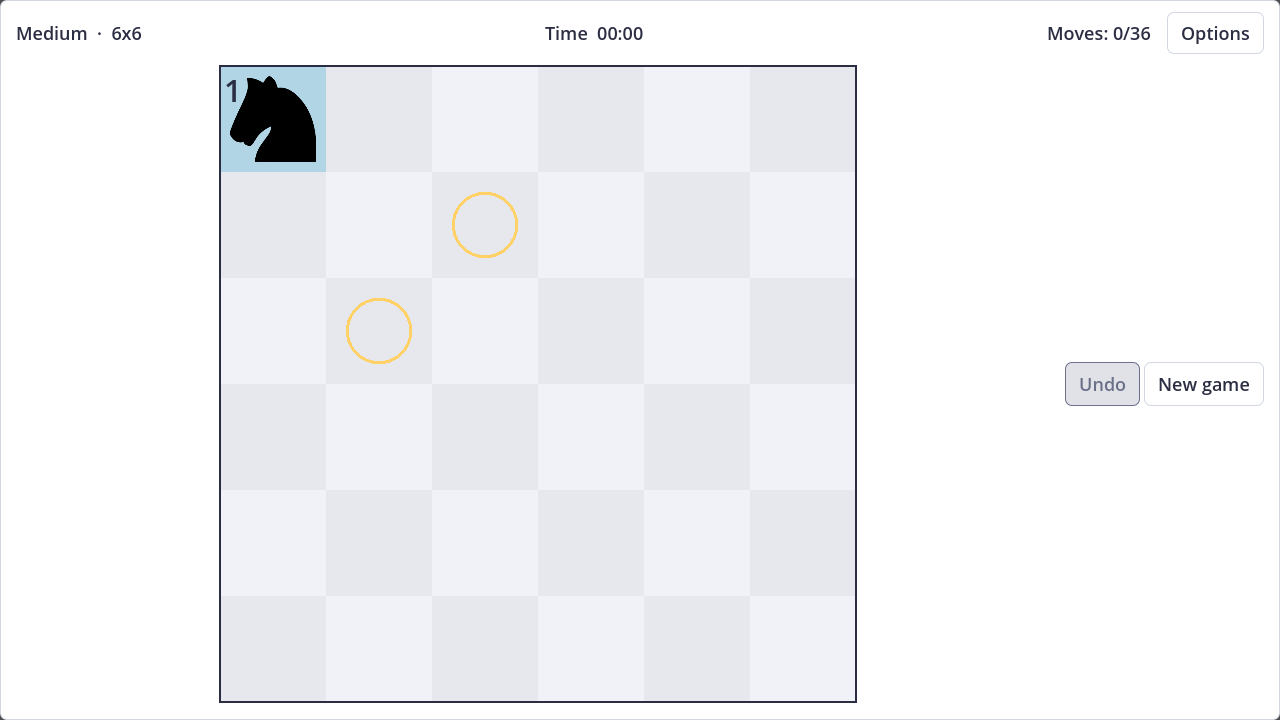
Early on, constrained squares choose you: a corner knight on a 6×6 has exactly two jumps, so the opening moves feel forced. Mid-tour, the numbered trail snakes across the board and the rings shrink as options die — every square you skip now costs freedom later.
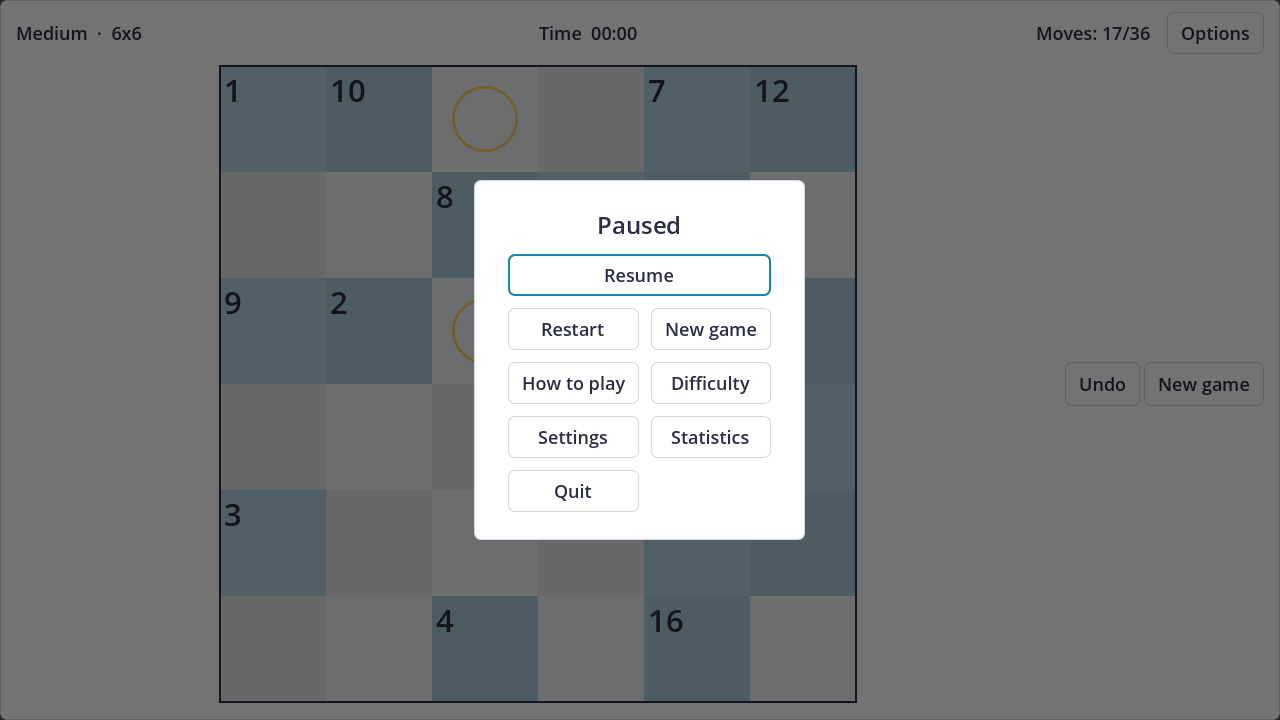
Pause whenever: Resume, Restart, New Game, How to Play, Difficulty, Settings and Statistics — seven options in the browser build; the installed app adds Quit. The help sheet holds the rules, including the open-versus-closed distinction.
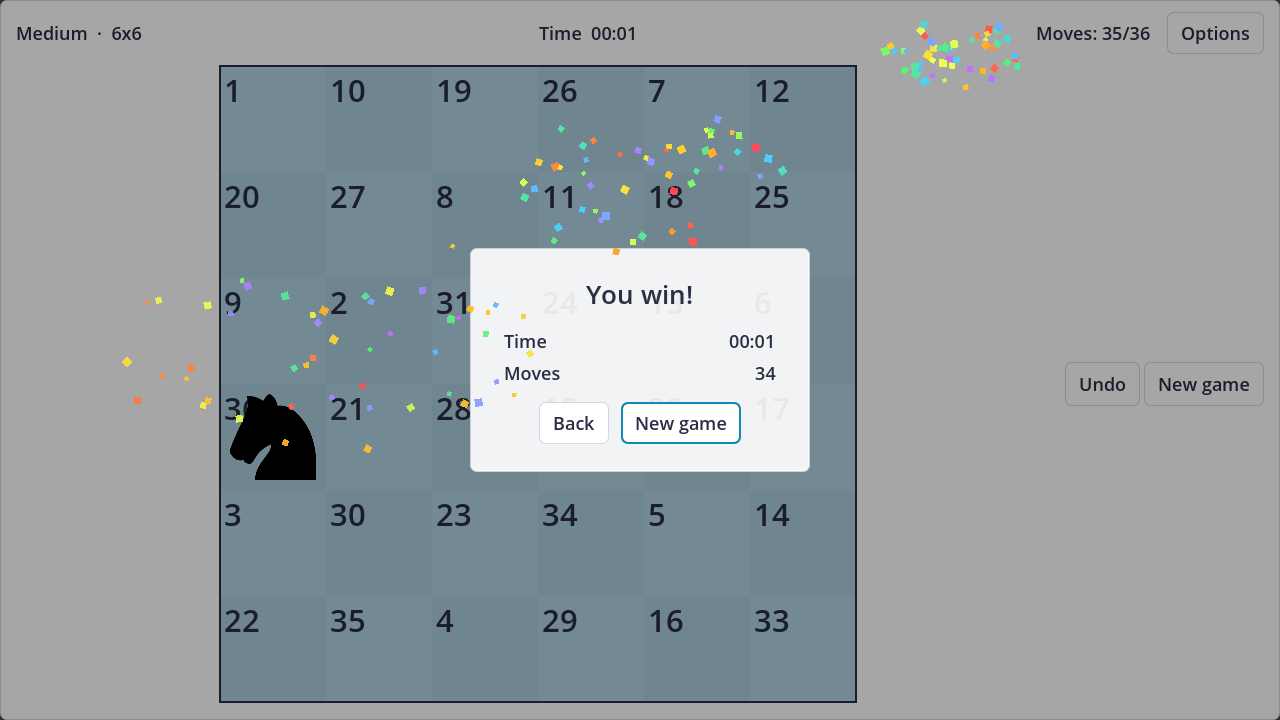
Number the 36th square and the win panel arrives, knight standing on the last cell, time and moves listed, confetti falling over the full tour.
Strategy and tips
- Warnsdorff's rule is the engine of this puzzle. Among your legal jumps, land on the square that leaves the fewest onward moves for itself. Counting exits sounds fussy, but this two-century-old greedy trick completes tours on most boards without ever backtracking.
- Handle tight corners early. Corners admit only two knight paths; edges few more. Squares like these get impossible if postponed, while the centre — up to eight jumps — will wait for you. Visit the constrained ground first and keep central squares as bridges.
- Think in quadrants. Let the tour chew one region at a time, but never cut a corner off completely — an unreachable pocket is a dead run.
- Backtrack without shame. When landings run out with squares unvisited, Undo peels the last visit away and lets you re-branch. Systematic backtracking finds a tour whenever one exists.
- Want a harder crown? Finish an open tour, then try to end one knight's jump from square 1 — a closed tour. A standard 8×8 board holds roughly 26.5 trillion distinct closed tours, so the trophy class is never empty.
Controls
- Mouse and touch: tap one of the ringed squares to jump there; taps on illegal squares simply do nothing. Buttons for Undo, New Game and the pause menu.
- Gamepad: the D-pad walks a cursor over the board, A taps the highlighted square — a jump or a pass, exactly like a finger — Start opens and closes the pause menu, and B steps back, asking whether to quit when focus is already on the board.
- Keyboard: arrow keys move the same cursor and Enter performs the tap.
- Knight's Tour has no hint system at all: no button, no counter — the rings of legal jumps are the only advice you get, and Undo is the eraser.
Difficulties and variants
Difficulty here means board size and nothing else: Easy 5×5, Medium 6×6, Hard 7×7, Expert 8×8 — Expert being the standard chessboard, 64 cells. The rules never change between them; only the depth of planning the extra squares demand. Changing difficulty discards the run in progress and deals a fresh board; Restart replays the same one; New Game starts a new attempt.
The problem itself predates every strategy guide: a Sanskrit poet, Rudrata, described a knight's path around 840 CE as a verse form; Euler brought a systematic construction to the Berlin Academy in 1759; and Warnsdorff published his exit-counting rule in 1823. Playing a tour is shaking hands with that timeline.
Where to play
Knight's Tour is free in the Tab and Blank catalog, in the browser, nothing to install: play Knight's Tour.
The same other-puzzles shelf keeps River Crossing — another walk through a graph you cannot afford to break.