
What the game is
Masyu is the loop-with-pearls puzzle, invented at Nikoli and first published in 1999 under the name Shinju no Kubikazari — "Pearl Necklace" — before the playful shortening to Masyu. A grid dots itself with two kinds of circles: hollow white pearls and solid black ones. The task looks like doodling and behaves like logic: one continuous closed loop passing through every pearl, each pearl dictating how the loop behaves at its square. On a black pearl it turns; on a white pearl it goes straight. Two clue types, one thread — enough interplay to fill boards of real depth.
The app builds each puzzle the safe way round: it lays a loop covering every cell of the grid, then reads the pearls off that loop's turns and straights, so a solution always exists. The win check is more generous than the recipe — it demands one closed circuit that threads every pearl correctly, and cells may stay unused; a tidy loop with slack around it wins just the same. Boards carry at least three pearls.
How to play
The rules, in the order the in-game help sheet numbers them:
- Draw a single closed loop — horizontal and vertical segments through cell centers, with no loose ends.
- The loop must pass through every pearl on the grid.
- Black pearl: the loop makes its 90-degree turn on the pearl itself, and travels straight through the cells immediately on both sides of that turn.
- White pearl: the loop crosses it going straight, but must turn in at least one of the two cells right before or right after it.
- The loop cannot cross itself or visit any cell twice.
- Not every cell needs to be used.
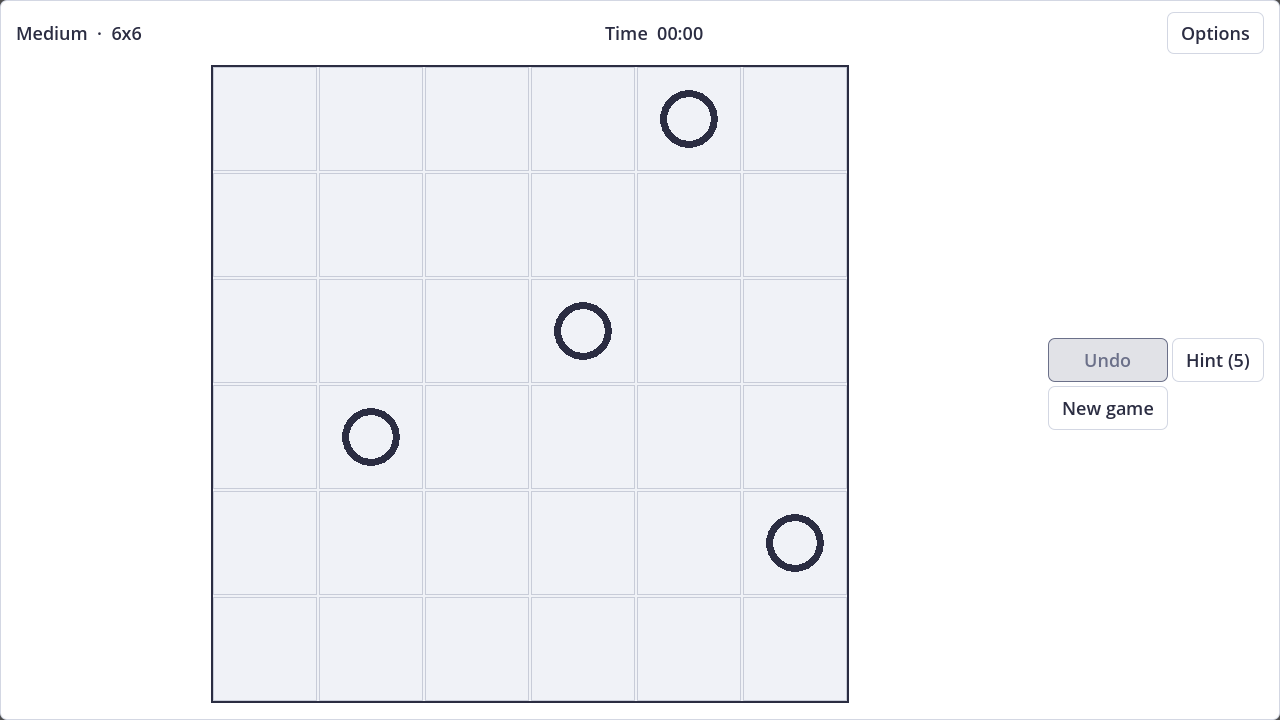
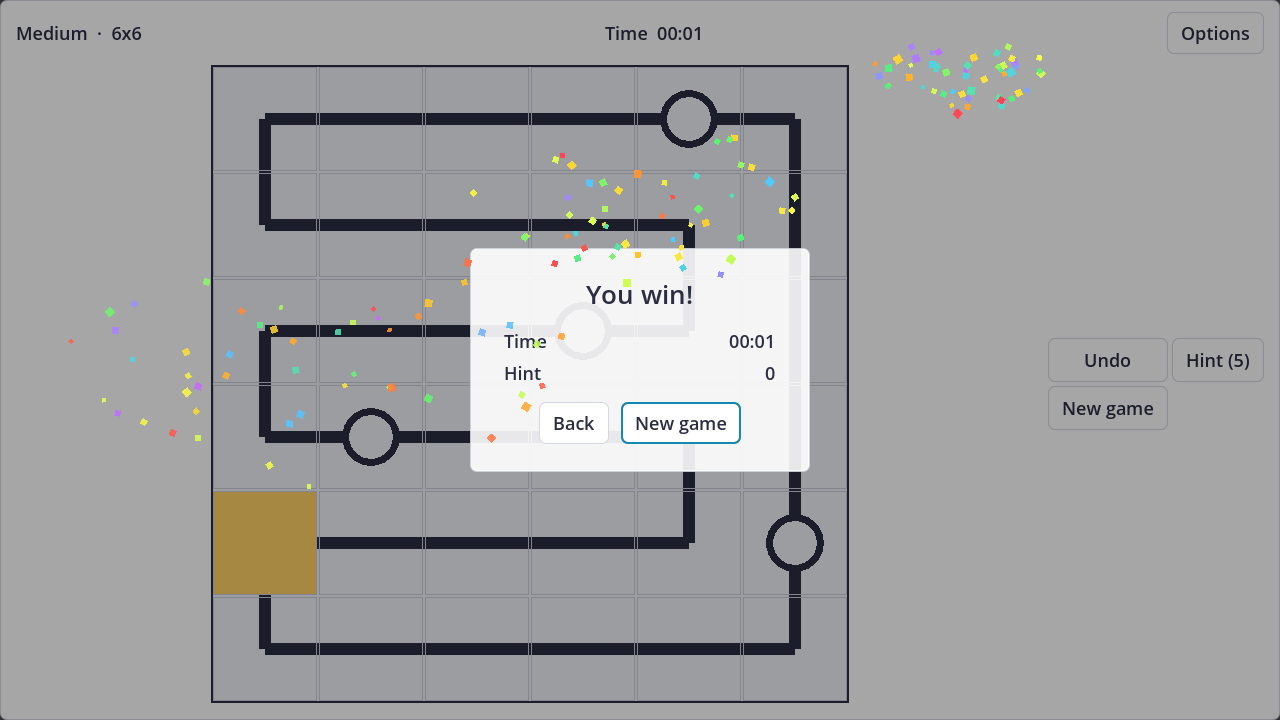
Step by step. Medium is a 6×6 grid — the HUD prints level and size together — with the pearls scattered and the board blank.
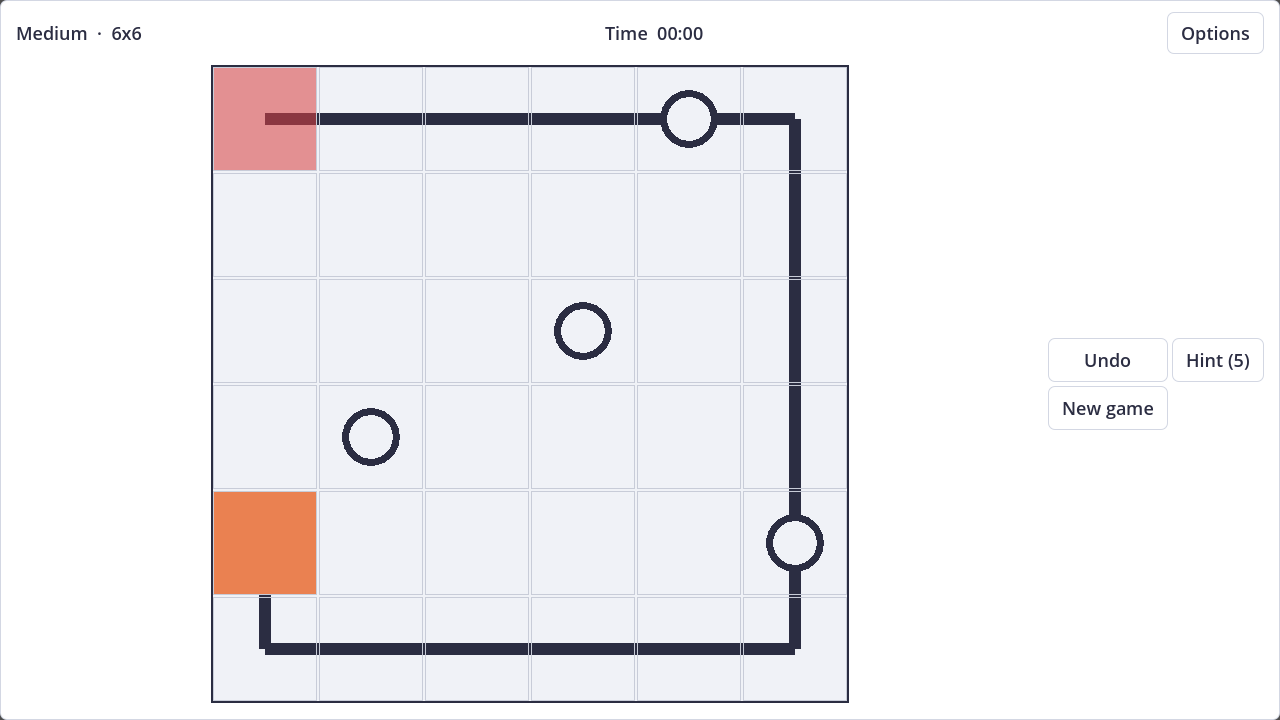
Drawing is two taps: one on a cell, one on an orthogonal neighbour, and a segment links them. Tap the same two again and the segment comes back off; tap a cell that isn't adjacent and the selection simply moves. A cell can hold at most two segments — forcing a third gets refused with an error buzz, because a clean loop never branches. The board talks back: any square with a single loose segment glows red, and any pearl the path crosses wrongly is flagged too. Five hints per game, each laying the next true segment of the hidden loop through the game's own move handler — undoable like everything else.
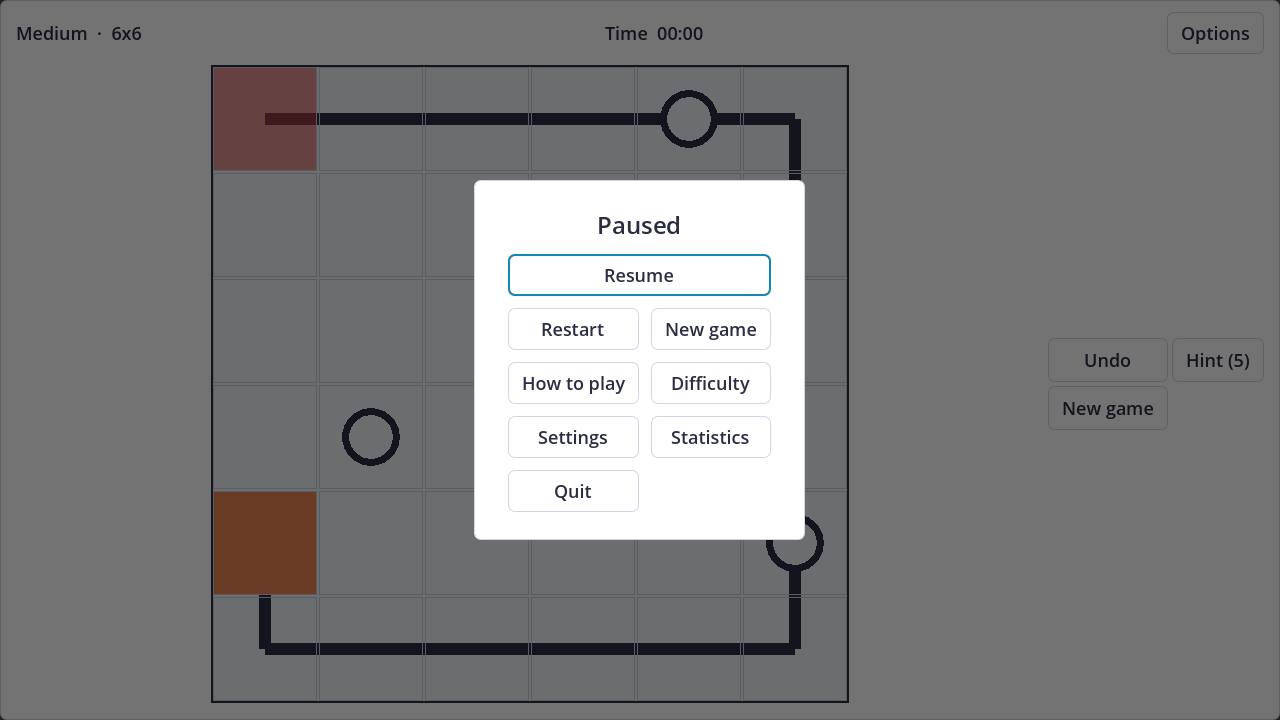
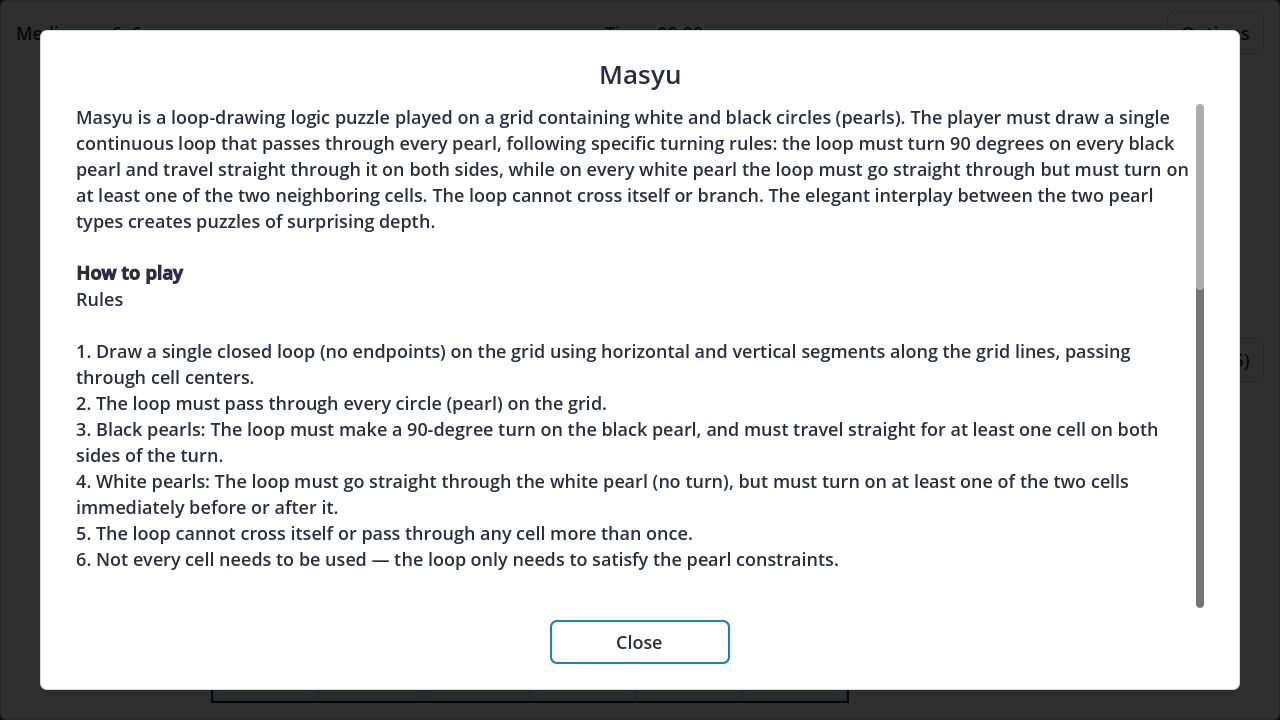
Pause covers the usual bench: Resume, Restart, New Game, How to Play, Difficulty, Settings and Statistics — seven options in the browser build; the installed app adds Quit. The help sheet keeps the black-turns-white-straight pair of rules at hand.
Close the last gap over the last satisfied pearl and the win panel drops — time spent, hints burned, confetti — over a circuit running through every square of this 6×6.
Strategy and tips
- Read the rim first. A black pearl on an edge has one turn geometry available, a corner black pearl is decided on sight; a white pearl on the edge forces the loop along that edge and a turn in the interior cell beside it.
- Give black pearls their runways. The straight-neighbour clause means the cells on either side along the loop can't be turn cells — a black pearl beside another tight clue often kills one of its options outright.
- Treat white chains as rails. Whites in a line must all be crossed straight: the loop threads them like beads and turns only beyond the ends.
- Watch for premature rings. A loop that closes while a pearl sits outside it is dead; before sealing a gap, check every pearl still has a way in.
- Let forced segments cascade. After each decision some pearl's geometry becomes forced — the puzzle unwinds from its tightest corner outward.
Controls
- Mouse and touch: tap a cell to select, tap an adjacent cell to lay or remove the segment between them; buttons for Undo, Hint, New Game and the pause menu.
- Gamepad: the D-pad walks a cursor over the whole grid, A taps the highlighted cell — select, join, erase, exactly like a finger — Start opens and closes the pause menu, and B steps back: it closes menus and panels, and with the cursor already on the board it asks whether you want to quit.
- Keyboard: arrow keys move the same cursor and Enter performs the tap.
- Undo peels the loop back segment by segment, hint placements included. Restart replays the same pearl layout with your drawing wiped; New Game deals a different board.
Difficulties and variants
Difficulty is board size and nothing else: Easy is 5×6, Medium 6×6, Hard 7×6 and Expert 7×8 — all four grids have an even cell count, because the hidden loop the puzzle was carved from covers every cell. Five hints at every level; the pearl rules never vary.
Where to play
Masyu is free in the Tab and Blank catalog, in the browser, nothing to install: play Masyu.
If closing loops had you counting turns, try Slitherlink — a single loop drawn with dots and numbers rather than pearls.