
What the game is
Nurikabe is the puzzle where numbers size the land and you pour the sea around it. It appeared in Puzzle Communication Nikoli in 1991, contributed by a reader signing "Renin" — one of the publisher's most successful finds from its mailbag of designs. The name comes from Japanese folklore: a nurikabe is a yokai, an invisible wall that steps into a traveler's road at night. Here the wall is made of shaded cells, it surrounds every numbered island, and it has to keep the water connected all the way round. A World Puzzle Championship regular since the late 1990s; in the abstract, deciding whether a grid like this is solvable at all is NP-complete — but a good board yields to pure logic with no guessing.
The app carves each board before you see it: it scatters seeds across the grid, grows each into an island of a random size, then throws the whole layout away if the sea comes out split or pools itself into a square — retrying up to four hundred times, so every board you meet was built from a layout that already works.
How to play
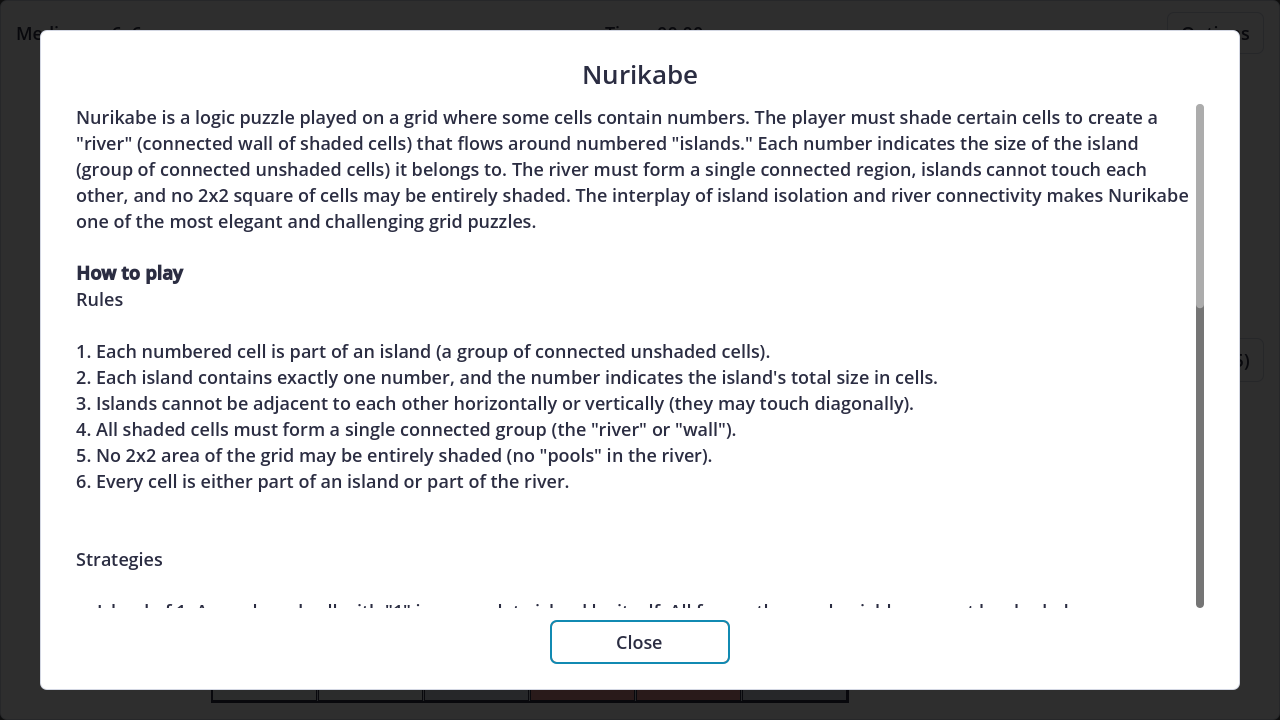
The rules, in the order the in-game help sheet numbers them:
- Each numbered cell is part of an island — a group of connected unshaded cells.
- Each island holds exactly one number, and that number is the island's total size in cells.
- Islands may not touch horizontally or vertically; a diagonal corner touch is fine.
- All shaded cells form a single connected region — the water, which the help sheet calls the river.
- No 2×2 patch of the grid may be entirely shaded.
- Every cell ends up either island or sea.
Step by step. Medium is a 6×6 grid; the HUD prints the level and the dimensions together. A fresh board arrives flush red across every cell — the game being honest, not broken: with nothing shaded yet, the grid is one giant landmass holding all five clues, failing the size rule everywhere at once. The first strokes of sea cut the mass apart and the red retreats to what is genuinely wrong: an island short of or over its number, two clues merged into one blob, a square of pooled water.
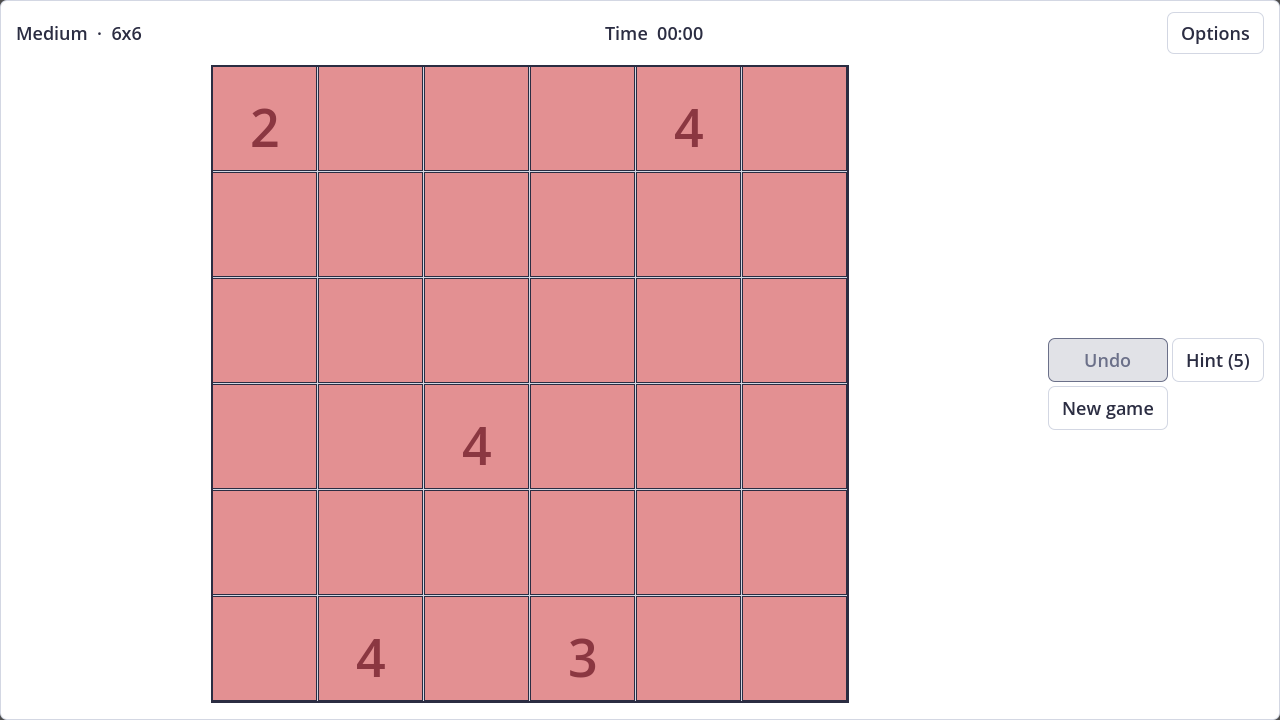
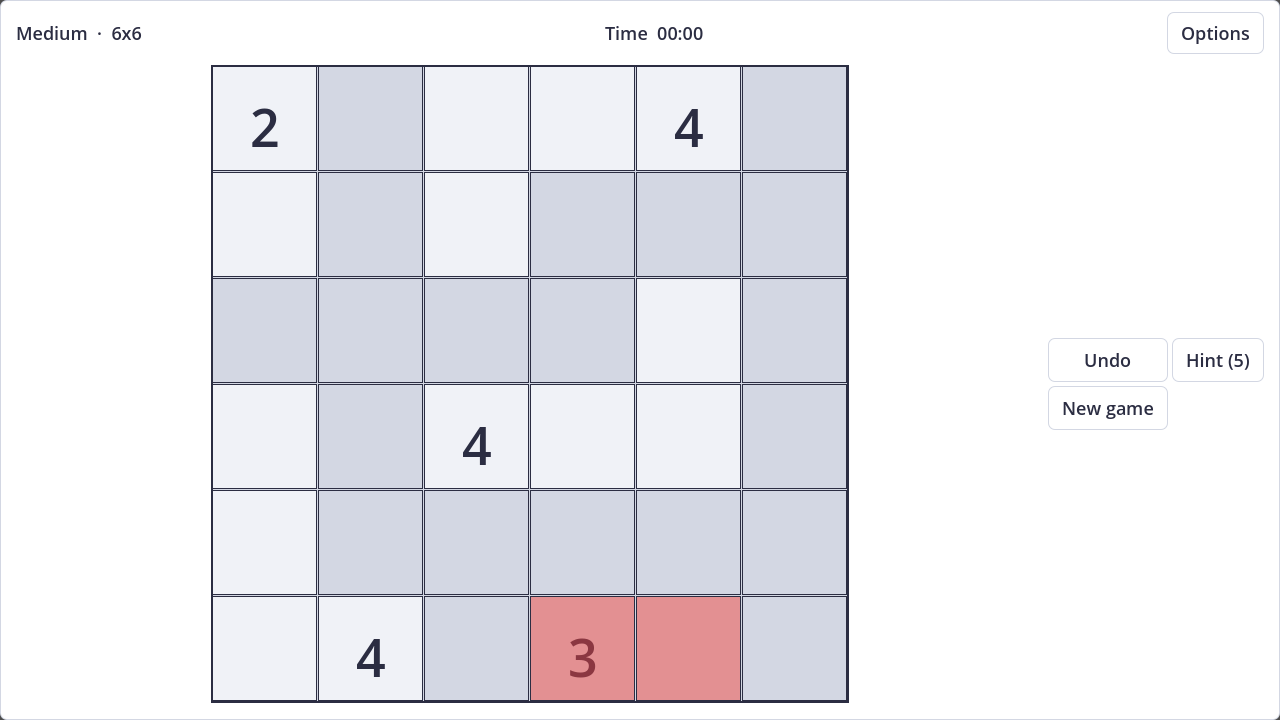
Tapping a plain cell flips it between sea and land; clue cells refuse your finger with an error buzz. Five hints per game, each flipping one cell where your board still disagrees with the layout the clues were carved from — undoable like any move. The same rules run the win check after every flip: islands exactly their size, water in one piece, no pools.
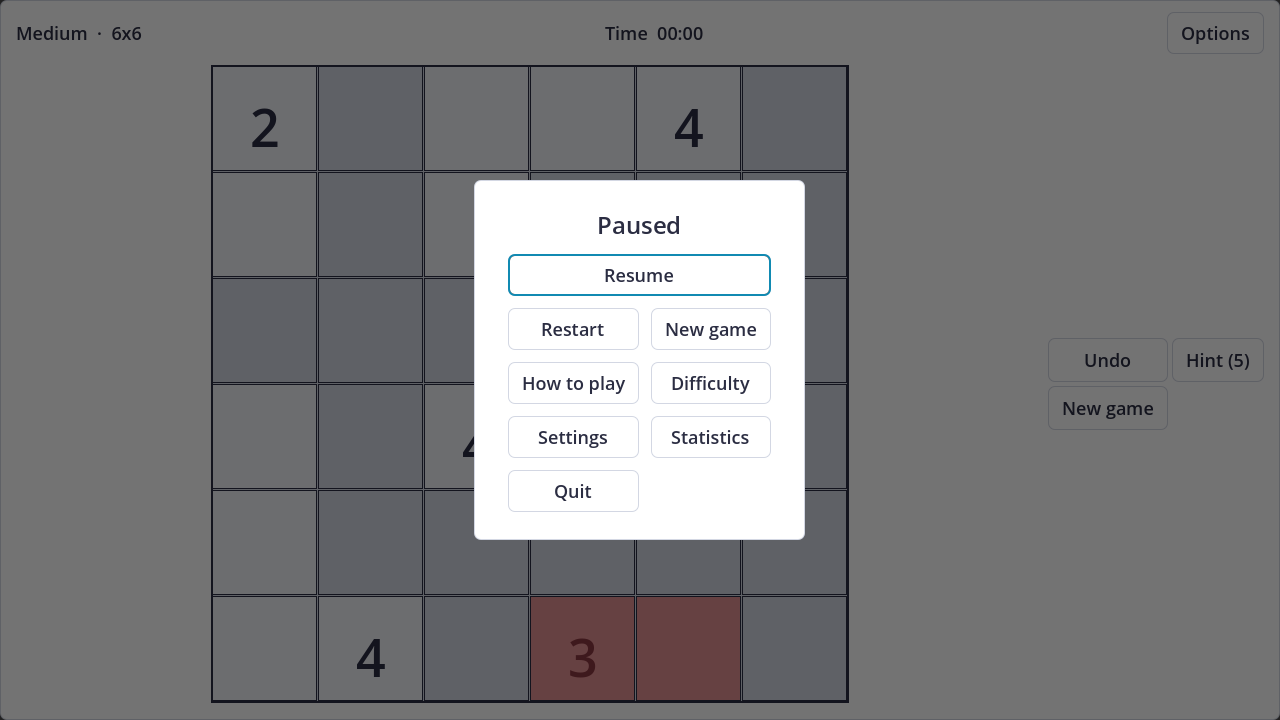
Pause covers the usual bench: Resume, Restart, New Game, How to Play, Difficulty, Settings and Statistics — seven options in the browser build; the installed app adds Quit. The help sheet keeps the six numbered rules and the strategy notes at hand.
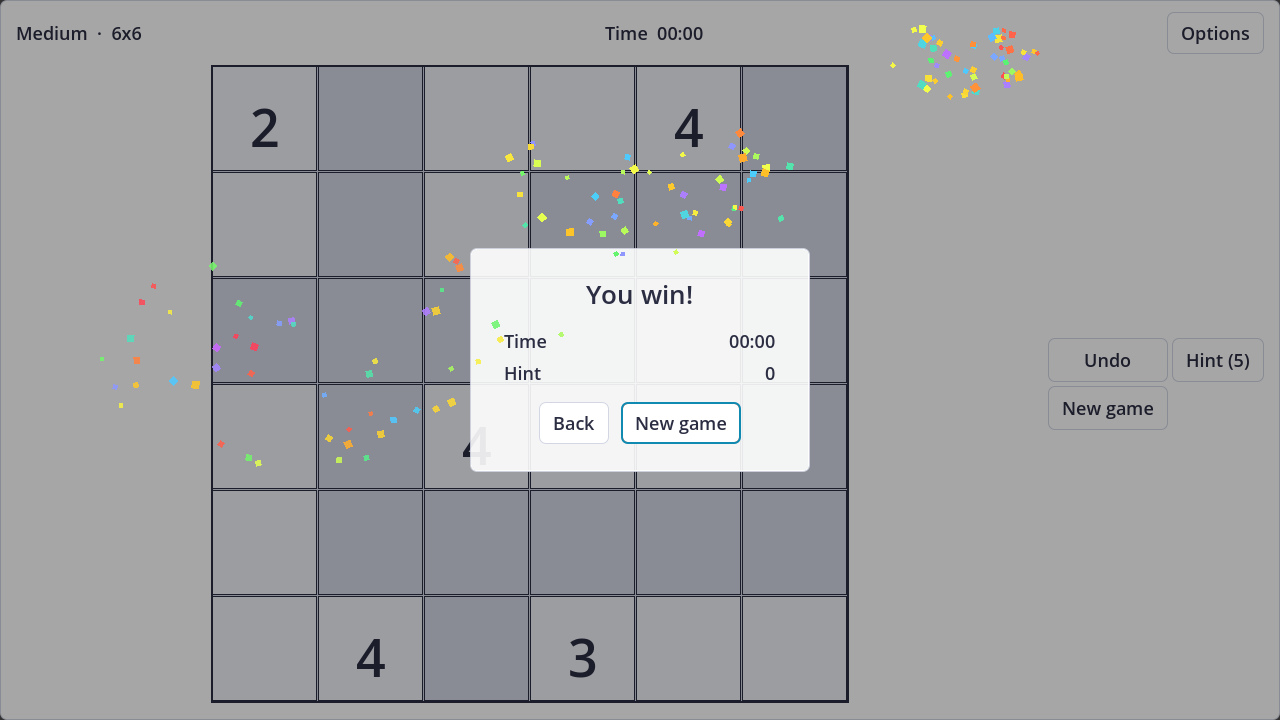
Set the last cell right and the panel drops over an archipelago where every number matches its island and one unbroken sea laps them all — time, hints, confetti.
Strategy and tips
- Count what no island can reach. A cell too far from every number to join any island without overshooting it is sea by pure arithmetic.
- Work the gaps between clues. Two numbered cells near each other claim the space between them; whichever island cannot legally take a cell, that cell becomes water.
- Follow the single lane. If an island can only grow in one direction to reach its size, that lane is land — decided now, not later.
- Three corners of a square decide the fourth. Wherever three cells of a 2×2 are shaded, the last must stay land. The no-pools rule is the sharpest pencil in Nurikabe.
- Never dam the sea. If shading a cell would cut the water in two, leave it open; if leaving one dry would strand the sea, flood it.
Controls
- Mouse and touch: tap any cell that is not a clue to flip it between sea and land; buttons for Undo, Hint, New Game and the pause menu.
- Gamepad: the D-pad walks a cursor cell by cell across the grid, A flips the highlighted cell — exactly like a finger — Start opens and closes the pause menu, and B steps back: it closes menus and panels, and with the cursor already on the board it asks whether you want to quit.
- Keyboard: arrow keys move the same cursor and Enter performs the tap.
- Undo peels flips back one at a time, hints included. Restart replays the same islands with your shading wiped; New Game rolls a fresh scatter, and changing difficulty discards the run.
Difficulties and variants
Difficulty is the grid and nothing else: Easy is 5×5, Medium 6×6, Hard 7×7 and Expert 8×8. The generator sows roughly as many islands as the board has cells along a side — on a 6×6 that lands between four and six clues — and on that board each island measures 2 to 5 cells. Five hints at every level; the island-and-sea rules never vary.
Where to play
Nurikabe is free in the Tab and Blank catalog, in the browser, nothing to install: play Nurikabe.
If digits that shape a whole grid are your medicine, the catalog also keeps Slitherlink, which hides a single closed loop among its numbers.