
What the game is
Peg Solitaire is a solo board game of one violent verb: a peg leaps over its neighbour into an empty hole, and the peg that was jumped comes off the board. Every move is a jump — nothing slides, nothing moves diagonally — and the aim is to strip the board down until exactly one peg survives.
The app plays the classic English board: a 33-hole cross, full of 32 pegs with the centre hole empty from the deal. Three details make it a puzzle: the peg count drops by exactly one per jump, so a win is always 31 jumps long; a dead order that leaves pegs with no jump available simply ends the run instead of stranding you at a frozen board; and finishing with the last peg in the centre — the traditional showpiece — depends entirely on the path you chose.
How to play
The rules, in the numbered order the help sheet teaches:
- The board starts with pegs in every hole except the centre.
- A peg jumps over an adjacent peg — horizontally or vertically, never diagonally — into an empty hole directly beyond it.
- The jumped peg is removed.
- One jump per move; the same peg can keep going in a later move if the board allows.
- The game ends when no jump is possible.
- A perfect solution leaves exactly one peg.
Step by step. Tap a peg and it gets a selection ring; the holes your peg could legally land in fill with a highlight colour, so the board shows you every answer before you commit.
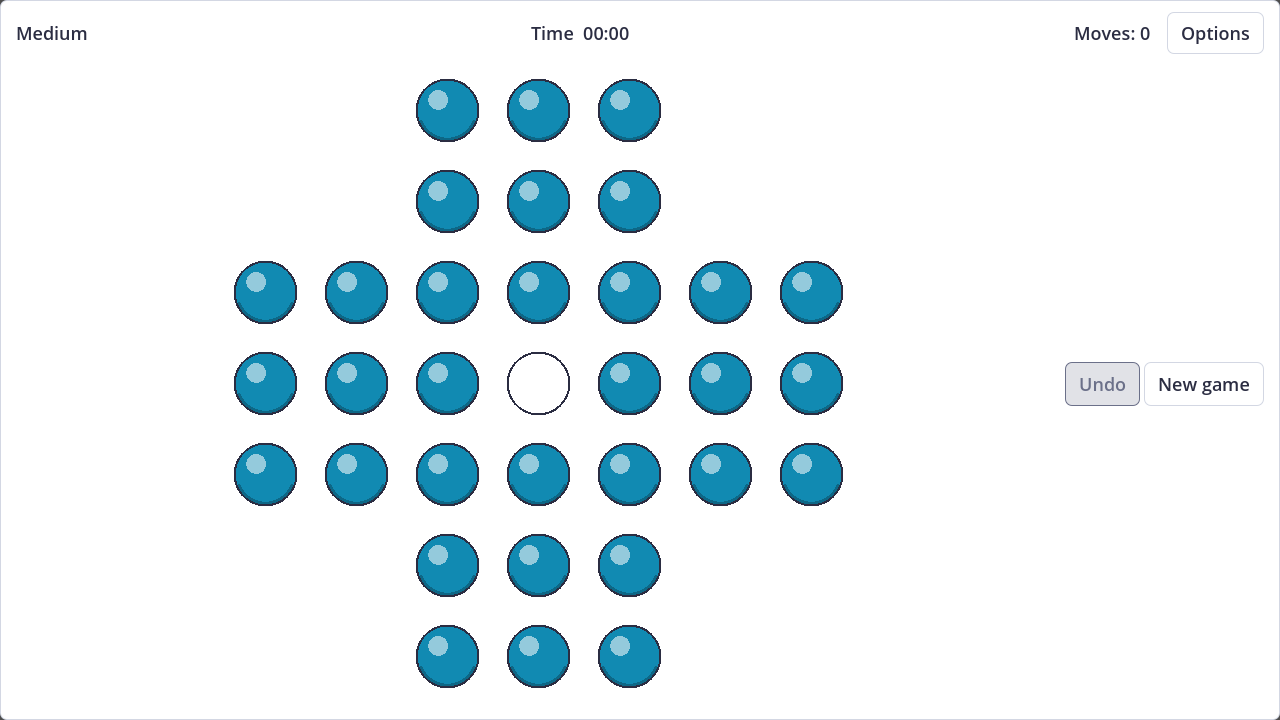
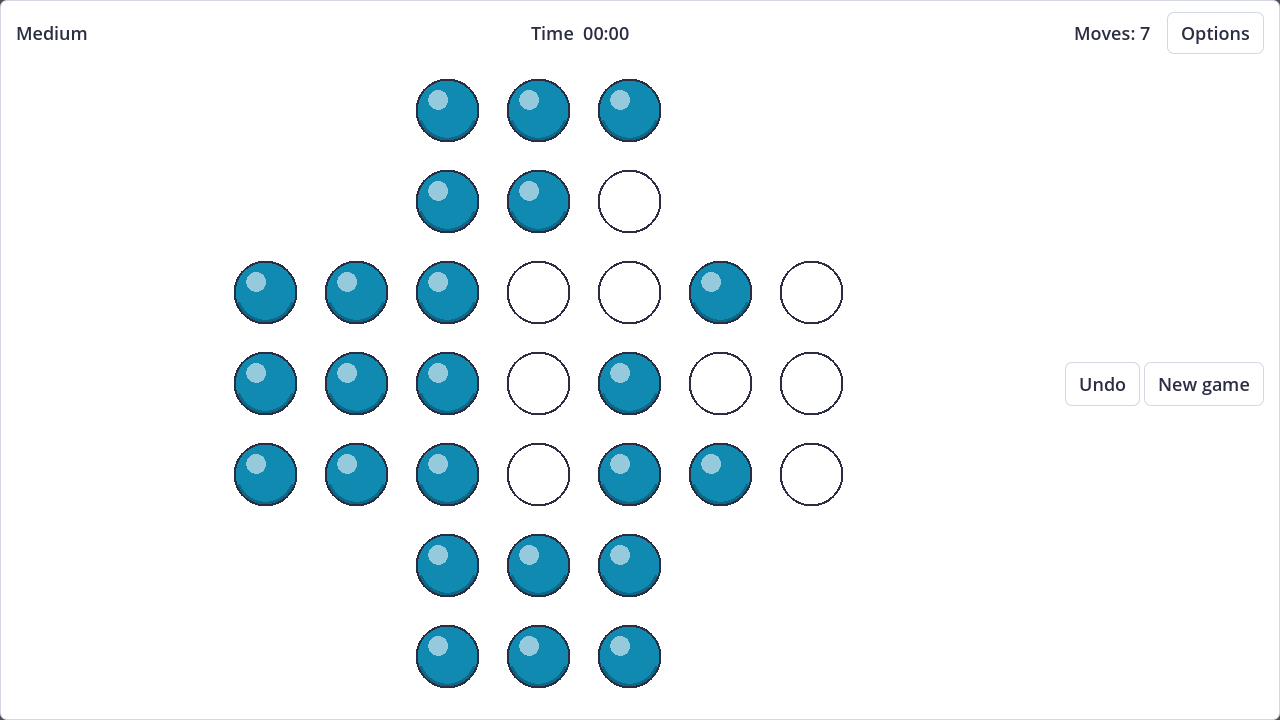
Tap a lit hole and the jump executes: your peg lands, the jumped peg vanishes, the selection clears. Tapping the selected peg again drops the selection instead. Empty holes draw as rings, pegs as solid discs, and the HUD counters track how far the purge has come.
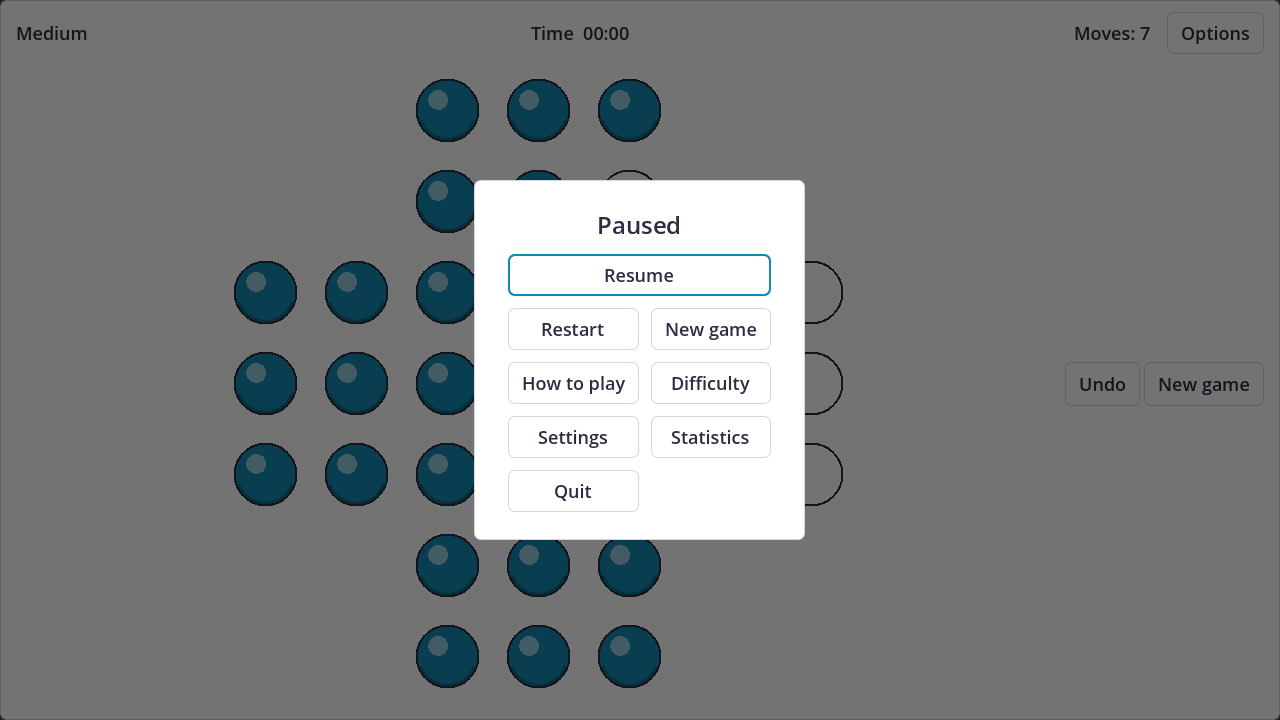
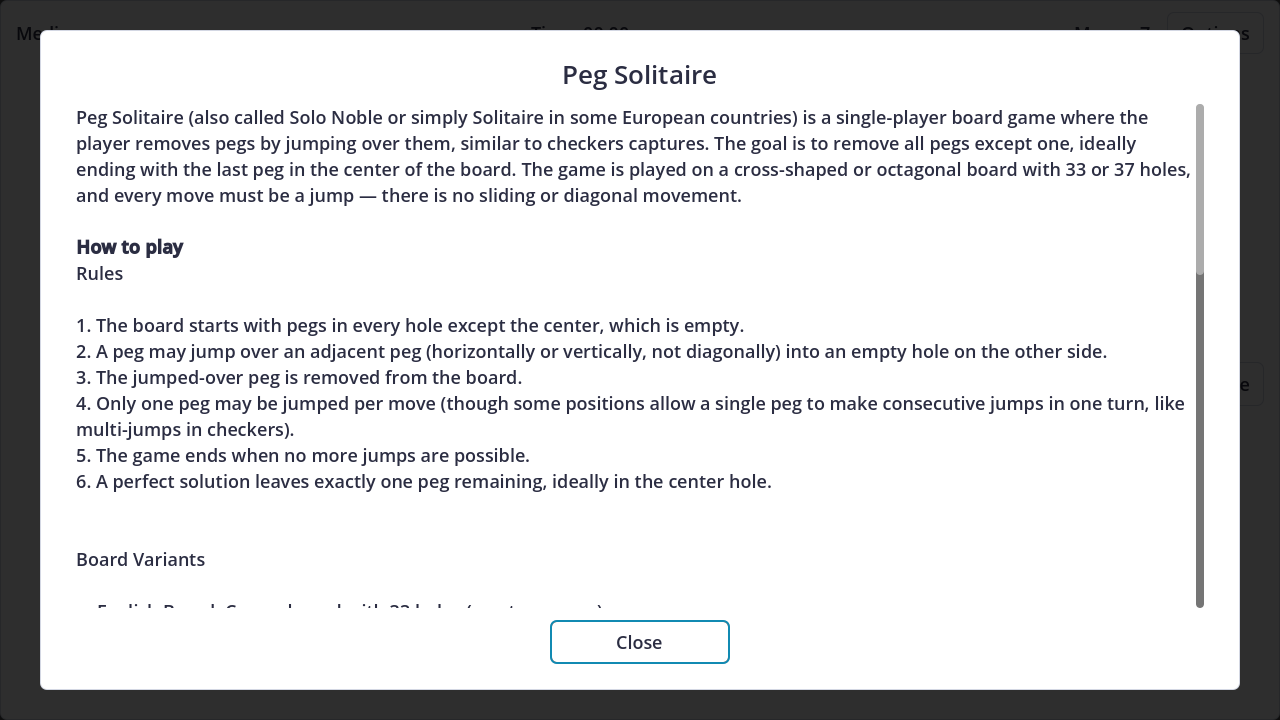
Pause any time: the menu holds Resume, Restart, New Game, How to Play, Difficulty, Settings and Statistics — seven options in the browser build, and the installed app adds Quit. "How to Play" keeps the jumping rules and the classic board variants readable inside the game.
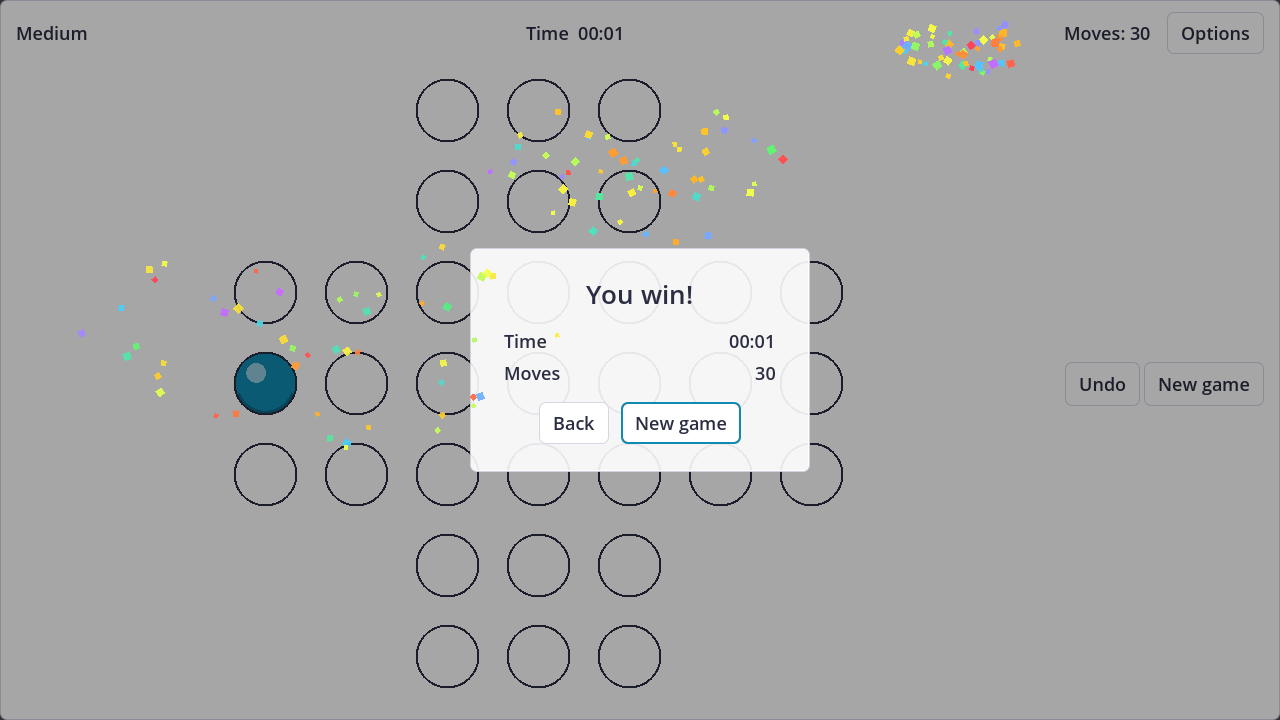
Reduce the field to a single peg and the win panel lands with your time and move count, confetti included. If no jumps remain with pegs still standing, you get the same panel in its game-over form — both count the run, and Undo is always there to rewind a jump you regret.
Strategy and tips
- Clear the arms first. Pegs out on the perimeter are the hardest to remove late, when their jump geometry runs out. Work edges inward and consolidate toward the middle.
- Keep symmetry. Mirrored positions tend to keep more solution paths alive; symmetric move pairs are a classic finishing pattern for the cross.
- Never strand a peg. An isolated peg with no neighbour to jump is stuck permanently — it will still be sitting there at the end, and the end needs one peg, not four.
- Run the chains. A peg that can take two or three jumps in a row clears several enemies with one survivor. The app hands you a fresh move after each jump, so re-select the same peg and let it keep eating.
- Watch the count. Pegs left minus one equals jumps still needed; clustering pegs in one corner early is how runs die.
- Steal the known openings. Optimal 33-hole solutions are fully enumerated — memorising one standard opening sequence is a legitimate head start.
Controls
- Mouse and touch: tap a peg to select, tap a highlighted hole to jump; buttons for Undo, New Game and the pause menu.
- Gamepad: the D-pad walks a cursor over the holes, A taps the highlighted one — selection or landing, exactly like a finger — Start opens and closes the pause menu, and B steps back, asking whether to quit when the cursor is already on the board.
- Keyboard: arrow keys move the same cursor and Enter performs the tap.
- There is no hint button in Peg Solitaire: the highlighted landing spots are the only assist the game gives, and Undo covers the rest.
Difficulties and variants
One honest note about this version: the board is always the same English cross — the difficulty choice labels your run, but nothing resizes the 33 holes, and "New Game" re-deals the identical opening position. The variety lives in how you play it, not in the layout.
The family is wider, and the in-game help sheet walks it: the European board rounds the cross out to 37 holes, the triangular 15-hole layout is the one that sits on tables at Cracker Barrel restaurants, and a 41-hole diamond keeps the mathematicians company. The game carries a Bastille-prison origin legend, but its earliest reliable image is a 1697 engraving of Princess de Soubise playing at Louis XIV's court; Leibniz analysed it in 1710, and the English board's state space runs past 187 million positions.
Where to play
Peg Solitaire is free in the Tab and Blank catalog, in the browser, nothing to install: play Peg Solitaire.
The same other-puzzles shelf also keeps Coin Weighing Puzzle and Rubik's Cube 2x2 (Pocket Cube) for solo-board appetite.