
What the game is
Pipe Puzzle is the rotation kind: a grid already packed with pipe tiles, every one of them twisted the wrong way, and one task — turn them back until the whole network joins. There is no water timer and no drop-the-wrong-piece panic here; this is the pure-deduction school of pipe games, where the solved board is a single connected network with not one open end pointing at a wall.
The shapes you work with are straight runs, 90-degree bends, T-junctions and four-way crosses, drawn plainly: each open side gets a segment from the tile's centre to its edge, with a hub dot in the middle so junctions read at a glance. Under the scrambled surface, the solution every board hides is a perfect maze — a branching tree that reaches all cells without loops — so every board is guaranteed connectable, and there is a fixed right orientation per tile even if you never see it.
How to play
The rules, in the order the help sheet teaches them:
- The grid is filled with pipe tiles, each holding one segment shape.
- Click or tap a tile to rotate it one quarter-turn clockwise.
- Every open connection must meet an open connection on the neighbouring tile.
- A connection aimed off the board, or at a neighbour that does not answer it, is a loose end.
- The puzzle is solved when no loose ends remain.
Step by step. Medium opens on a 7×7 grid, every tile spun one to three quarter-turns away from its solved orientation — which is why the starting board bristles with ends pointed at walls.
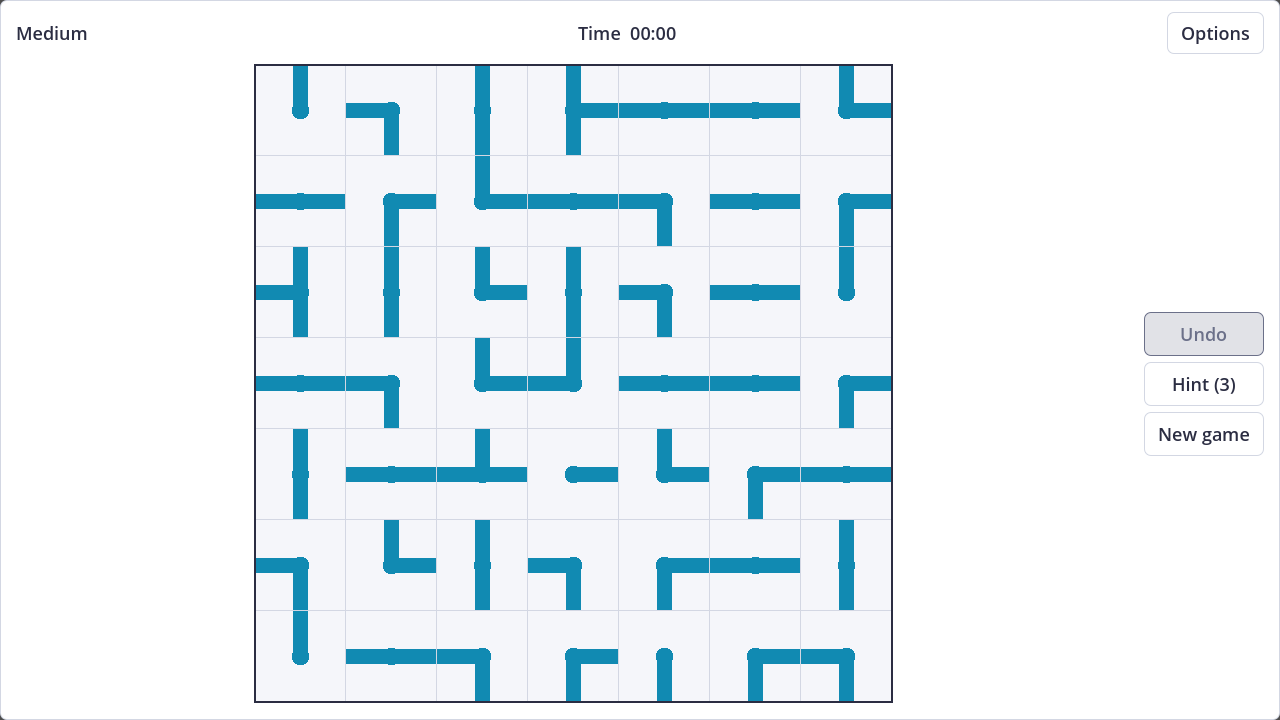
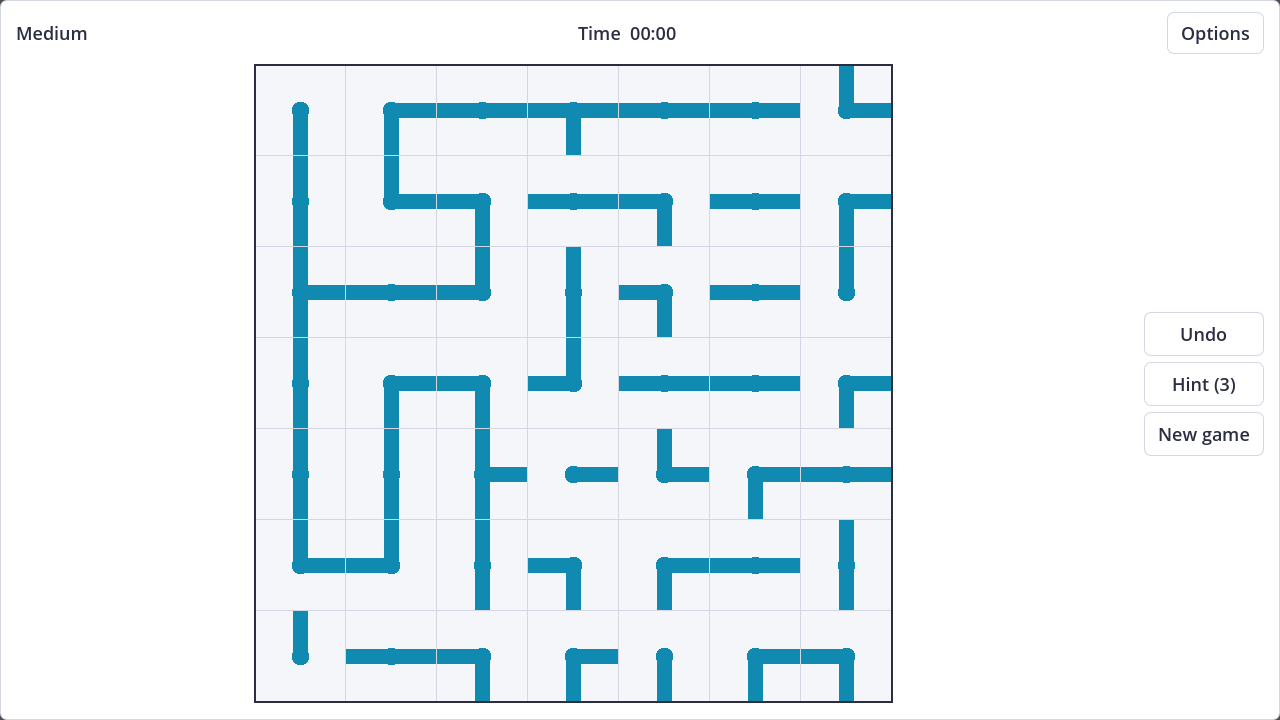
Rotation is the whole verb. Tap enough times and any tile cycles back to where it started, so nothing is irreversible except your time. As orientations line up, patches of joined pipe visibly spread across the grid; the HUD keeps the run honest with the level label, an optional clock, the Undo button and a Hint button counting what is left. You get three hints per game, and a hint is an answer, not a nudge: it snaps one wrong tile straight to its solved orientation in a single move. When they run out the game says so plainly.
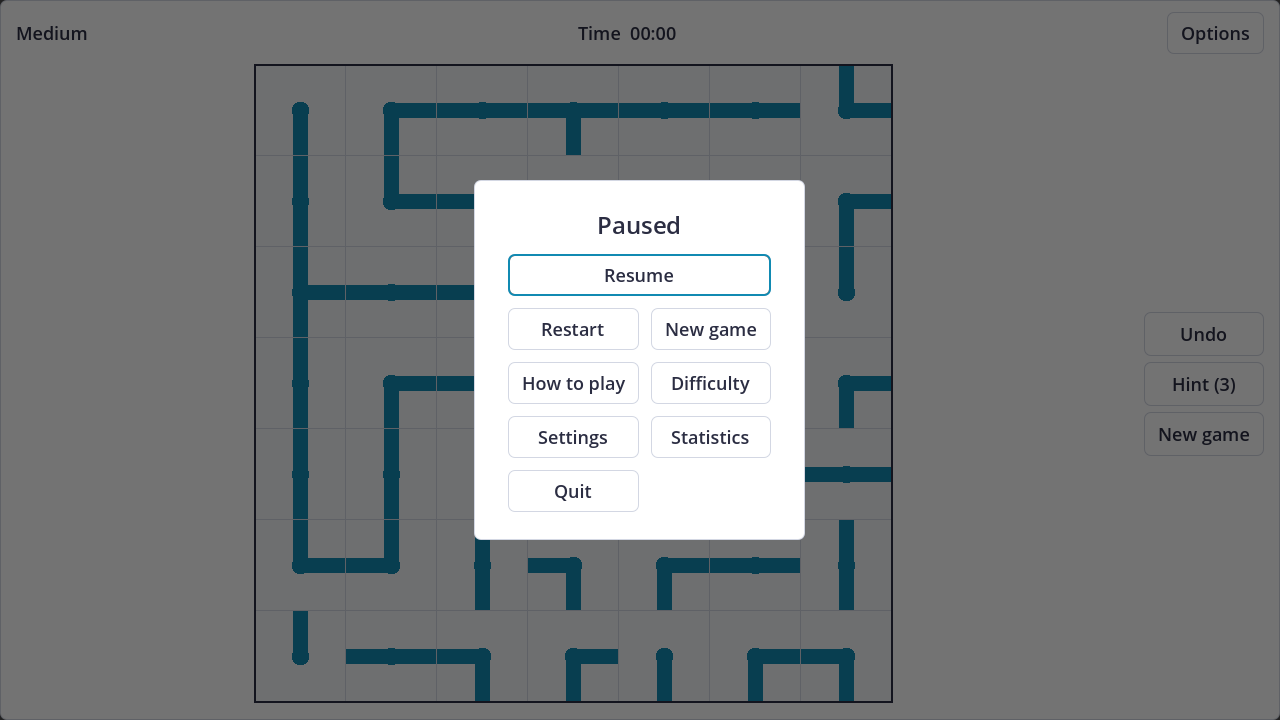
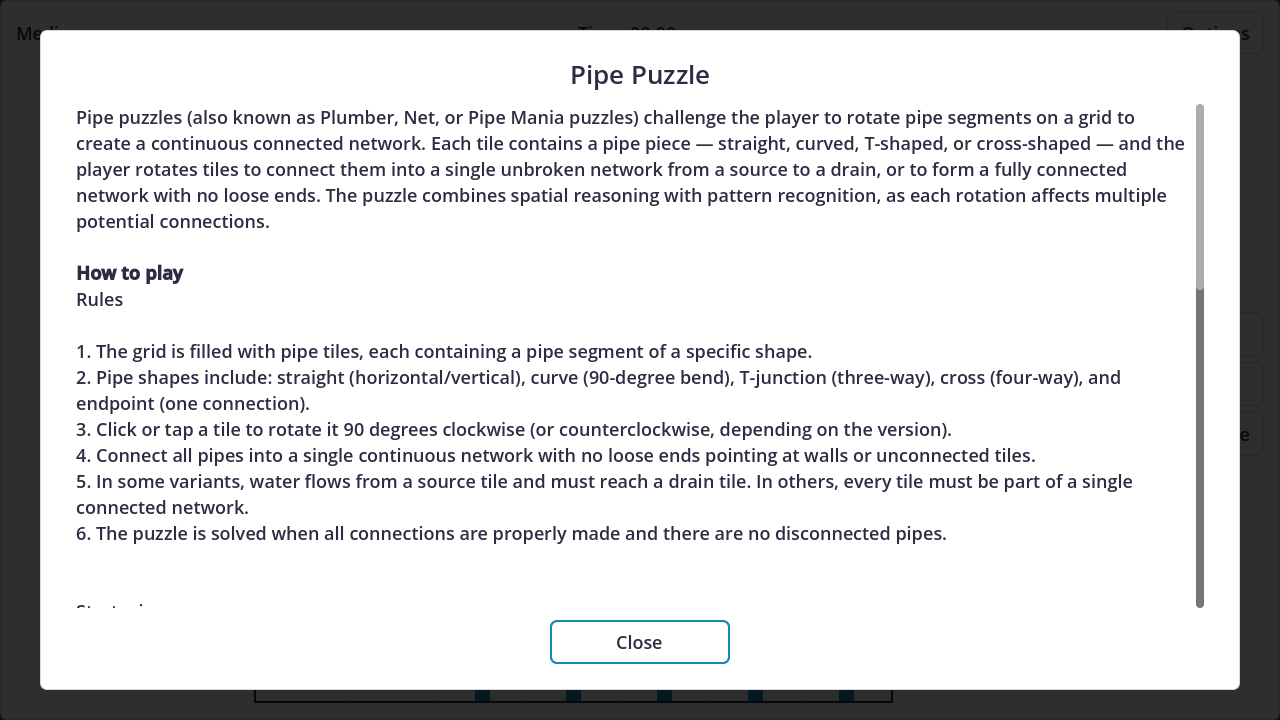
The pause menu is the usual workbench: Resume, Restart, New Game, How to Play, Difficulty, Settings and Statistics — seven options in the browser, and the installed app adds Quit. The help sheet keeps the rules and the rotation idea readable inside the game.
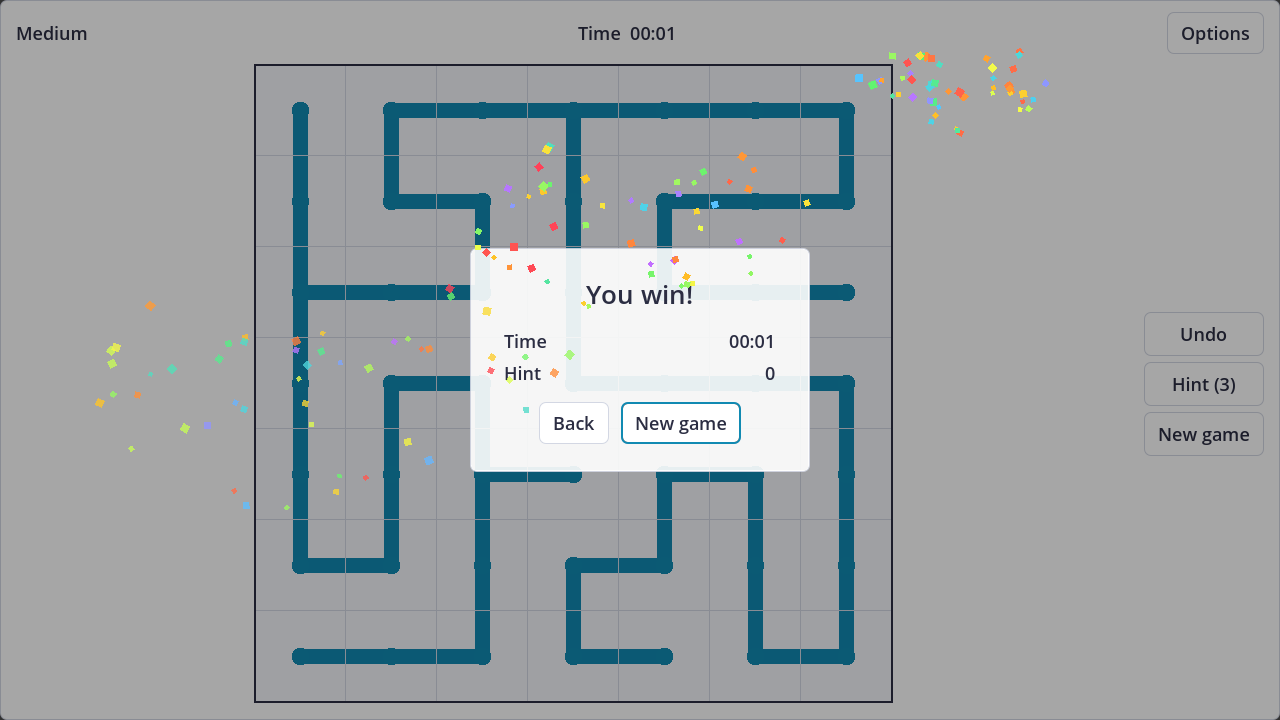
After every rotation the game re-checks the network. The last tile clicking into place triggers the win panel with your time and how many of the three hints you burned — confetti included.
Strategy and tips
- Start with edges and corners. A corner tile can only ever answer two neighbours, so its legal orientations are few; edge tiles come next. Lock the rim in first.
- Follow forced connections. If a tile has only one neighbour it could possibly link to, that junction is decided — set it and let the constraint propagate outward.
- Dead ends anchor. One-opening tiles must point at their only viable neighbour; find them early and they become anchors for everything around them.
- Crosses are free. A four-way tile works in any rotation; leave crosses for last and don't waste taps — or hints — on them.
- No openings into walls. If your rotation sends water-space at the board edge, it is wrong by definition; loose ends are the puzzle telling you where it hurts.
Controls
- Mouse and touch: tap a tile to rotate it clockwise; buttons for Undo, Hint, New Game and the pause menu.
- Gamepad: the D-pad walks the cursor over the grid, A taps the highlighted tile (one quarter-turn per press — hold your aim and keep firing A to cycle it), Start opens and closes the pause menu, and B steps back: it closes menus and panels, and with the cursor already on the board it asks whether you want to quit.
- Keyboard: arrow keys move the same cursor and Enter performs the tap.
- Undo walks your rotations back one step at a time, so experimenting is free. One caveat: a hint's snap into the solved orientation is final — it never enters the undo history — and stands until you turn that tile yourself.
Difficulties and variants
The selector moves the grid, not the rules: Easy is 5×5, Medium 7×7, Hard 9×9, Expert 11×11, and the three hints per run are the same at every level. Bigger boards mean longer constraint chains — the logic stays the same, the bookkeeping grows.
Three habits worth knowing: changing difficulty discards the run in progress and deals a fresh board; "Restart" replays the same scramble from clean pipes; "New Game" rolls a different one. The rotation-pipe format descends from real-time classics like Pipe Mania (1989) and pure-logic collections like Simon Tatham's Net — this app follows the second, unhurried line.
Where to play
Pipe Puzzle is free in the Tab and Blank catalog, in the browser, nothing to install: play Pipe Puzzle.
If routing pipes appealed to you, the maze shelf next door keeps Classic Maze and Sokoban.