
What the game is
Slitherlink is Nikoli's loop-drawing puzzle, first printed in Puzzle Communication Nikoli in 1989 — known in Japan as Suriza, and elsewhere as Fences or Loop the Loop. A field of dots arrives with numbers tucked into some of the boxes between them. Connect adjacent dots with horizontal and vertical strokes until a single unbroken loop circles the board with every number telling the truth: a 2 wants exactly two of its box's four edges drawn. That is the whole contract.
The app builds each puzzle the safe way round: it grows a blob of cells — connected, hole-free — and lets geometry do the rest, because on a square lattice the border between such a region and everything outside is always one clean, closed loop. The numbers are read off that loop's edges, and a share of the boxes keep theirs while the rest stay silent. What the checker grades is your drawing against those numbers, never the recipe it came from: the win lands the instant your strokes form one closed circuit consistent with every clue, whatever loop those clues were carved from.
How to play
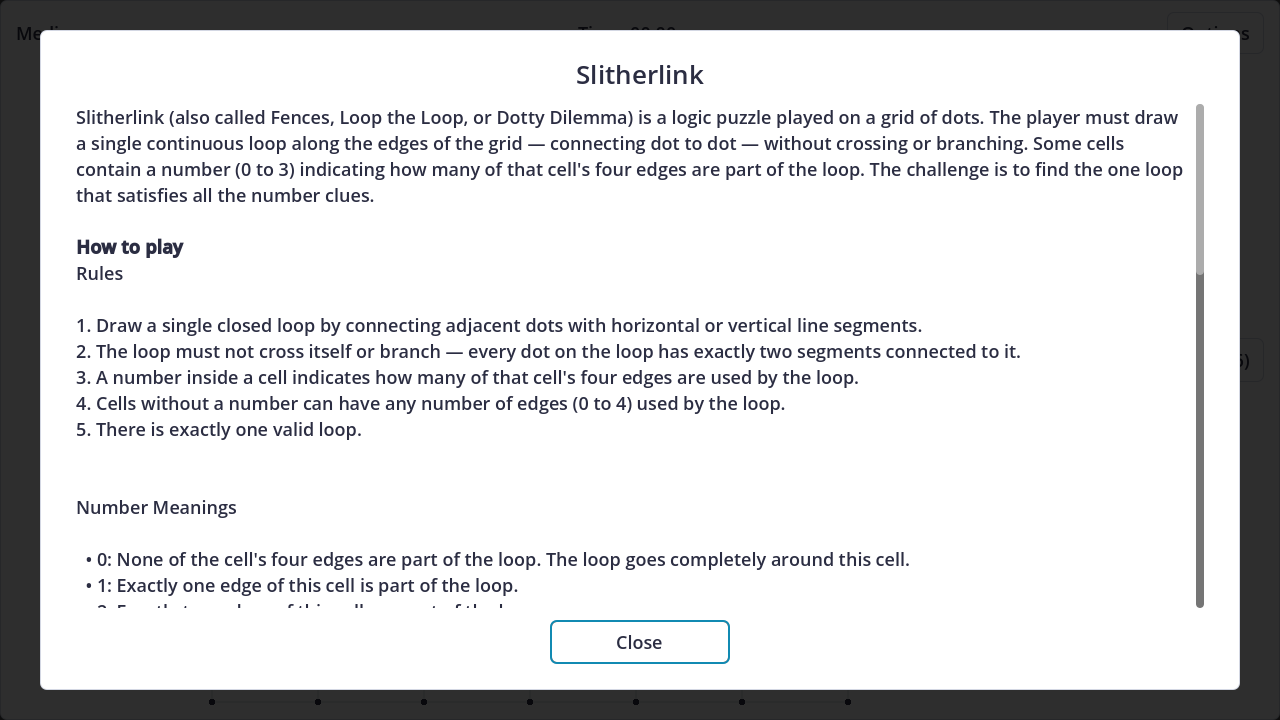
The rules, in the order the in-game help sheet numbers them:
- Draw a single closed loop by connecting adjacent dots with horizontal or vertical strokes.
- The loop never crosses itself or branches — every dot it touches has exactly two strokes meeting there.
- A number inside a box says how many of that box's four edges the loop uses.
- A box without a number constrains nothing: any of its 0 to 4 edges may carry the loop.
- There is exactly one valid loop — a single circuit satisfying all the clues at once.
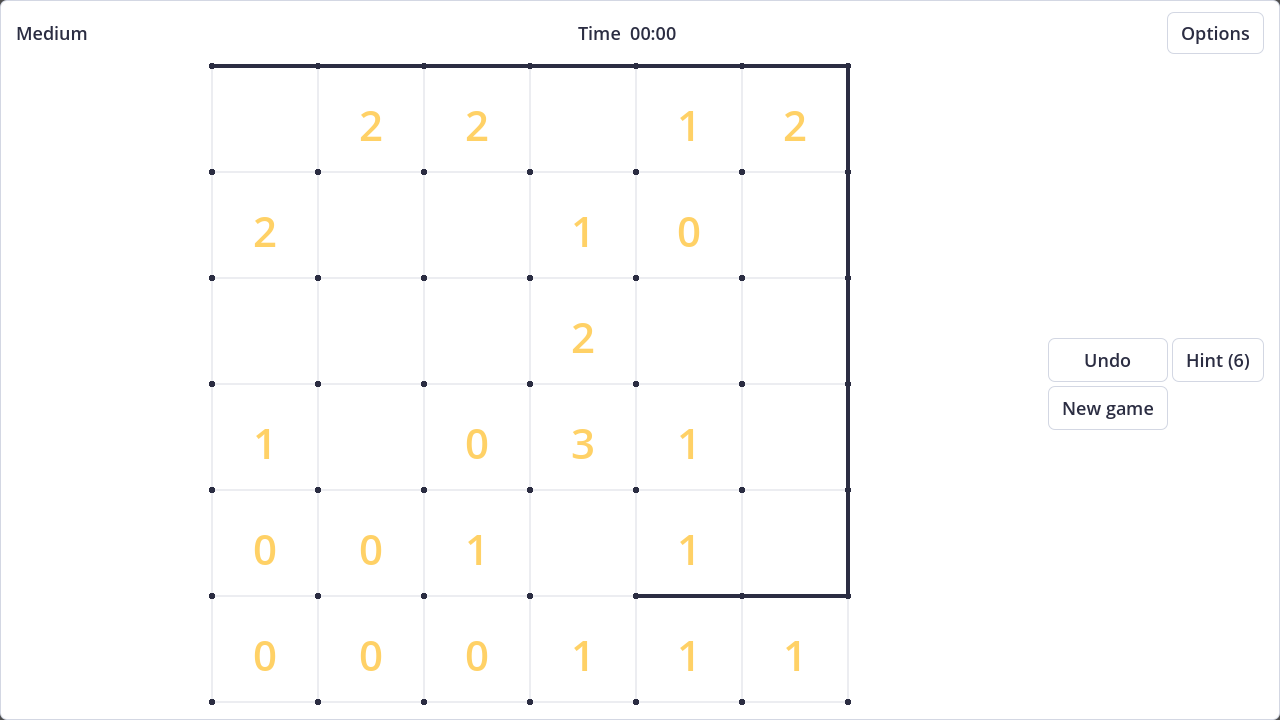
Step by step. Medium is a 6×6 field of boxes — 7×7 dots — with clues in about 65% of them; the HUD names the level and nothing more. Touching near an edge lights a stroke along it; touching it again takes it back off. That toggle is the entire game.
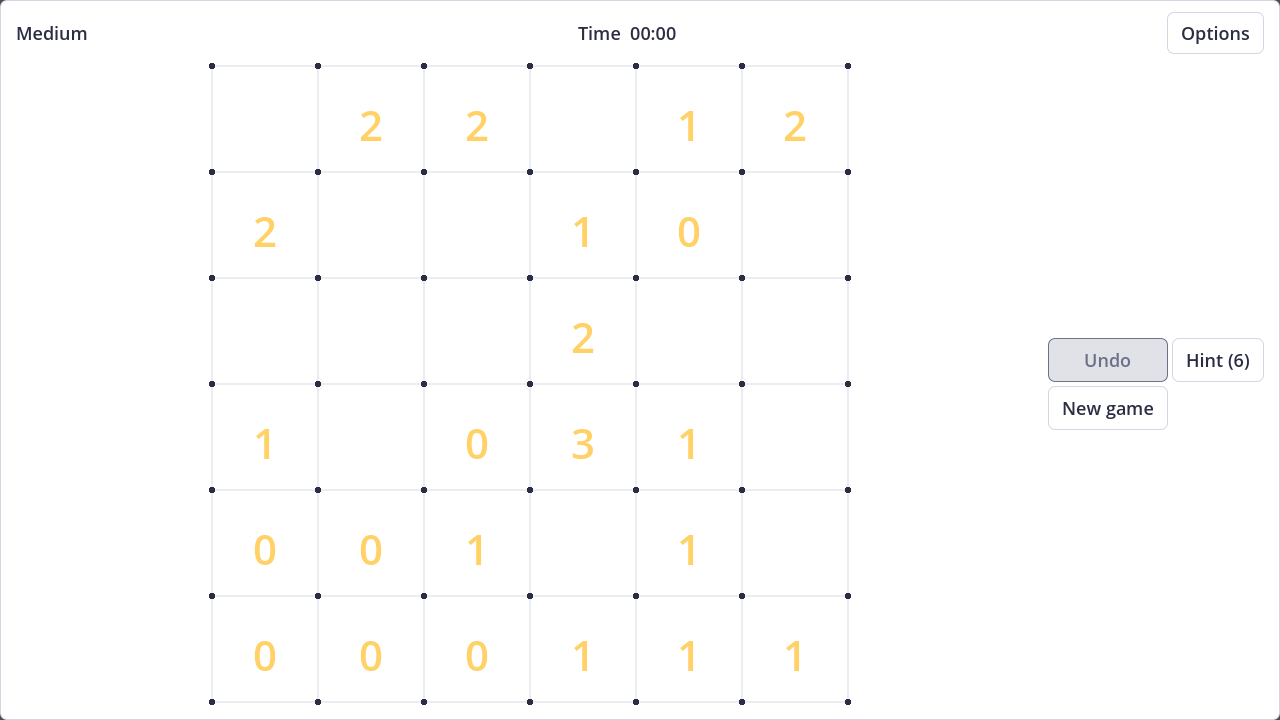
The board talks back in red only about geometry that can no longer be right: a dot with three or more strokes, or a numbered box already over its clue, flags its strokes; a half-drawn path with loose ends stays plain — unfinished, not wrong. Six hints per game, each lighting one stroke the carving loop still owes, placed through the same toggle your finger uses — undoable like everything else.
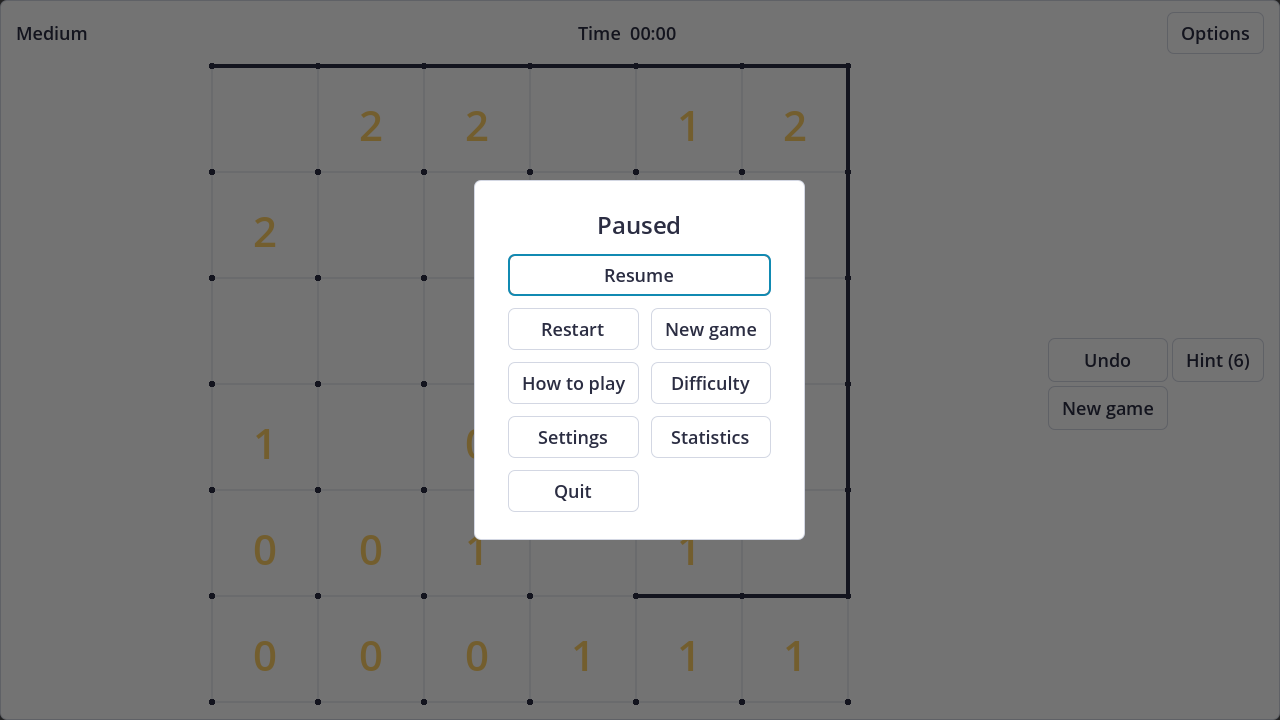
Pause covers the usual bench: Resume, Restart, New Game, How to Play, Difficulty, Settings and Statistics — seven options in the browser build; the installed app adds Quit. The help sheet keeps the five rules and the number-meanings table at hand.
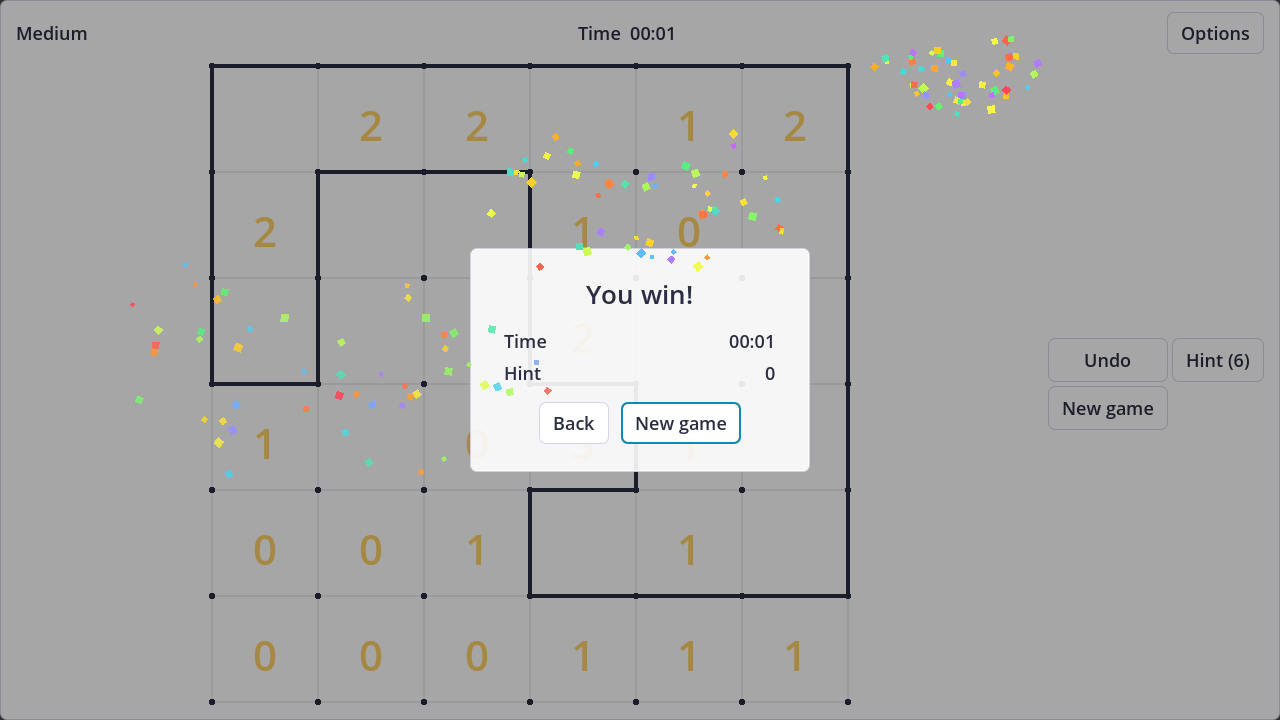
Close the last gap and the win panel drops the moment the circuit seals — time, hints, confetti — over one closed loop with every digit true.
Strategy and tips
- Let the 0s and 3s speak first. A 0 excludes all four of its edges — the loop passes around the box without touching. A 3 needs three of four; neighbours usually decide which single edge stays out.
- Adjacent 3s share a verdict. Two 3-boxes side by side force the edge between them into the loop; a 3 beside a 0 keeps its three edges on the far side.
- Corner boxes talk louder. A number in a corner of the grid leaves the loop fewer plausible paths, so its clue bites harder than an interior one.
- Never seal a ring too early. A circuit that closes while numbered boxes sit hungry outside it is dead — check that no clue is stranded before sealing.
- Count in twos at the dots. Every dot ends with zero or two strokes: once one is confirmed, exactly one more must join it. Dead ends do not exist.
Controls
- Mouse and touch: tap near an edge to light or kill its stroke; buttons for Undo, Hint, New Game and the pause menu.
- Gamepad: the D-pad walks a cursor edge by edge over the dot grid, A toggles the highlighted edge — draw or erase, exactly like a finger — Start opens and closes the pause menu, and B steps back: it closes menus and panels, and with the cursor already on the board it asks whether you want to quit.
- Keyboard: arrow keys move the same cursor and Enter performs the tap.
- Undo peels strokes back one at a time, hints included. Restart replays the same board with your drawing wiped; New Game deals a different one, and changing difficulty discards the run.
Difficulties and variants
Difficulty turns two dials and bends no rules. The field of boxes grows from 5×5 at Easy through 6×6 and 7×7 to 8×8 at Expert — dots always one more per side — while the share of numbered boxes thins from 75% to 65%, 55% and finally 45%. Clues stay whole numbers from 0 to 3, six hints wait at every level, and the logic never changes; only its amount.
Where to play
Slitherlink is free in the Tab and Blank catalog, in the browser, nothing to install: play Slitherlink.
If one loop was not enough, the catalog also keeps Nurikabe: numbers on the cells themselves, and a sea to shade around the islands they size.