
What the game is
Sudoku is the puzzle that reached newspaper pages in more than 80 countries. Some digits already sit on the board; the rest of the squares are empty. Your job: fill all 81 cells with the digits 1 through 9 so that no row, column or 3×3 box ever repeats a number.
It is not arithmetic and it is not luck. It is deduction: every digit you place shrinks the options of the others. In a well-built board — ours always have exactly one solution — guessing is never required. The satisfaction comes by accumulation: cells that looked hopeless at first narrow down one option at a time, until the last squares fill almost on their own.
This version respects the paper classic: a fixed 9×9 grid, four difficulty levels, pencil notes for candidates and a hint button. If you know the Sudoku you met on newsprint, you know this one. Its direct ancestor appeared in 1979 in a US magazine under the name "Number Place"; the Japanese publisher Nikoli gave it the name "Sudoku" in 1984.
How to play
The rules, numbered as in the game sheet:
- The grid is divided into 9 rows, 9 columns and 9 boxes of 3×3 cells.
- Each row must contain the numbers 1-9 with no repetition.
- Each column must contain the numbers 1-9 with no repetition.
- Each 3×3 box must contain the numbers 1-9 with no repetition.
- The puzzle has a unique solution.
Step by step. Open a game and you get the starting board: the opening digits printed, everything else blank. On Medium that is around 34 given digits.
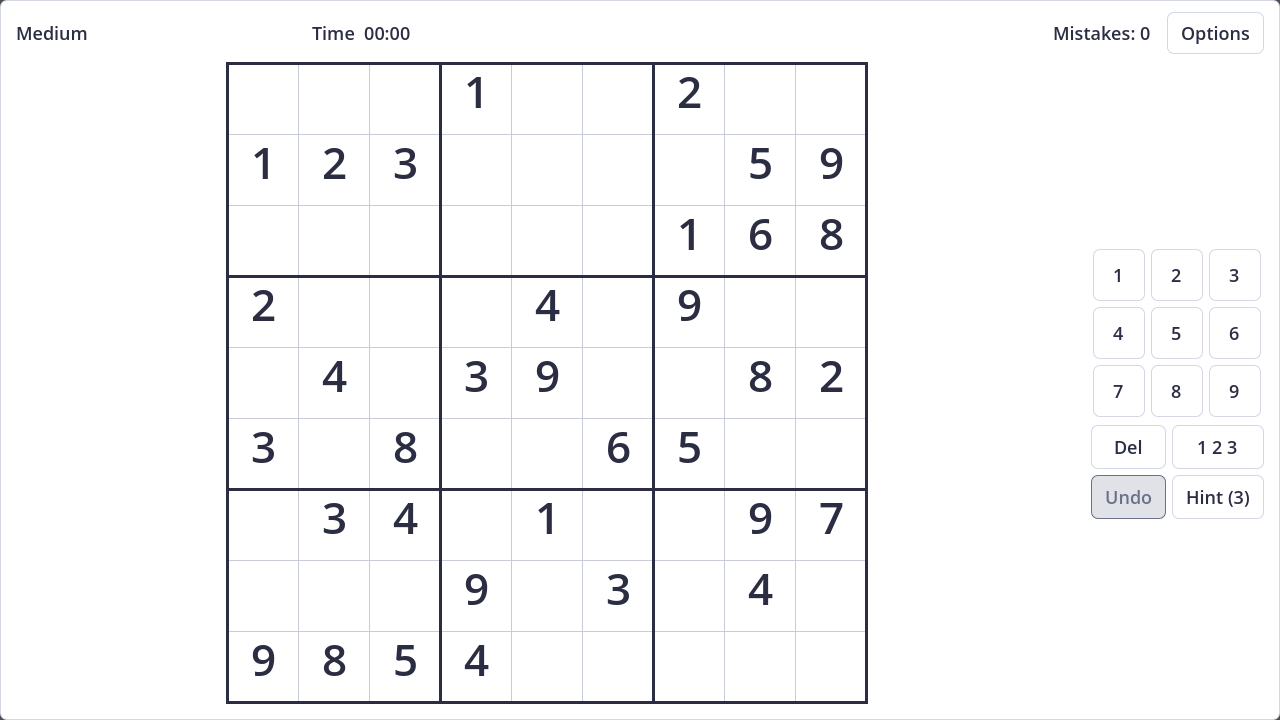
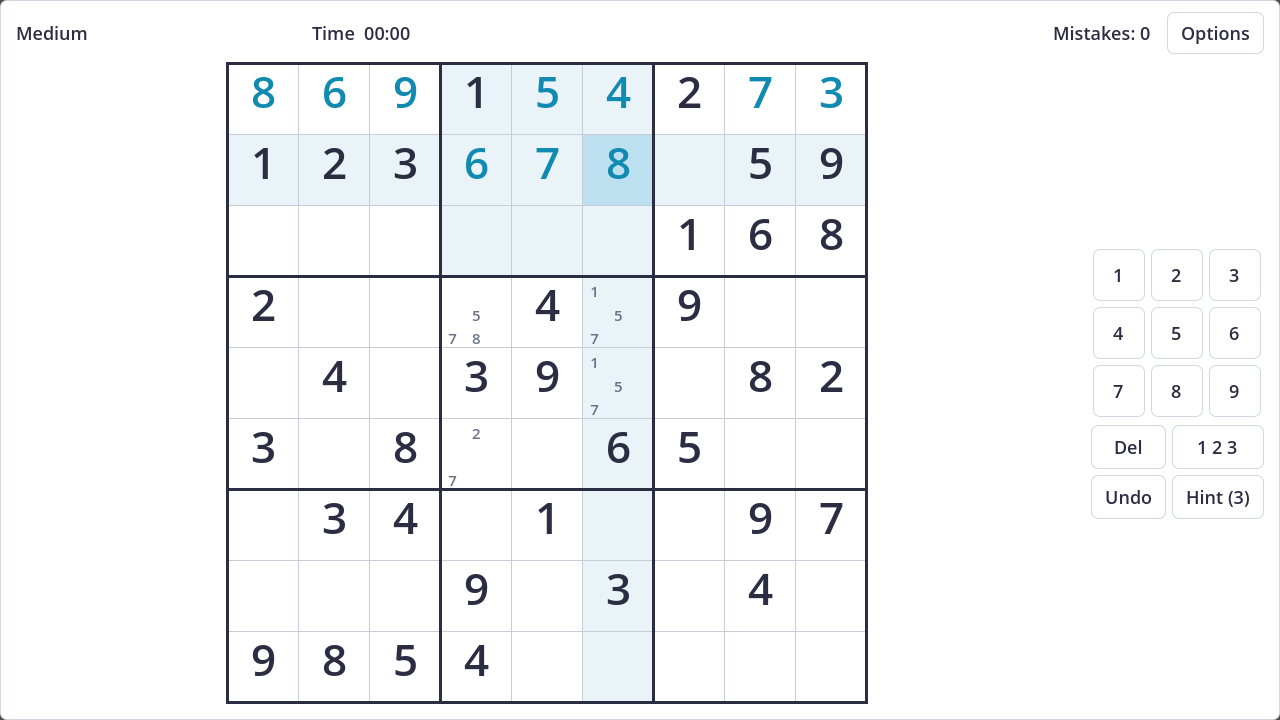
Click an empty cell to select it, then give it a digit: from the on-screen number pad or from the keyboard. Still unsure? Switch on notes mode and pencil candidate digits into the cell — notes are not answers, just your own margin of doubt. The cell you touched last stays highlighted, and the Undo button takes a mistake back.
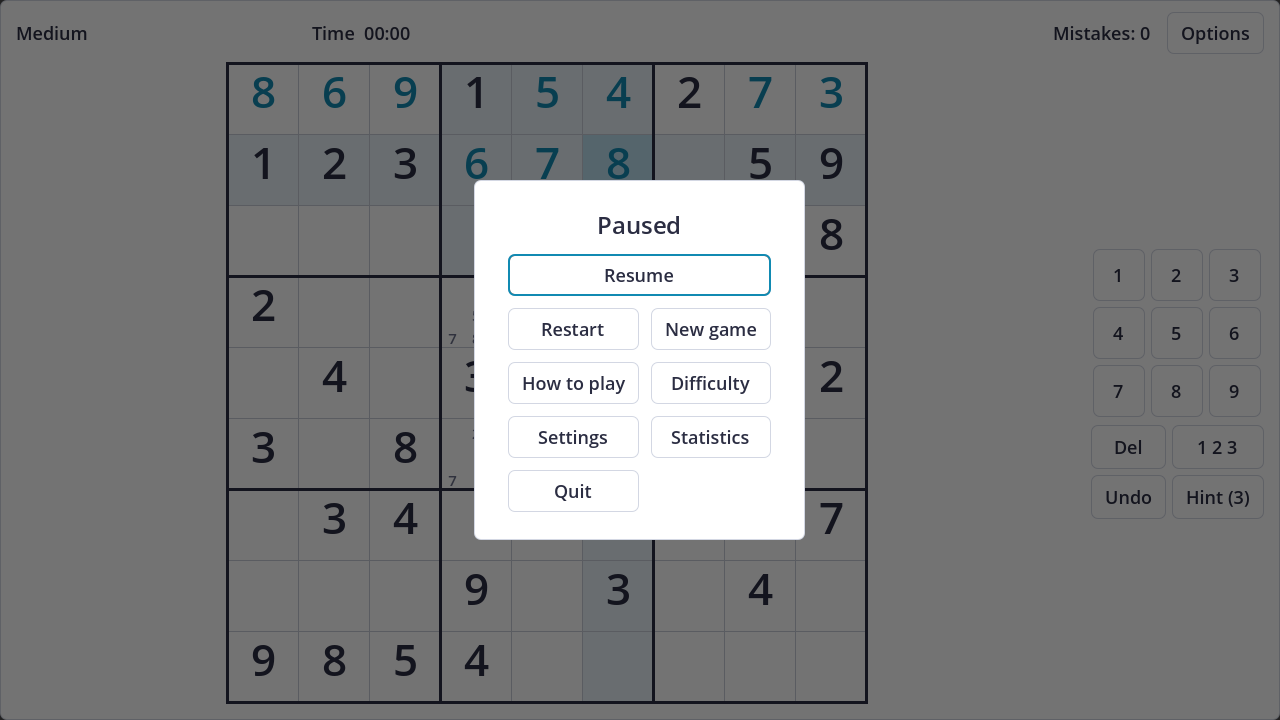
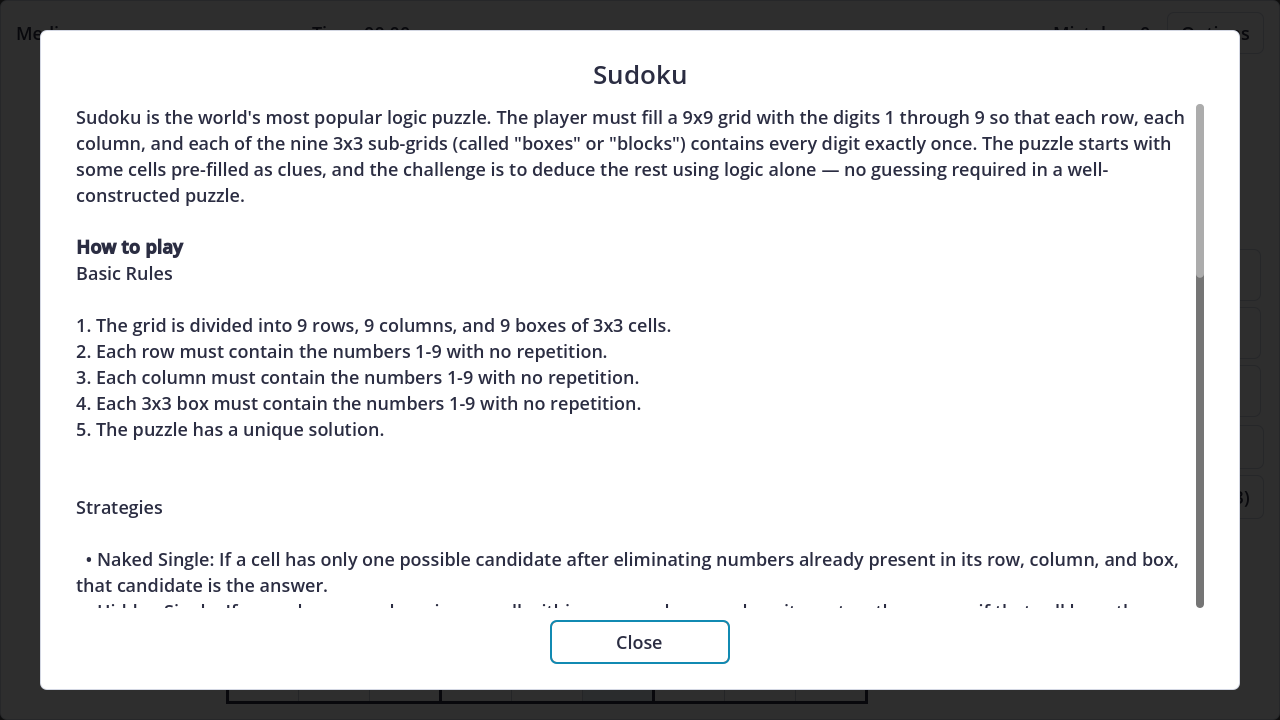
Resting, or changing something? The pause menu holds Resume, Restart, New Game, How to Play, Difficulty, Settings and Statistics; the installed app adds Quit. "How to Play" keeps the rules and the strategies readable inside the game itself, without leaving the board.
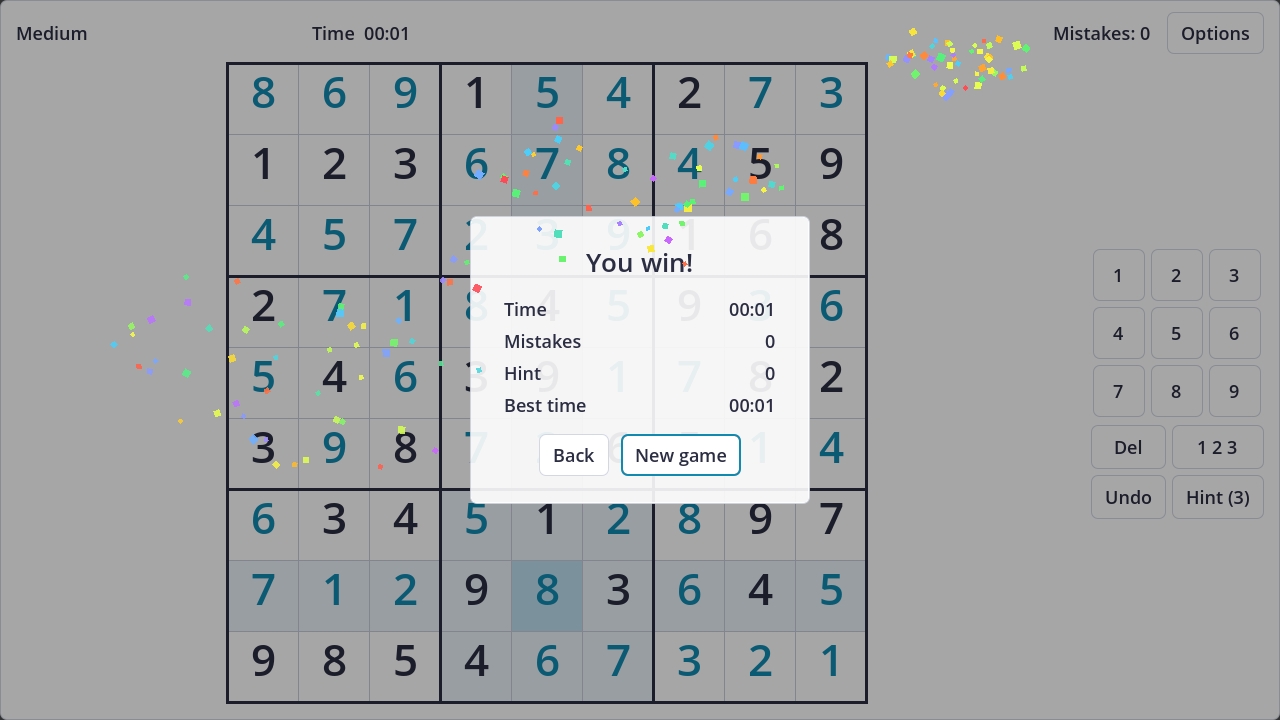
When the 81st cell falls into place, the game notices: a win panel with your run stats, confetti included.
Strategy and tips
- Take the singles first. A naked single is a cell where only one digit survives after crossing out what its row, column and box already hold. A hidden single is a digit that fits only one cell in a row, column or box, even if that cell could take others. Easy boards fall to singles alone — check them before anything else.
- Then hunt pairs. With notes on, look for two cells in one area that share exactly the same two candidates: those digits cannot live anywhere else in that area. Medium boards run on pairs and triples, not just singles, so alternate — open with singles, unlock with pairs.
- Work the fullest lines. Nearly finished rows, columns and boxes give the cheapest information: see which digit is missing, then see where it can still go.
- Save the hints. You get three per run. Spend one on a real dead end, not as a shortcut around re-reading the board.
Controls
- Mouse and touch: click to select a cell, tap the number pad for the digit; buttons for Erase, Notes, Undo, Hint and pause.
- Keyboard: arrows move the cursor through the grid; 1-9 enter digits (the numpad works too); 0, Backspace or Delete clears the selected cell; N toggles notes mode; Ctrl+Z undoes, Ctrl+Y or Ctrl+Shift+Z redoes.
- Gamepad: the D-pad moves the cursor across the grid, A selects the cell it points at, Start opens the pause menu, B returns to the board.
Difficulties and variants
The selector offers four levels: Easy, Medium, Hard, Expert. The grid never changes — it is always 9×9 — but the number of given digits does: roughly 45 on Easy, 34 on Medium, 28 on Hard and 24 on Expert. Fewer digits, more technique. Easy solves with singles; Medium wants pairs, triples and pointing candidates; Hard brings in X-Wings and Swordfish; Expert may need chains or the occasional extreme case.
Two menu behaviours worth knowing: picking a new difficulty throws away the run in progress and starts a fresh one — a board cannot continue under other rules. "Restart" gives you the same puzzle back from zero; "New Game" rolls a different one.
Where to play
Sudoku is free in the Tab and Blank catalog, in the browser, nothing to install: play Sudoku.
The classic left you wanting more? The same catalog keeps sudoku variants — Killer, X and mini — and the rest of the grid-puzzle family.