
What the game is
Thermometers is a filling puzzle. The grid is crossed by thermometer shapes, and you decide how far the mercury rises in each one. The numbers around the board state how many filled cells that row or column must hold. It is a game of small sums and chained deduction.
The charm is the physical metaphor: mercury rises from the bulb — the round end — and never jumps gaps. That directionality turns each decision into two: what rises drags the cells below with it, what falls empties everything toward the tip. Boards often look like they are closing "on their own" by the middle.
Thermometers is a modern classic: spread by online logic communities and puzzle magazines in the 2000s, present at the World Puzzle Championship and national competitions. Our generator draws a full solution first and keeps a board only when it counts to exactly one solution; if the 600 ms generation budget runs out first, it accepts the last valid board, which may then allow more than one solution.
How to play
The rules, numbered as in the game sheet:
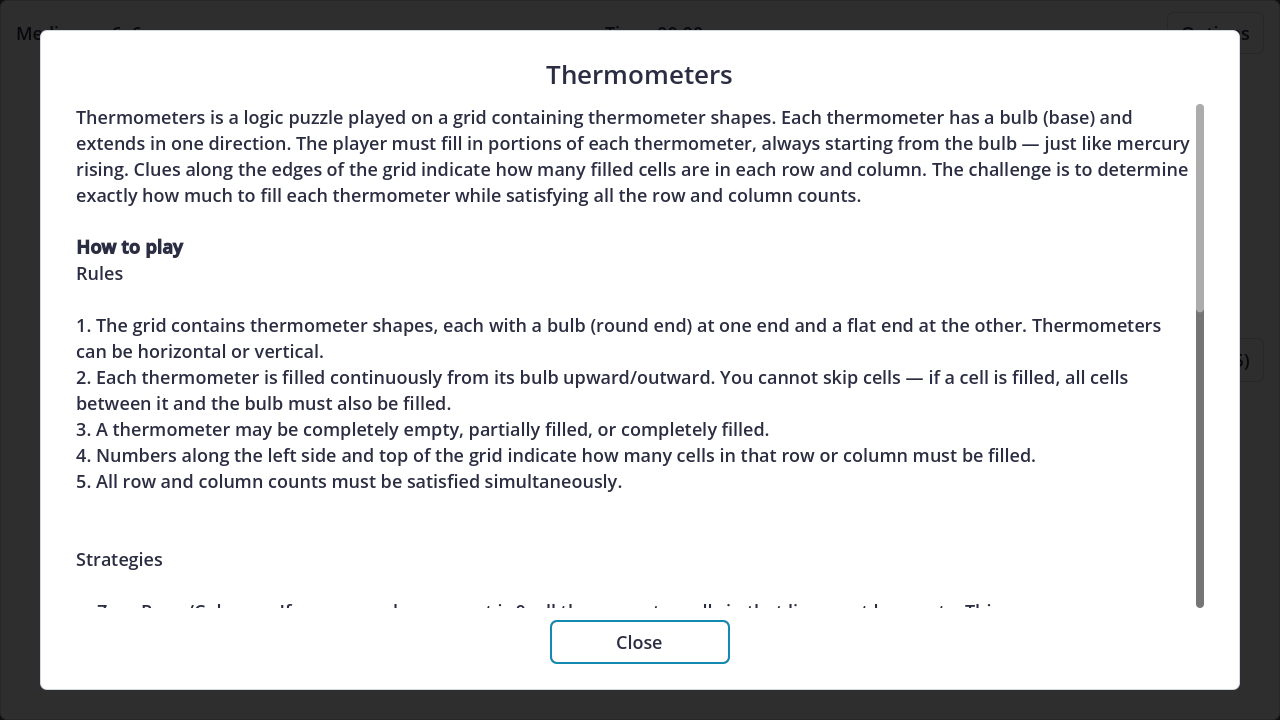
- The grid contains thermometer shapes, each with a bulb (round end) at one end and a flat tip at the other. In this game they run horizontally or vertically and measure between two and four cells.
- Each thermometer fills continuously from its bulb outward. You cannot skip cells — if a cell is filled, all cells between it and the bulb are filled too.
- A thermometer may sit completely empty, stand partly filled, or run full to the tip.
- The numbers along the left edge say how many cells in that row must be filled; those along the top do the same for each column.
- All row and column counts must be satisfied at the same time.
Step by step. A fresh board shows the thermometers with their bulbs and the counts on the margins, everything empty; Medium is a 6×6.
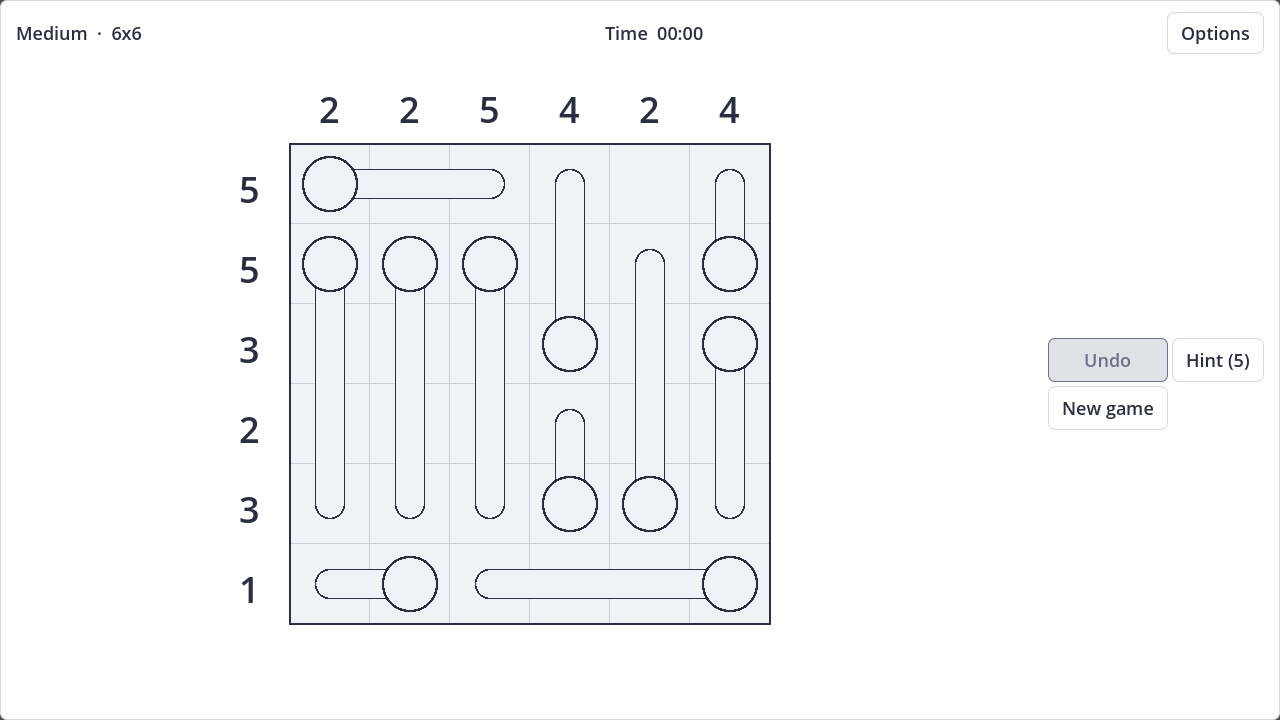
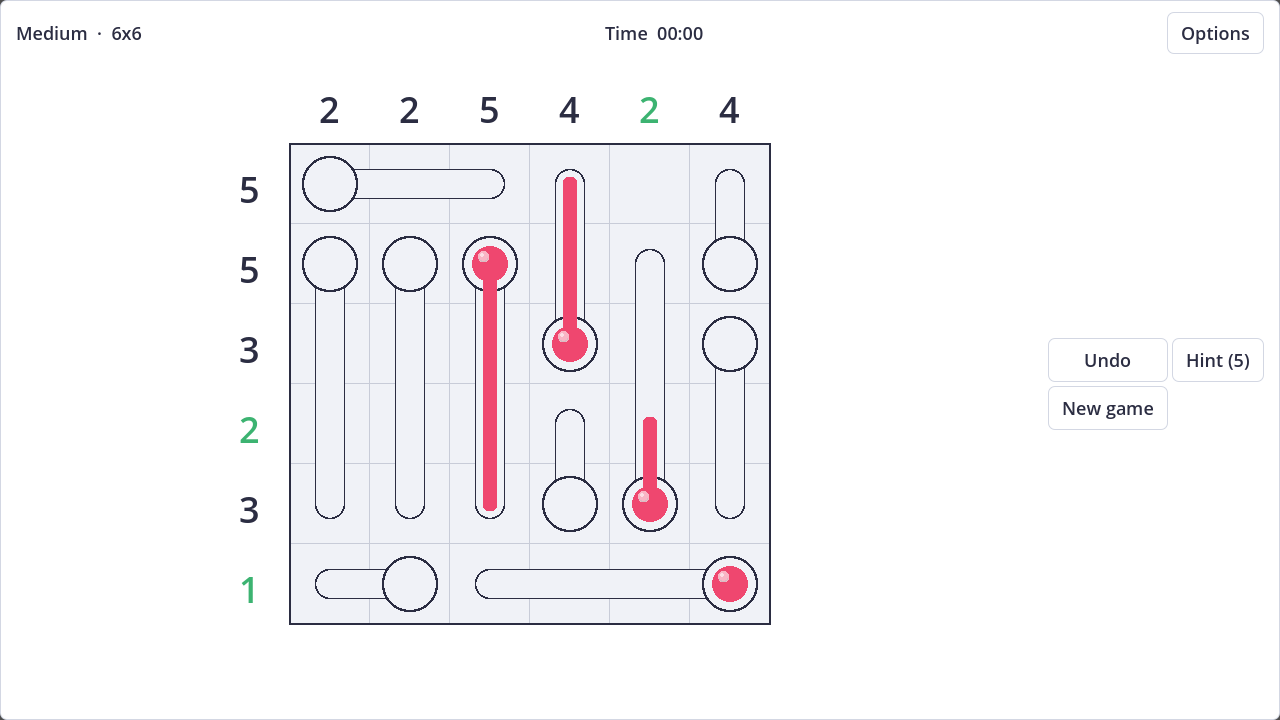
Tap a cell of a thermometer and the mercury rises to it in one motion; tap a filled cell and it drops back to just below. The board grades itself as you go: a row or column count that already holds turns green. Undo takes moves back, and you get five hints per run — the button counts them down.
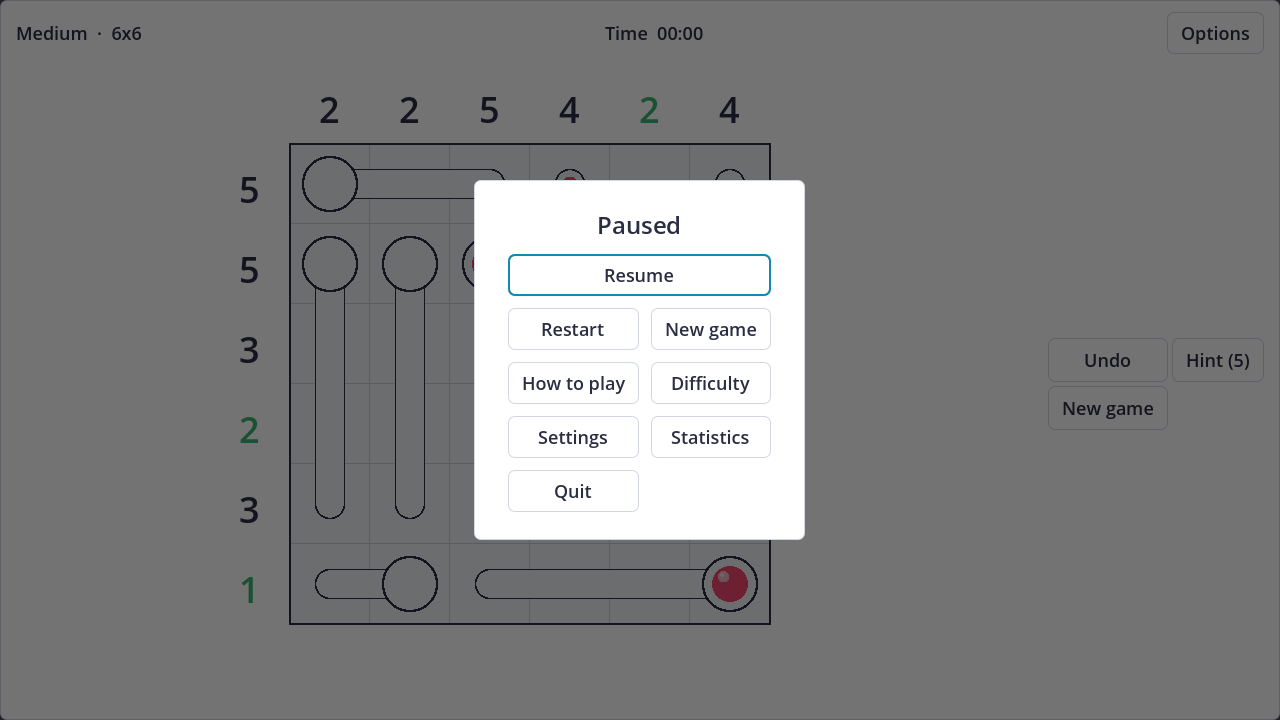
The pause menu lays eight options in two columns over the dimmed board — Resume, Restart, New Game, How to Play, Difficulty, Settings, Statistics and Quit (Quit only in the installed app) — and "How to Play" keeps the fill-from-bulb rules readable inside the game.
When the last count turns green, the win panel arrives with the run stats and its confetti.
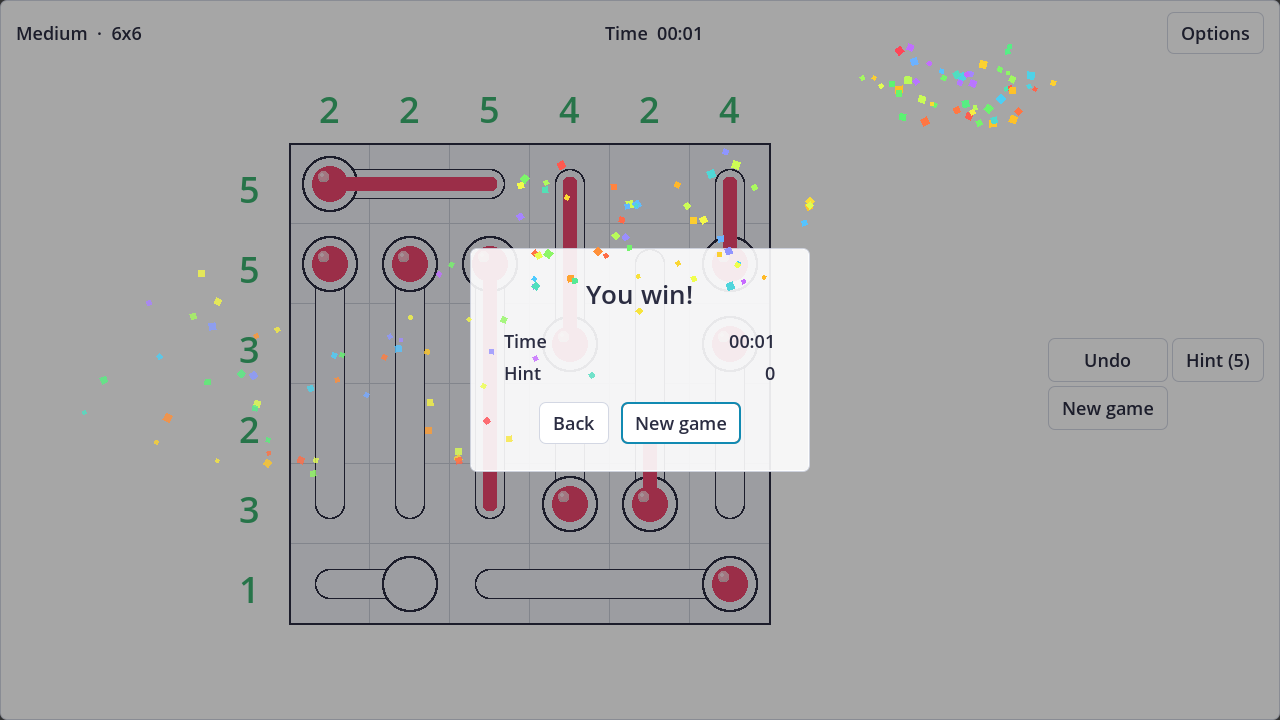
Strategy and tips
- Open the margins for the free cases. If a row or column asks for 0, every thermometer cell in that line stays empty; if it asks for as many filled cells as it contains, all of them fill. Read the whole margin before touching the board.
- Reason from bulb to tip. The empty side of the mercury rule works both ways: a cell that must be empty forces everything behind it, toward the tip, to be empty too. And if a tip is forced filled, the entire thermometer fills with it.
- Cross each cell's two accounts. Every cell belongs to a row count and a column count at once. When one line only tolerates certain combinations of fill levels, compare it with the perpendicular count and the options narrow from both sides.
- Experiment cheaply. One tap raises the mercury, one tap lowers it; testing a level costs seconds and Undo is always there. Keep the five hints for a genuine jam.
Controls
- Mouse and touch: click a cell to raise the mercury to it; click a filled cell to lower it; buttons for Undo, Hint, Restart and the pause menu.
- Gamepad: the D-pad walks a cursor over the grid, A applies the move to the highlighted cell, Start opens the pause menu, B returns to the board.
- Keyboard support is not verified for this build; once confirmed in game, it will be added here.
Difficulties and variants
The selector offers four levels — Easy, Medium, Hard, Expert — and in this game the level decides one thing only: grid size. Easy is 5×5, Medium and Hard are both 6×6, Expert is 7×7. The interface shows level and size together, so you know what you ordered. The climb is purely by measure: bigger boards bring more thermometers to fit and more counts to watch; the small ones close in minutes. If the 6×6 feels easy, the step up is Expert.
Picking another difficulty discards the run in progress and starts a fresh one. "Restart" replays exactly your board from zero; "New Game" rolls a different one.
Where to play
Thermometers is free in the Tab and Blank catalog, in the browser, nothing to install: play Thermometers. It sits in the same catalog as the rest of the grid-puzzle family — one page per game, with rules and difficulty ready to open.