
A grid of squares. Ten mines hidden somewhere in ninety. Click one and, if you survive, it tells you a number: how many mines touch that square. Deduce the rest, flag what you are sure of, open what you are not, and clear the board without dying. A generation recognizes it on sight — and nobody can tell you who made it. Minesweeper is the rare pastime with no birth certificate and one famous birthday.
The fog
The honest starting point: the good sources disagree. The pinned encyclopedia article simply rules: the origin is unclear. TechRadar, looking back in 2009, treated the first version of the game as Microsoft's own, from 1990. Eurogamer, in 2014, argued the true first was Mined-Out, 1983, for the ZX Spectrum. And Curt Johnson — the man who actually wrote Microsoft's version — conceded that his design was borrowed from another game, while denying it was Mined-Out. Three sources, three answers — that is the fog from the outside. The older claims that circulate online, named mainframe ancestors and an aptitude-test origin, have no primary source we could link, and stay off this record.
Predecessors with names and dates
What can be dated is worth the walk. Mined-Out (1983) was Ian Andrew's first commercial game, published by Quicksilva for the ZX Spectrum: you cross a grid-shaped minefield from bottom to top while a detector tells you how many invisible mines touch your current square — how many, never which. Every step is deduction; every wrong step, instant death. It sold well enough to fund Andrew's own studio, and the encyclopedia's verdict is careful: not the first Minesweeper-style game, but it preceded Microsoft's by several years and likely influenced it. Four years later, Mines (1987, Tom Anderson) carried the same grammar — numbered clues over hidden death — to SunOS, the Unix of the office. By 1990 the idea was clearly in the water. Whose boat carried it to every desktop is the disputed part.
1990, and then the window
The Microsoft version has authors and a paper trail: Curt Johnson wrote it for IBM's OS/2, and Robert Donner, both then Microsoft employees, ported it to Windows. It was released in 1990 inside the Microsoft Entertainment Pack 1 — a literal box of amusements — and in 1992 it entered the standard Windows 3.1 install, replacing Reversi. From novelty to furniture in two years. Why ship a minefield inside a business operating system? The explanation most often repeated is mouse training, stated plainly by TechRadar: the game was "partly intended as a way of teaching people basic mouse controls in an era where most computing had been text-based". Teaching, not testing — the aptitude-exam origin story people love to retell is a telephone-game version of that hedge; we found no primary source for it. The effect was absolute: Minesweeper shipped inside Windows for twenty-two years, until Windows 8 removed it in 2012 and Microsoft republished it as a free, ad-supported Store game developed by Arkadium — a change several tech outlets openly called greedy. The preinstalled era ended; the game did not.
The game moves out
It had long since stopped being anyone's property: OS/2 had it, and the free desktops — KDE, GNOME — never let go. A competitive scene grew up around pure speed: patterns memorized, some players refusing to flag at all, world tournaments — the 2025 World Championship was held in Madrid — and rankings that move: the snapshot consulted in April 2026 lists the fastest run through all three classic boards at 32.88 seconds. Numbers like that age like milk; the theorem ages like wine. In 2000, Richard Kaye proved that deciding whether a half-cleared Minesweeper position is consistent — whether any arrangement of hidden mines could make every visible number true at once — is NP-complete. The proof is constructive: any Boolean circuit can be wired into a grid that admits a mine layout exactly when the circuit can be satisfied. The office pastime, at bottom, is circuitry — a game with no birth certificate hiding one of the deep problems of computing.
Ours hides; it does not solve
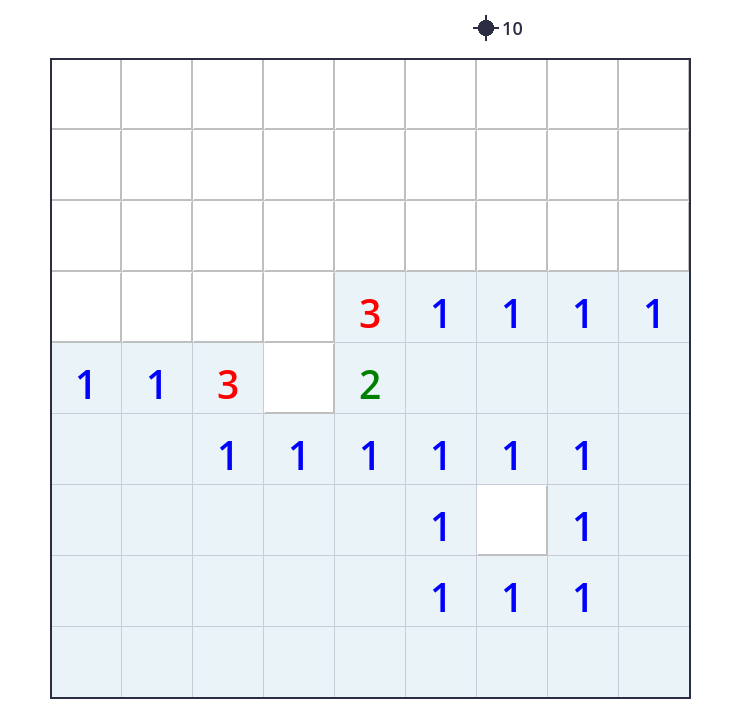
Our Minesweeper in the Tab and Blank catalog plays the classics straight: 9×9 with 10 mines, 16×16 with 40, 30×16 with 99 — and adds a fourth rung the classics never asked for: the same 30×16 board with 130 mines, thirty-one deeper than Expert. Two mercies are built in. The first click is always safe: the mines do not exist when the board starts; they are placed after your first click, avoiding that square and all its neighbors. A blank square then opens its neighbors, chain-reacting, so one lucky click can clear a corner. You win by revealing every safe square; flags are your notebook, not the goal. And now the honest confession: nothing in this game solves the board for you. No engine deduces, validates your logic, or takes over when you stall. The machine only hides and counts — everything after the first click is your side of the bargain. After thirty-plus years, Minesweeper is still the exam it always was. Only now you grade yourself.
One grid, no birth certificate
The rules in one line: hidden mines, numbered clues, open every safe square. Minesweeper is free in the browser — start on the 9×9, keep the first-click mercy in mind, and see how far deduction gets you before luck is needed.