
If you picture the World Puzzle Championship as a contest at one game — the way a chess tournament is at chess — you have the wrong shape. Competitors sit down to a paper booklet whose rounds jump from drawing a single loop, to flooding a sea around numbered islands, to slicing a grid into rectangles, to placing digits that sum, letters that spell, lamps that light. Each type is a small language of logic with three or four sentences of grammar. There is a list that keeps them all: a community wiki that mirrors the championship's puzzle zoo, and the most recent snapshot I could read — 31 August 2026 — carries 299 entries. Two hundred and ninety-nine ways to make someone reason on paper.
What the championship is
The WPC is an annual international competition run by the World Puzzle Federation, with national teams formed through its local affiliates; the pinned encyclopedia article sums up the point of the format neatly: the problems are pure-logic, built on simple principles, designed to be solvable regardless of language or culture. No trivia, no reflexes, no vocabulary — a grid, a rule set, and your afternoon. The 299-entry list, to be fair about its rank, is not an official WPF document; it is an unofficial mirror of the type families the championship keeps returning to. Unofficial, but the best public inventory of the bestiary we have.
The families
Grouping the list is an editorial act, so here is mine, stated as such — the diagram below draws the same map flat. Most of those 299 types obey one of a handful of rules shapes. Loops drawn through cells or dots — Slitherlink, Masyu, Yajilin and dozens of cousins with extra constraints. Shading and islands — Nurikabe, Creek, Tapa, the class where black and white cells must connect or avoid touching. Digits and cages — Sudoku, Kakuro, KenKen, all arithmetic wearing different hats. Regions and cuts — Shikaku, Fillomino, Suguru: divide the grid, respect what each area claims. Routes and trails — Hidato, Arukone, paths that number their own steps. Letters and words — Anagram, Word Search and the spelling crowd. Light and visibility — Akari, where lamps shoot rays until every square glows. And piece placement — Tangram, Pentominoes, Rubik's Cube, shapes that must fit. Eight shapes; hundreds of games.
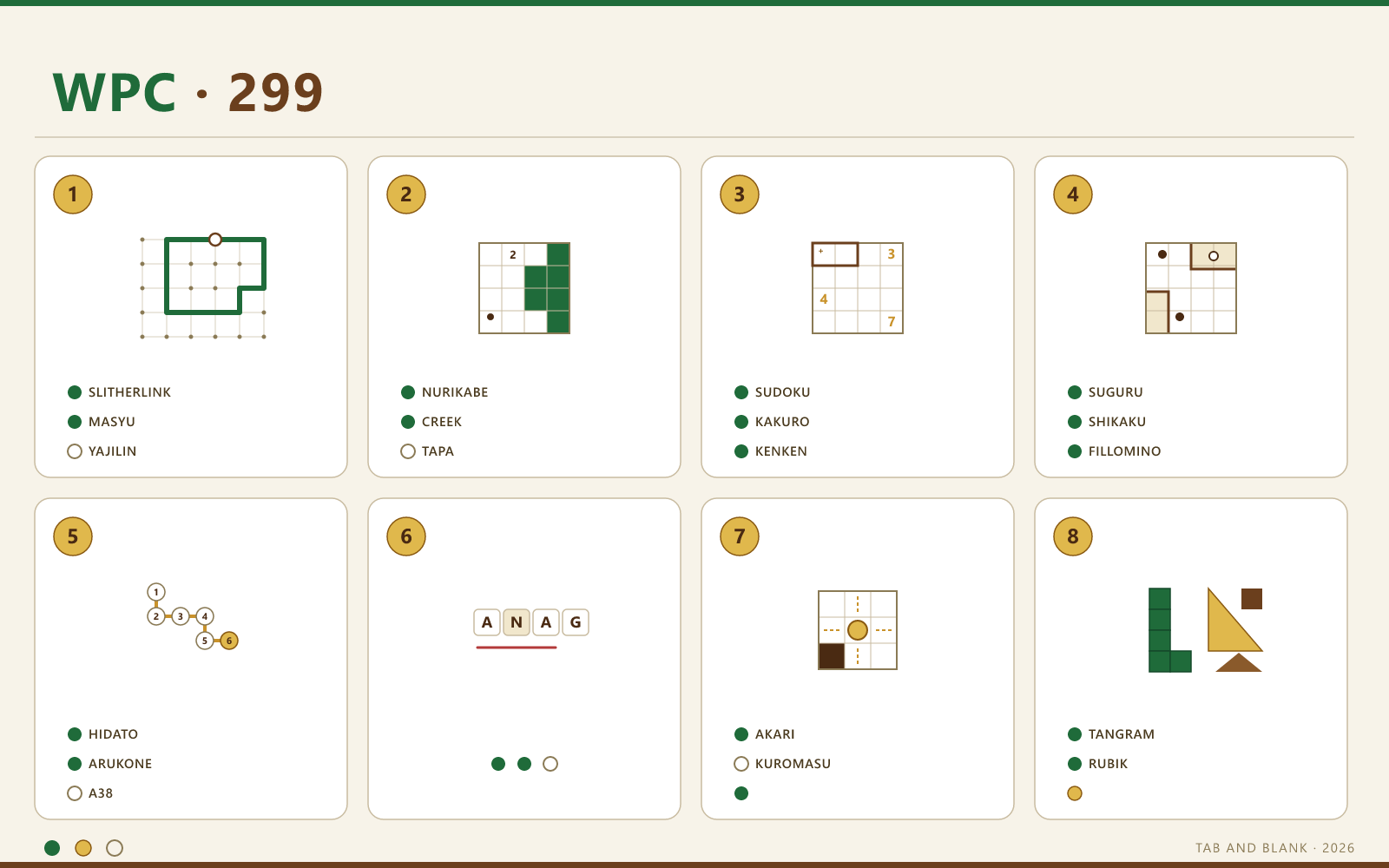
Where our catalog sits on that map
Tab and Blank holds 120 games across 9 categories — counted off our own catalog inventory today, 21 October 2026, not from the marketing copy. Against the list of 299, the honest criterion I use is small enough to state in one sentence: a type counts as covered when you can play it in the catalog right now. On that criterion, counting each entry of the list once, today the tally is 38 of the 299.
Four footnotes, because the tally deserves them. One game can cover two entries: Slitherlink answers for both it and Simple Loop, the list's separate name for the same loop. One type can rest on two games: TomTom is played here as both KenKen and Calcudoku. Some coverages are partial — the Rubik's entry means a 2×2 pocket cube, the pentomino one a fraction of the variants the championship has named. And one covered type was simply missing from our inventory notes: Paint by Numbers, the plain nonogram, counts because the catalog's Nonogram is playable today, with its own catalog page. The notes also show where they went stale: they still file Masyu under "not implemented", while Masyu sits playable in the catalog today — the map hadn't been checked against the live catalog until now, and a recount is exactly the medicine for that.
What the recount really says is humbler than any percentage: this catalog touches every one of the eight families, and the map is far bigger than the catalog — 261 of those 299 entries still have no playable home here. The diagram says it too, with its hollow rings: listed types we cannot play, Yajilin, Tapa, A38, Kuromasu among them. Those gaps come with no promised date.
Three doors
If you want to stand on the map instead of reading about it, three entries are the shortest walk in. Slitherlink: one closed loop, four kinds of numbers telling it where to pass. Masyu: a loop that must turn precisely at black pearls and run straight through white ones. Nurikabe: numbered islands, one connected sea, and no 2×2 of water ever. Loops, shading, regions — three of the eight shapes, in the time of a coffee.
The bestiary is enormous, and the full list — all 299 entries with their rules pages — is the category page of the unofficial WPC wiki, archived copy linked because the live wiki was offline when this was checked. Start anywhere. The knight has already been to every square.